Get Out and Explore … The Palisades Region

With autumn leaves now turned, hiking in the Palisades region of State Parks offers spectacular views of the Hudson Valley and the Catskills to go with a fascinating history that includes an outlaw’s lair, the state’s early iron industry, and a traitor’s secret meeting place.

Located on the west side of the Hudson River, this region between the Capital Region and New York City stretches through Rockland, Orange, Ulster and Sullivan counties, and contains 23 parks and seven historic sites.

As with all hikes, there are few things to remember beyond carrying a mobile phone. Wear sturdy yet comfortable shoes or boots, bring water and snacks, and perhaps carry a camera, to capture what you see. Be mindful of hikes on steep terrain or that go near cliff tops. Having a small first-aid kit available in case of emergency is never a bad idea

Hiking poles are useful, and can transfer some of the stress of hiking from your knees and legs to your arms and back. And use a trail map, which is available online at each park website at https://parks.ny.gov/ and at the main office at each park. Check the park’s individual website to see if its maps can be downloaded to your iOS Apple or Android device, but a paper map is a good backup in the event of device failure.

These maps include Park facilities such as parking, park offices, nature centers, campsites, and boat launches in addition to the location, name and distance of each designated trail in the park. For some facilities, data is available as a Google Earth KML file or a map is available to download to your iOS Apple and Android mobile devices in the free PDF-Maps app. Learn more

For the Palisades region, more information on hikes is also available online from the New York-New Jersey Trail Conference, and at the bookstore near Exit 17 on the Palisades Interstate Parkway.

It’s smart to know how long a trail is and how long it ought to take to finish. Since daylight is not an unlimited resource, especially in fall as days grow shorter, tossing a flashlight or headlamp into your backpack is a good form of insurance, should you unexpectedly find yourself on the trail as dusk approaches.

And, as the incidents of tick-borne diseases surge in the state, it is always important to check yourself for ticks after being outside, even if it is only time spent in your own backyard.

Rockland County

Rockland Lake State Park, 299 Rockland Lake Road, Valley Cottage, (845) 268-3020: The Nyack River Trail runs along the western short of the Hudson River between Haverstraw Beach State Park and Nyack Beach State Park. About five miles long, the level trail offers excellent river views. It is lined with crushed stone, and so is easy on the knees for a run, and also makes for an excellent bike ride or walk with a dog (must be leashed per NYS Parks rules). This trail also passes a county historical marker for the infamous “Treason Site,” where during the American Revolution in 1780 American General Benedict Arnold meet secretly with British spy Major John Andre to hand over plans for the capture of the strategic Patriot fortress at West Point. Thankfully, the plot was thwarted, with Arnold becoming one of the fledgling nation’s most despised figures.

Find a trail map here

Strolling along the Nyack River Trail.
A historical marker for the Treason Site erected by the Rockland County Historical Society (Photo from Wikipedia Commons.)

Harriman State Park, Seven Lakes Drive/Bear Mountain Circle, Ramapo, (845) 947-2444: At more than 47,500 acres, the second-largest State Park has more than 200 miles of hiking trails. At its northeastern edge, it borders Bear Mountain State Park as well as the U.S. Military Academy’s forest reserve. To the southwest lies the 18,000-acre Sterling Forest State Park. This vast park includes a large rocky shelter that was the remote hideout for a bandit named Claudius Smith, who led a gang of pro-British marauders during the American Revolution, known at the time by terrified local residents as “Cowboys.” To find it, go to the parking lot at the end of Old Johnstown Road, and look for the Blue Trail. Follow this steep trail to the top of Dater Mountain for its views, and then continue until you reach the rocky den, which had enough room to shelter both the gang and their horses. After taking in the panoramic views, which allowed the gang to see anyone coming, head down on the Tuxedo-Mount Ivy Trail to return to the parking lot. The hike is a five-mile trip, with one very steep section.

Find a trail map here

A vintage photograph of hikers exploring Claudius Smith’s Den.

Ulster County

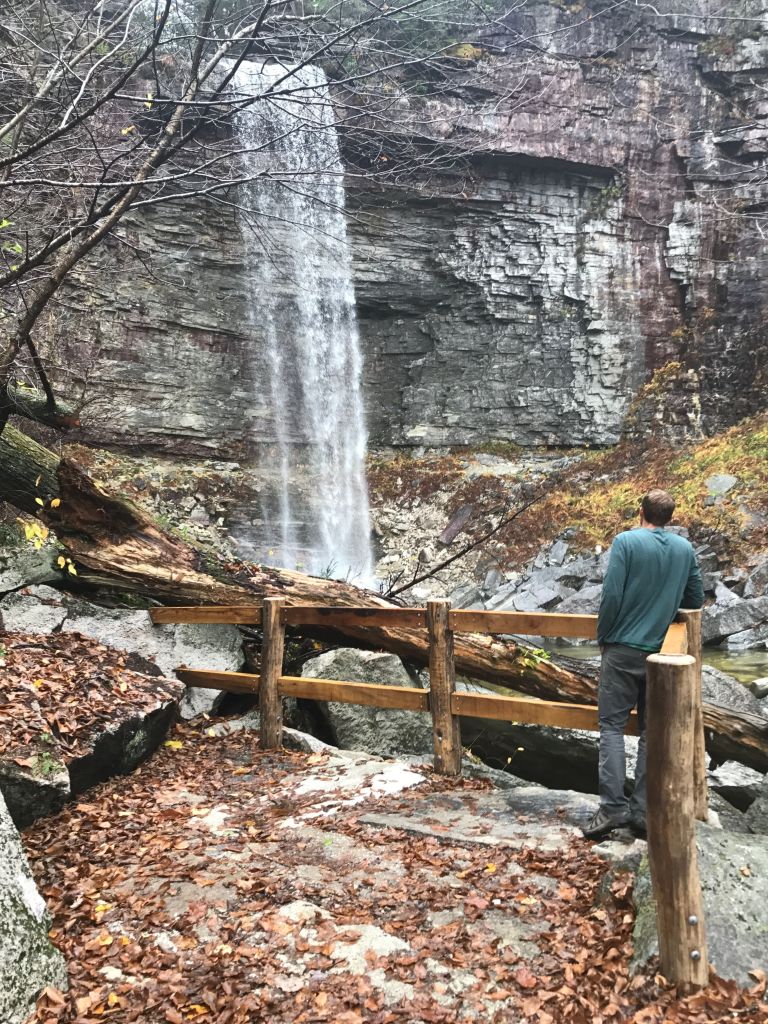
Minnewaska State Park Preserve, 5281 Route 44-55, Kerhonkson, (845) 255-0752: Take in Catskills from atop the Stony Kills Falls at the northwestern edge of the park on this short, but challenging one-mile hike. Start at the parking area at the end of Shaft 2A Road and follow the gravel trail that crosses two wooden bridges on its way to the base of the 78-foot waterfall. Follow a set of stone stairs upward, using iron hand holds and railings for safety, to reach the top of the falls and its sweeping northerly views. You can either backtrack to the parking lot, or connect to the Stony Kill Falls carriage road atop the Shawangunk escarpment to make a longer hike.

Find a trail map here

Taking in the view at Stony Kills Falls.

Orange County

Bear Mountain State Park, Palisades Parkway or Route 9W North, Bear Mountain, (845) 786-2701: Take in the view of four states and even glimpse the Manhattan skyline from the Perkins Memorial Tower atop 1,289-foot Bear Mountain. Take the completely rebuilt Appalachian Trail, which features about 1,000 stone steps along a steep granite face. It took crews, including members of the New York-New Jersey Trail Conference, seven years of arduous labor to renovate the 1.5 mile trail up to the top. There is a new wooden bench at one of the lookouts for those who might find themselves in need of a breather on the way up.
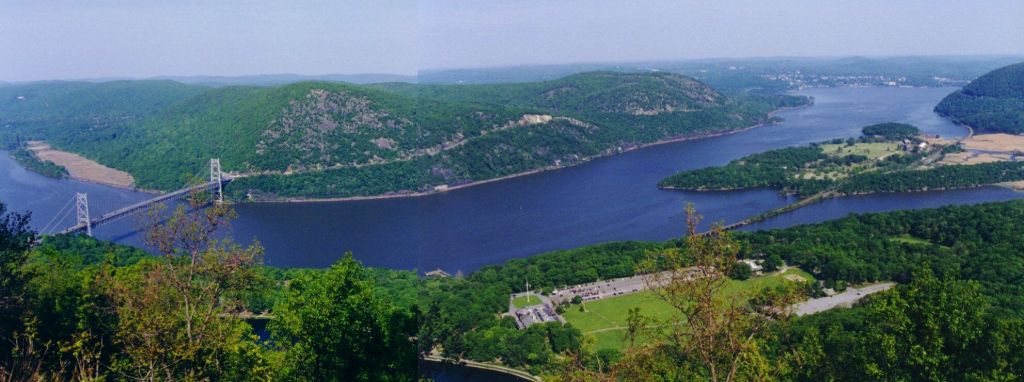
The view from the top.

Also at Harriman, photographers will enjoy the trail to West Mountain that starts at the Anthony Wayne Recreation Area. Start on the Fawn Trail to the Timp-Torn Trail, which takes you to the mountain ridge to the West Mountain Shelter. From there, return using Timp-Torn to the intersection of the Appalachian Trail westbound, which will lead to Beechy Bottom Road that returns to the main parking area. The moderate hike is about five miles.

Find a trail map here

Looking out from the West Mountain Shelter.

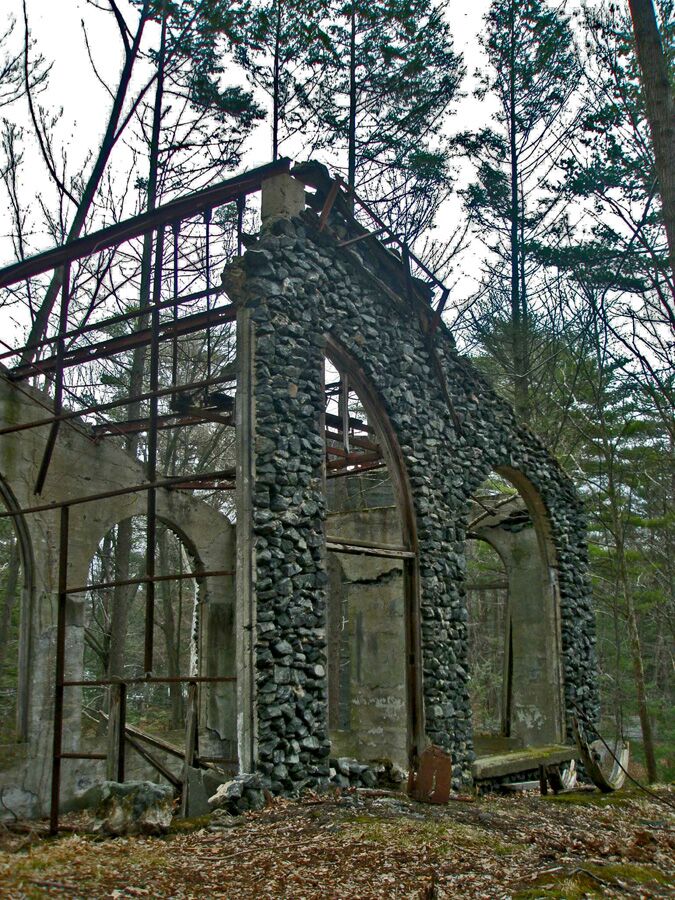
Sterling Forest State Park, 116 Old Forge Road, Tuxedo, (845) 351-5907: For larger groups or school trips, there is the Lakeville Ironworks Trail Loop, which takes in the remains of an iron industry that once dominated the area. At about a mile long, the easy loop includes views of Sterling Furnace, the Lake Mine, and other mining remnants. This trail is among more than 30 trails, including the Appalachian Trail, within a 21,935-acre park in the midst of the nation’s most densely populated areas.

Find a trail map here

The former cable house at the ironworks.

Cover Photo of West Mountain summit view by Abigail Leo Parry, manager of Beaver Pond Campground at Harriman State Park.

All photos from NYS Parks unless otherwise credited.


Post by Brian Nearing, deputy public information officer at NYS Parks

Parks Won’t Let Invasive Species Get Its Goat
Invasive plant species are a huge problem in modern conservation at our State Parks. These plants can overrun areas and if left unchecked, push out our native species, disrupt natural systems, and negatively impact human activities.

Controlling large infestations is challenging, and sometimes requires using chemical herbicides, which can come with unforeseen costs and undesirable consequences.

But there can be another way that is easier on the environment. To deal with invasive plants at Heckscher State Park on Long Island, we are experimenting with a greener and much cuter alternative – a small army of hungry and quite friendly invasive plant-eating goats.

A little goat can be a big eater of invasive plants. Goats can eat up to a quarter of their body weight each day.

The goats came from Green Goats, a company from Rhinebeck in Dutchess County that for more than a decade has hired out its goats to combat these invaders at various public parks. Their herd has traveled to seven states, as far away as West Virginia and as close by as Riverside Park and Fort Wadsworth in New York City.

Last year at Heckscher, we released goats into a fenced-in, five-acre site overtaken by an invasive plant called Chinese Silvergrass (Miscanthus sinensis). The goal is for the goats to eat the silvergrass so there will be room for our native plants to again take hold. The goats also have been eating other invasives, including Japanese honeysuckle (Lonicera japonica), common reed (Phragmites australis), and Japanese angelica tree (Aralia elata).

Chinese Silvergrass (Photo credit Western New York PRISM)
The hungry herd takes on the Chinese Silvergrass.

However, since goats will eat pretty much everything, we did not want them to eat the handful of native shrubs left in the enclosure, including eastern baccharis (Baccharis halimifolia), highbush blueberry (Vaccinium corymbosum), and common elder (Sambucus canadensis). So, we put up fences around these native plants to protect them so that when the goats leave, these shrubs will be able to spread into cleared areas.

Last year, we had a bit of a late start and only received the goats in September, but by the end of the growing season in October, we had 70 goats moving and eating through the area. When the goats left for the season, there was significant thinning of the silvergrass and quite a few individual plants were eaten down to the ground. The goats also ate a lot of the Japanese honeysuckle and, surprisingly, killed several angelica trees by eating their bark. The bark and leaves of the angelica tree are covered in many sharp thorns and spines to dissuade herbivores from eating it, but that didn’t stop the goats, who happily stripped the bark right off the invasive trees!

This year, our goats arrived in June and as of this month, we have 61 goats working in the area with more on the way. We have used a drone to fly over the site to track their progress, and expect to do another flight shortly.

A goat stretches for its meal of Silvergrass.

A hungry goat can eat up to 25 percent of its body weight each day, said Larry Cihanek, owner of Green Goats with his wife, Ann. An adult goat can weigh between 140 to 180 pounds, so that works out to up to 45 pounds of invasive plants a day. For our herd at Heckscher, that is up to 2,700 pounds of plant invaders being eaten every day!

And the goat “droppings” are a good source of nutrients for the soil as well.

“Using goats like this is like mowing your lawn over and over,” said Cihanek. “You keep the goats on site for a season, and they keep eating as the plants continue trying to regrow. But the goats keep eating the new growth and eventually they starve the roots bit by bit, and the plants will die.”

Ann and Larry Cihanek, owners of Green Goats in Rhinebeck, Dutchess County. They have about 200 goats in their herd. (Photo courtesy of Green Goats)

The Cihaneks now have about 200 goats in their herd, with nearly all the animals being donated by former owners who had been using them for milking, for show purposes, or as pets.

“Eight years is about the maximum for milking, but goats can live for 12 to 14 years. So, this is their second career with us,” he said. “Our goats are living the American Dream: They eat for a living.”

In addition to helping project the environment, the goats are also a good way to draw more people into the park. “In some of our past projects, we have seen that attendance at a park can go up by about 20 percent after the goats come in,” said Cihanek.

Officials at Riverside Park in New York City even held a celebration after the goats finished working there this summer, making the goats the stars of a $1,000-a-ticket fundraiser at a lawn party in August. More than 800 people showed up and there was a contest to vote for the most popular goat, with the winner being Massey, who was presented with a medal and an elaborate bouquet of weeds.

Riverside Park President & CEO Dan Garodnick honors Massey at the winner of the public “Vote the G.O.A.T” contest in August. (Photo by Riverside Park Conservancy)

If you would like to see the goats in action, they are staying through October in the eastern section of Heckscher State Park, to the north of the cottages. The Long Island Greenbelt Trail briefly passes a section of the enclosure when it turns westward.

If you see goats with numbered collars, these are the goats that were honored at Riverside Park.

The goats are quite friendly and like being petted. But please, stay outside the fence and do not feed the goats. They are already surrounded by all the food they need!

A Parks visitor encounter with one of the Green Goats.

All photographs by New York State Parks unless otherwise credited.


Post by Yuriy Litvinenko, New York State Parks Regional Biologist for Long Island

Big Hopes for Little “Army” in Parks’ Fight against Hemlock Invaders

As the third most common tree in New York, hemlocks fill our forests and are found in many New York State Parks. Located along hiking trails, streams, gorges, campsites, and lake shores, the evergreens can live to be hundreds of years old, providing vital ecosystem services and supporting unique habitats.

In addition to providing homes and food for many forest creatures, hemlocks also keep fresh water resources cool and clean by moderating water temperature and acting as a natural filtration system along streams. Since hemlocks are such a critical component of eastern forests, they are known as a “foundation species.”

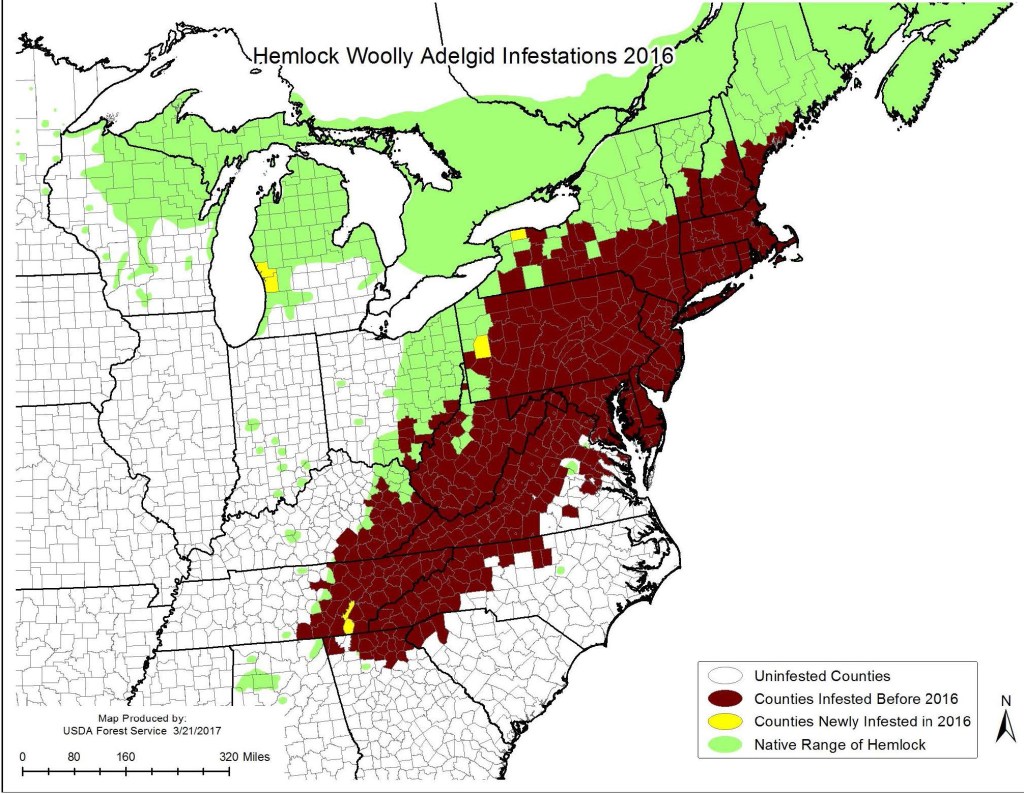
Hemlocks in New York have been under attack by an invasive forest insect pest that originated from southern Japan, the hemlock woolly adelgid (HWA), which after being found in Virginia in the 1950s has spread to kill untold millions of hemlocks from Georgia to Maine.

Hemlock Woolly Adelgid infestation in the Eastern U.S. (U.S. Forest Service)

Adelgids are tiny insects that insert piercing-sucking mouthparts into hemlock twigs, causing damage to woody tissue that inhibits water and nutrients from reaching emerging hemlock buds. This limits the growth of new twigs and eventually kills the tree.

First detected in New York in the 1980s, the insects have spread through the Hudson Valley, Catskills, Southern Tier and Finger Lakes regions. Infested hemlocks can be found at state parks including Harriman, Minnewaska, Taughannock Falls, Watkins Glen, Letchworth, and Allegany.

At about 6/100ths of an inch long, the flightless adelgids are hard to spot, but in the winter through early summer leave distinctive white “woolly” egg masses on hemlock twigs. In an infestation, developing buds are killed first, then in a few years, the weakened tree loses its needles and dies.

Left, a dead hemlock after being killed by HWA. Right, a healthy tree.
A map of New York State towns and counties where HWA had been found in the Hudson Valley, Capital Region, and Southern Tier by 2017. The HWA has yet to move into the Adirondacks or the Tug Hill Plateau. (State Department of Environmental Conservation)

The threat posed by HWA is dire, especially since the state’s ecosystems lack natural controls _ known as biocontrols _ such as predators or tree resistance that could fend off some infestations and avert widespread hemlock destruction.

Currently, insecticide treatments are our only sure option for saving trees, but trees must be treated on an individual basis, so it can be costly or impractical to treat large swaths of hemlocks. In parks with thousands of trees and important or rare ecosystems to protect, biocontrol is the only solution to counter a pest like HWA.

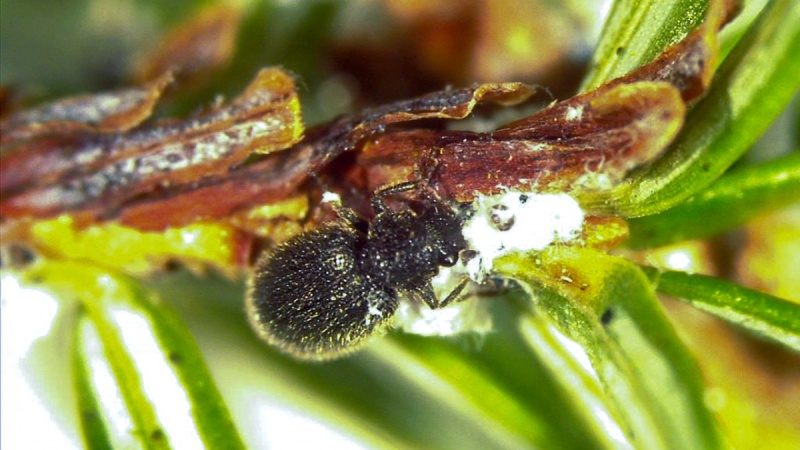
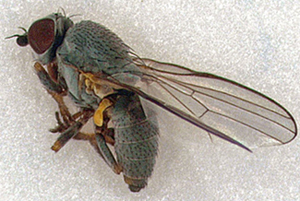
But biocontrol against the invading adelgid may be on the way. It is the form of a small dark beetle and a small silvery fly, nicknamed “Little Lari” (Laricobius nigrinus) and “Little Leuc” (Leucopis spp.), respectively, by researchers at the New York State Hemlock Initiative at Cornell University.

Led by forest entomologist Mark Whitmore, the program operates a biocontrol lab researching the introduction of HWA predators throughout New York, hoping to protect hemlock trees by slowing the spread of adelgids into new areas.

The NYSHI collects these predators in the Pacific Northwest where HWA is native and has many predators controlling population growth so the hemlocks are not damaged. The collected beetles and flies are shipped to the quarantine facility at Cornell  to be certain none of the western adelgids are accidentally introduced into New York with the predators.

Knowing where to release these “good bugs” can be a challenge, but we are helped in this by State Parks staff, who provide critical data from ground surveys to find emerging infestations, assess potential biocontrol sites, and monitor for whether the biocontrol insects are thriving and growing in their new homes.


Read this post in the State Parks blog by Abigail Pierson, state Parks Forest Health Specialist, to learn how crews search for and document the presence of HWA.


Since 2009, the Cornell initiative has released more than 4,500 Laricobius beetles in State Parks including Harriman in Rockland County, Letchworth in Wyoming County, Mine Kill in Schoharie County, and Taughannock Falls, Buttermilk Falls, and Robert H. Treman in Tompkins County. Additionally, parks staff at Minnewaska State Park Preserve in Ulster County helped survey for Laricobius beetle establishment, and mapped hemlocks to help identify hemlocks stands and prioritize HWA surveys in the park. 

Since 2015, when Leucopis silver fly releases began, researchers have released more than 3,300 flies at several state park sites including Taughannock Falls and Buttermilk Falls state parks in Tompkins County.

“Little Lari” (Laricobius nigrinus) (New York State Hemlock Initiative)
“Little Leuc” (Leucopis spp.) (New York State Hemlock Initiative)

While there has been no evidence of the biocontrol bugs suppressing HWA populations on a large scale, it takes time for predator populations to build. There has been recovery of Laricobius beetles at some sites, indicating establishment. By continuing to release more “Little Laris” and “Little Leucs” to bolster those established populations, we will be able to build on that initial success.

The list of parks that have reported HWA infestations is growing, especially in the Capital Region. Thacher State Park in the Capital Region reported adelgid infestations in 2017 and while insecticide treatments reduced the local problem, the insects continue to threaten the Adirondacks, which so far remains uninfested.

In State Parks, preventing dead trees from injuring park visitors or damaging park infrastructure including campsites and trails is crucial. Additionally, preventing the loss of a critical foundation tree species in forest habitats is another major priority.

Park visitors can play an active role in slowing the spread of the adelgid in New York by keeping an eye on hemlocks. Reporting any infestations that you find provides researchers and land managers with invaluable data for improving our management efforts.


How You Can Help

If you believe you have found HWA:

  • Take pictures of the infestation signs (include something for scale such as a coin or ruler).
  • Note the location (intersecting roads, landmarks or GPS coordinates).
  • Fill out the hemlock woolly adelgid survey form.
  • Email report and photos to Department of Environmental Conservation Forest Health foresthealth@dec.ny.gov or call the Forest Health Information Line at 1-866-640-0652.
  • Contact your local Partnership for Regional Invasive Species Management (PRISM) by visiting http://www.nyis.info/.
  • Report the infestation at iMapInvasives.
  • Slow the spread of HWA in our forests by cleaning equipment or gear after it has been near an infestation, and by leaving infested material where it was found.

The New York State Hemlock Initiative has produced a variety of educational videos on the threat posed to hemlocks by the HWA.


Cover Photo: A hemlock branch showing the woolly white egg masses of Hemlock Woolly Adelgid. (New York State Department of Environmental Conservation)


Post by Charlotte Malmborg, Education and Outreach Technician, New York State Hemlock Initiative, Cornell University Dept. of Natural Resources

The Glory of Goldenrod

With fall almost here, now is the perfect time to enjoy the brilliant goldenrods and discover the array of interesting insects that visit them. There are many different kinds of goldenrod, but most are late-bloomers that don’t come into full bloom until late summer and fall.

Goldenrod continues blooming until the frost, which in New York ranges from late September to October, depending on location. As one of the few groups of wildflowers in peak flower at this time, many insects depend on these plants for food, feasting on the nectar and pollen.

There are more than two dozen species of goldenrod native to New York State. They are a member of the Aster family (Asteraceae) and most are in the Genus Solidago, but a few are in the Genus Euthamia and Oligoneuron. All but one species are deep golden yellow (silverrod, Solidago bicolor is white), with hundreds of tiny flowers making up the “inflorescence” or flower head.

If you are interested in learning more about insects, this is one of the easiest ways to get an up-close look at all different kinds.

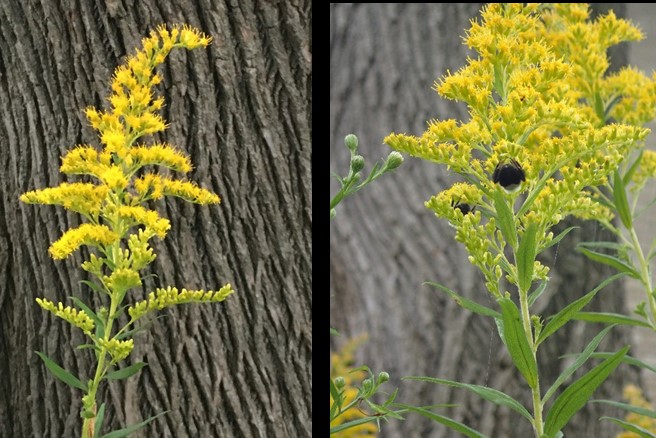
Giant or swamp goldenrod (Solidago gigantea) is very showy and grows up to seven feet tall. Common eastern bumble bee (Bombus impatiens, shown here) is the most common bumble bee in New York State and the species you are most likely to see feeding on the tiny golden flowers.

You can find goldenrods in a variety of habitats from roadsides, fields, alongside open trails and bike paths, in the dunes of the ocean and Great Lakes shores, and on rocky summits. In almost every State Park you can find goldenrods, and perhaps you will discover you have some in your backyard, neighborhood garden or vacant lots.

State Park’s pollinator habitat initiative has also helped create areas for goldenrods, asters, milkweeds and native grasses by reducing mowing along some roadsides and fields


Common flat-topped goldenrod (Euthamia graminifolia) growing with boneset (Eupatorium sp.) in a coastal grassland at Heckscher State Park.

Many insects are attracted to the goldenrod flowers. Take a close look and be patient. You may find a variety of bees from bumble bees, carpenter bees, tiny mason bees and sweat bees. On a cool morning, the insects are often a bit sluggish which means they are less likely to fly away while you get in close. In fact, in morning or evenings, look for bumblebees sleeping upside-down under the goldenrod flower branches!

Canada goldenrod (Solidago canadensis) is among the species with a tidy cone-shaped top, this one complete with sleeping bumble bees.

Beetles are another common visitor, like the ladybugs, lightening and flower beetles. Perhaps you will find an inch-worm or another kind of caterpillar.

A close-up look at the goldenrod flowers and one of a species of long-horned flower beetles.

On sunny days, goldenrod patches are a good place to watch for butterflies like painted lady, monarch and viceroy across the state. On the coast, large numbers of monarch butterflies follow the path of the seaside goldenrod that grows in abundance on the dunes and upper edges of the beach. Without this vast food supply, many of those monarchs would not survive their long journey of up to 3,000 miles.

A Monarch butterfly feeding on seaside goldenrod (Solidago sempervirens).
Seaside goldenrod (Solidago sempervirens), common at state parks like Orient Point, Jones Beach, Napeague and Hither Hills in Long Island, is a key food source for Monarch butterflies migrating south along the Atlantic coast on the way to wintering grounds in Mexico.

In addition to protecting the habitats where goldenrod thrives in the wild, this hardy perennial can also be a beautiful and important part of a pollinator garden or habitat, where birds and small mammals also benefit from the seeds. If you want to add some to your garden or landscape, some plant nurseries carry them, but check the New York Flora Atlas to make sure that the species is native to New York state and not listed as rare or invasive in New York.

Learning to appreciate goldenrods is a great way to support a whole suite of native flora and fauna.


Resources:

NY Flora Atlas http://newyork.plantatlas.usf.edu  (search for Solidago or Euthamia)

GoBotany (a good source plant identification) https://gobotany.nativeplanttrust.org

Check out the other pollinator blogs at NY State Parks Blog too.

Post and photos by Julie Lundgren, New York Natural Heritage Program (nynhp.org)

Where the Holocaust Came to America: The Last Reunion of the Fort Ontario Refugees

Now 90 years old, Bruno Kaiser remembers arriving 75 years ago at a U.S. Army base along the shore of Lake Ontario, a day that ended his family’s long struggle to escape death during World War II at the hands of the Nazis.

“We felt safe, which had been our biggest worry for so long,” said Kaiser. “At last, we felt perfectly safe.”

On Aug. 5, Kaiser returned to Fort Ontario State Historic Site, along with 18 other surviving refugees of the Holocaust, to gather for a final reunion to remember their lives at the Fort Ontario Emergency Refugee Shelter.

Surrounded by a fence and guarded by military police, the base at Oswego was America’s only wartime sanctuary for escapees of Hitler’s genocide.

European refugees arrive at the Fort Ontario Emergency Refugee Shelter in Oswego on Aug. 5, 1944. As part of their passage to the U.S., they were assigned military tags normally used to identify “casual baggage.” (Photo from the collection of the U.S. Holocaust Memorial Museum in Washington, D.C.)
Refugees receiving shoes, soap, and towels upon arrival at the camp. (Photo from ‘Token Shipment’ by Edward B. Marks)
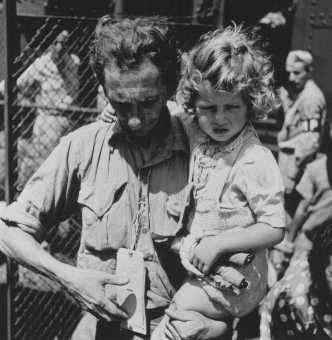
The day of her arrival, Doris Schecter (Dorrit Blumenkranz at the time) has her first taste of an American hot dog. She told reporters at the time that it was “swell.” She is still wearing the military “casual baggage” tag used to track her passage to America from Europe. (Photo courtesy of International News, Aug. 6, 1944)

Kaiser was one of 982 European refugees who arrived at the fort Aug. 5, 1944, about a month after the first accounts of a liberated Nazi death camp horrified the world.

Coming from 18 different countries, the new arrivals were predominately Jewish, but their ranks also included some Catholics, Orthodox and Protestants. Having escaped annihilation in their homelands through a combination of luck and pluck, the refugees came to the U.S. under a program created by President Franklin D. Roosevelt., whose selection of Fort Ontario stemmed from his earlier time as U.S. Secretary of the Navy and later as Governor of New York state.

Gov. Franklin Roosevelt visits Fort Ontario in 1931.

Providing security, shelter and food _ but not the ability to leave _ the camp was to be home to the weary refugees for the the next 17 months. After the war’s end, their fate ended up drawing national attention over whether they should be forced to return to their devastated countries.

In late 1945 Roosevelt’s successor, President Harry Truman, gave the refugees the choice of remaining in the U.S. or going back to Europe. Like Kaiser, most chose to stay, building lives and families in their new homes.

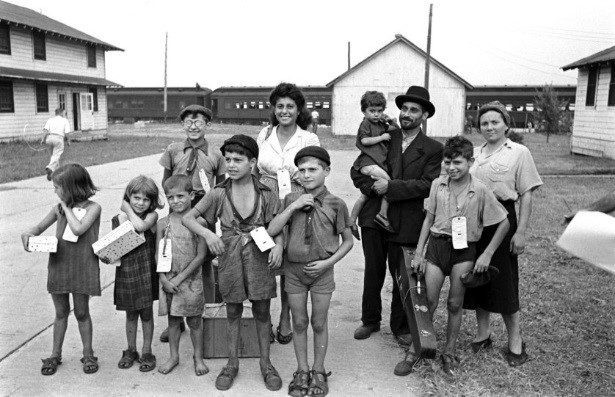
Refugees outside their barracks. The trains that brought them to the camp can be seen in the background.
Now 90 years old, former refugee Bruno Kaiser at the 75th reunion of the Fort Ontario Emergency Refugee Shelter in Oswego. A California resident, he has three adult daughters and two grandchildren.

Today, no more than 35 former camp residents remain alive, said Paul Lear, manager of the historic site and co-organizer of the reunion and commemoration. He said it will likely be the last such gathering for a group whose members are now in their mid-70s to early 90s.

More than 600 people attended the reunion, said Lear, including Ambassador Dani Dayan, Consul General of Israel in New York; Rebecca Erbelding, a historian with the U.S. Holocaust Memorial Museum in Washington, D.C.; Michael Balanoff, President and CEO of the Jewish Federation of Central New York; Geoff Smart, son of Refugee Shelter Director Joseph Smart; and Oswego Mayor William Barlow Jr.

Surviving former refugees at Fort Ontario pose during a dinner held Aug. 5 to commemorate the 75th anniversary of their arrival at the camp, which was America’s only wartime sanctuary for escapees of Hitler’s genocide.
A ceremony at a local cemetery where some refugees who died while at Fort Ontario are now buried.
The grave of six-month old Rachel Montiljo, a refugee who died on the way to Fort Ontario. Weakened by poor nutrition, the child died of a fever on Aug. 2, 1944, the day before the ship from Europe docked in New York City. She is buried in Riverside Cemetery in Oswego.

Kaiser’s story is both unique and similar to that of his fellow escapees, spending months or years on the run, trying to stay ahead of arrest and shipment to concentration camps. Along with his father, mother, and two grandparents, Kaiser had fled Yugoslavia in the spring of 1941 after his father had been arrested – and miraculously released after only a few days – in the wake of the Nazi invasion and takeover when Jews were being rounded up.

“My father decided we should leave _ quickly,” said Kaiser, so the family caught a train bound for the safety of the Italian-occupied Adriactic coast. During the trip, the train stopped in a switching yard.

“Across from us was another train, this one with prisoners being taken away by the Nazis. I could see their faces. That is how close we came,” said Kaiser. “The rest of my (extended) family, who did not leave, ended up being wiped out.”

His family remained in relative safety under Italian control until September 1943, when the Italian government surrendered to the Allies, which led the Nazis to attack and occupy all Italian-held territory. The Kaiser family then gained passage on a small ship that took them to an island occupied by the Allies.

From there, the family was shipped to the Allied-controlled portion of the Italian mainland, and taken with several hundred other refugees to the port of Toranto for shipment to North Africa. But the family decided on its own to stay in Italy, and was helped by a local stranger to find an apartment. And it was there, while the teenage Bruno was attending a local high school, that the family learned of Roosevelt’s program for America to accept a very small number of European and Jewish refugees.

“We applied, and because we had family in Cleveland and Chicago, were accepted. The Oswego camp was a peaceful place. I went to the public high school, with about 40 other kids from the camp,” said Kaiser, who recalled he had to “learn English from scratch” to go along with his other languages:  Croatian, Italian and German. “The people of Oswego were nice to us. There was never any anti-Jewish anything.”


Oswegians conversing with World War II refugees housed at Fort Ontario. Local people passed the refugees gifts of money, food, clothing, shoes, toys, dolls and more. (Photo from ‘Token Shipment’ by Edward B. Marks)

After being released from the refugee camp in January 1946, the Kaiser family joined relatives in Cleveland, their son finishing his senior year of high school there. He later earned an electrical engineering degree from Ohio State University. Now retired after working for various companies, he is father to three daughters and two grandchildren.

Asked what the lesson of Fort Ontario is for people today, Kaiser paused. “It is that anti-Semitism rears its ugly head every once in a while. And it is happening now.”

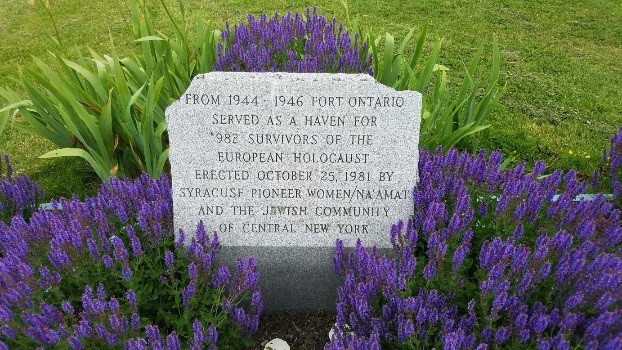
Tellingly, a 1981 stone monument to Fort Ontario camp was vandalized shortly after being installed, with the word “Jewish” partially chipped away and its corners knocked off. Site officials decided to leave the monument as it is as a reminder of the dangers of anti-Semitism.

The vandalized monument at Fort Ontario.

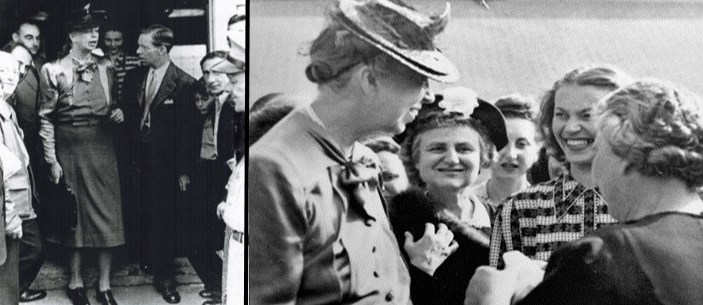
To create the camp, Roosevelt avoided rigid immigration quotas by identifying the refugees as his “guests,” a status that gave them no legal standing and required them to sign documents agreeing to return to Europe at the end of the war. In September 1944, First Lady Eleanor Roosevelt visited the camp to draw attention, writing about it her weekly newspaper column.  After the war, camp director Joseph Smart stepped down from that post to form a national campaign that pushed for the refugees to be given the choice to stay in America, a step that was taken by President Truman.

Later, the state historic site at Fort Ontario was established and opened to the public in 1953.


Eleanor Roosevelt visiting Fort Ontario in September 1944. (Photo from ‘Token Shipment’ by Edward B. Marks)

Linda Cohen came to the Oswego reunion from her home in Michigan, to remember her parents, Leon and Sarinka Kabiljo, who lived at the camp.

“My parents were married on April 6, 1941, the day the Nazis invaded Yugoslavia. They were on the run for three years, hiding in the forests with the partisans. My mother worked with them as a nurse,” she said. Once Italy surrendered, the Kabiljos went to that country, and while there also learned of the U.S. refugee program.

“My older sister was born nine months to the day after my parents arrived in Oswego,” said Cohen. “My mother told me that refugees cried when they got to the Oswego camp. They had beds with sheets, and most had not slept on sheets in years. She told me the camp director said to them: “When there is a knock on your door now, it will be a friendly one.”

Her parents eventually settled in Baltimore, where Linda was born in 1951 and where Leon lived to age 94 and Sarinka to age 92. Cohen wrote a book about their story entitled Sarinka: A Sephardic Holocaust Journey: From Yugoslavia to an Internment Camp in America.

At the start the reunion ceremony, a recording was played of Neil Diamond’s 1981 song America. “I have heard that song a thousand times,” said Cohen. “But sitting here that day, near where the refugee barracks and my parents used to be, it was like they were that song.”


Linda Cohen, whose parents, Leon and Sarinka Kabiljo, were among the refugees at Fort Ontario. She has written a book about their experiences.

Currently, the National Park Service is studying whether Fort Ontario should receive national park status, as part of the Fort Ontario Study Act passed by Congress and signed by President Donald Trump in 2018. The site is open to the public and various activities and exhibits run throughout the year.

During his tour of the fort, Israeli Ambassador Dani Dayan praised the people of Oswego for their warm embrace of the camp, with residents often coming to the fence to visit the refugees, passing food and other gifts. “The people who welcomed Holocaust refugees into Oswego were a shining example by saying with their actions that they were not indifferent, that they cared about them and wanted them to be there while the rest of the world rejected refugees solely because they were Jewish,” he said.

Ambassador Dani Dayan, Consul General of Israel in New York, examines a section of camp fencing and a U.S. flag that flew over the fort.

During a ceremony near the site of the former barracks, Lear recalled the words of refugee Dr. Adam Munz at the first reunion in 1981: “The Oswego Refugee Shelter was and has remained for me, and I suspect for some others as well, a paradox.  It symbolized freedom from tyranny, oppression and persecution on the one hand, and yet there was a fence, a gate that locked and guards were felt necessary to contain us at the very time we longed for the kind of freedom this country stood for and professed. Our country’s immigration laws continue to be paradoxical.”

Lear also recalled General Dwight D. Eisenhower’s prediction that someday people would deny that the Holocaust ever happened. To protect against that, he ordered U.S. troops in Europe to tour concentration camps to bear witness that it did. 

Now, in a time of rising anti-Semitism and attacks on Jews, Lear said Fort Ontario, while no longer an active military base, remains “a fortress against forgetting and denying the Holocaust.”


Resources:

Erbedling, who has also written a book on subject, entitled Rescue Board: The Untold Story of America’s Efforts to Save the Jews of Europe, said given the age of the surviving former refugees: “For everyone younger than 75, it is our job to remember their story.”

In 1987, the public broadcasting station in Rochester, WXXI, made a documentary about the camp. It can be found here.

Cover Photo: During a visit to the Fort Ontario museum, Yugoslavian refugee cousins Ella, David and Rikika Levi touch a section of the wire fence that used to surround the camp. Behind the fence is a 48-star flag that used to fly over the fort during World War II.

Post by Paul Lear, Site Manager of Fort Ontario Historic Site, and Brian Nearing, Deputy Public Information Officer.

The official blog for the New York State Office of Parks, Recreation & Historic Preservation