Trail Work: Excelsior Conservation Corps Helps out at Hamlin Beach State Park

Recently, members of the Excelsior Conservation Corps (ECC), an AmeriCorps program, visited Hamlin Beach State Park to help the staff with some major trail maintenance projects. The ECC is a partnership between State Parks, the Department of Conservation, the Environmental Facilities Corporation, and the Student Conservation Association. The members in this program range from ages 18-25, and have learned skills and methods in conservation and preservation of the environment. While working at Hamlin Beach, for nine days, the ECC crewmembers were given projects to work on at various trail sites.

The first area the crewmembers worked on was the Devil Nose Trail. This trail is located right next to some very high cliffs and had been closed off for a while due to storm damage. The team was given the task to help re-route a portion of the trail, so that it would be further from the edge of the cliffs. They also needed to widen the full route to 8 ft. so that a small all-terrain vehicle could drive through it in order to bring woodchips onto the path. The original trail was very uneven and hard to follow, so the goal was to create a nice finished and flatter area to walk on.

After clearing away leaves and moving the dirt aside to widen the section of the pre-existing trail, the crewmembers followed the newly flagged route to create a new trail corridor using chainsaws, and tools such as hard rakes, pick mattocks and Mcleods. The chainsaws were used to cut up fallen trees so they could be move away from the trails or used along the trail edge. The other tools were used to move dirt, sand, leaves and smaller sticks to level the path.

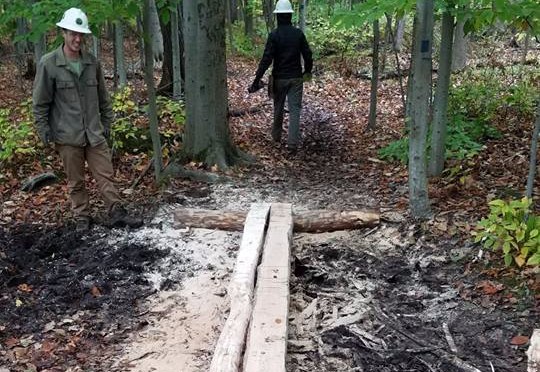
HamlinTrailBefore
A section of Devil’s Nose Trail before they cleared it away, photo by the ECC.

After the trail was cleared away, the Parks’ maintenance staff dumped piles of woodchips throughout the trail, and then the ECC members spread them out with rakes.

HamlinTrailWoodchips
Section of the Devil’s Nose trail completed with wood chips, photo by the ECC.

Once the half-mile long of Devil’s Nose Trail was completed, the ECC crewmembers were asked to work on maintaining a small short loop trail over by the campground. After walking the area, they marked off which trees were hazardous and needed to be taken down with a chainsaw. In the beginning of the trail the team noticed that there was a trail turnpike, but the area right after it was very muddy. Help was needed.

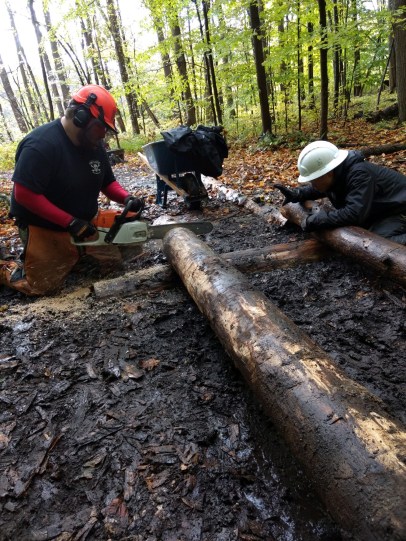
HamlinTrailECCWorking
Two ECC crewmembers working on using the chainsaw to cut the ends of the lumber to match the ends of the lumber on the pre-existing turnpike, photo by the ECC.

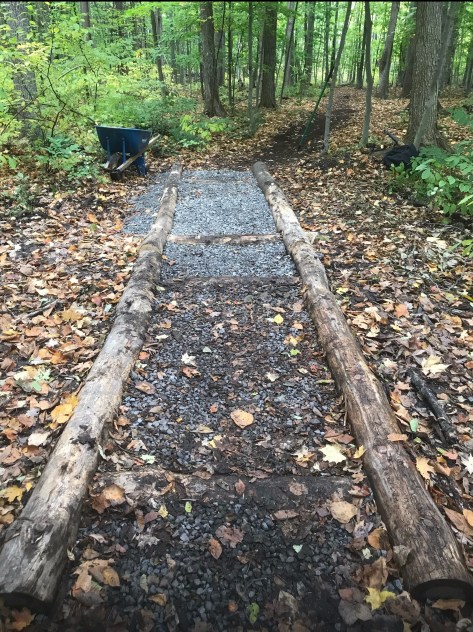
The purpose of a turnpike is to raise the trail surface out of a muddy or wet area to make the trail better to walk on. It consists of two short pieces of lumber that are laid down going across a trail. They are buried about 3/4ths down, and serve as “sills”, for the longer lumber to sit on. The long pieces of lumber need to be cut out with a chainsaw so that there are little sections for it to fit the sill. This makes them sitting level with the ground. Once all of the pieces of wood are laid out the open, area is filled with gravel so it will provide a durable surface for hikers to walk on.

HamlinTrailTurnpike
The turnpike in the process of being set into the sills, photo by the ECC.

The ECC members created a new section of turnpike completely from scratch. They searched for the lumber among the trees just cut down and had to actually de-bark the trees before the construction began. They then measured everything out and set up the pieces of wood to match the previously made turnpike. In the end the turnpike turned out to be 14 feet long!

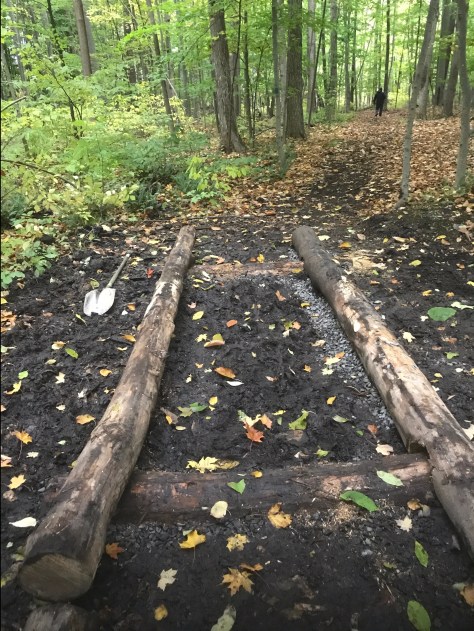
HamlinTrailTurnpikeDone
The finished turnpike. The new addition is the last section furthest away in the picture, photo by the ECC.

This is one of many projects the ECC has worked on this summer. They also helped remove invasive species at Ganondagan State Historic Site and make a new trail at Mine Kill State Park.  State Parks is grateful for the help ECC provides in our parks and historic sites.

ECC is recruiting for the 2019 season. If you would like to join the crew, follow this link for more information.

Post by Amber Goodman, ECC


First Saturday Hikes in the Finger Lakes Region

Each year in the Finger Lakes ten hikes are offered throughout the region on the first Saturday of each month.  Hikes are led by Parks staff or Parks interns and are offered at different locations each month and vary in length (3-5 miles) and difficulty.   As leaders, we try to keep everyone together during the hikes as much as possible but with group size ranging from 2-50, variable terrain and different fitness levels we sometimes get spread out until we take a rest and regroup.   We encourage everyone to attend, including but not limited to families, seasoned hikers, visitors to the region, locals, groups, clubs, well behaved dogs and anyone else you can think of. There is no First Saturday hike in January because of the January 1st  First Day Hike on offered at Taughannock Falls State Park and no hike in May due to I Love My Park Day always falling on the first Saturday of May.

RTreman_Gary Cremeens
Jane Suhey from the 2017 First Saturday Educational Hike at Robert H. Treman State Park, photo courtesy of Gary Cremeens

The idea behind these hikes is to get people out exploring new parks and learning more about hiking parks while getting a little exercise.  Each hike is unique because there are sometimes different leaders and the mix of people who attend is always varied.  Both of factors shape how the hike unfolds.  We routinely discuss park history, geology, natural history, hiking basics and anything else that is relevant or sometimes topics that come from left field! Last month the temperature was in the low 40’s and there was a steady rain so we began with a discussion on hypothermia and how to tell if someone might be hypothermic.

CatherineValley_J Teeter
October 6th hike along the compact stone-dust Catherine Valley Trail (quick side trip to see Montour Falls)

The origin of this offering of hikes is linked to the 2014 First Day Hike when I first met Gary and Wendy Cremeens. After hiking five miles with me they said that they had such a good time that we should do it every month.  Their positive energy and willingness to help and support everyone around them sold me on the idea. We offered our inaugural First Saturday Hike at Buttermilk Falls State Park in February of 2015.  Gary is in the Cubs outfit in the photo below; he is usually wearing something fluorescent, almost always in shorts and when he attends, he runs around distributing the hike schedule, offering bug spray or tissues and welcomes everyone who shows up. Wendy is equally supportive and always acts as the hike sweeper so no one gets left behind.

ButtermilkFallsHikers_Wendy Cremeens
Aug 4th 2018 hike at Buttermilk Falls State Park, photo courtesy of Wendy Cremeens

Hikes are free (certain parks at certain times of year charge a parking fee) and reservations are not required but will be accepted via my email at josh.teeter@parks.ny.gov.  If you have questions about the hike location, difficulty or any other related questions, feel free to email me in advance.  The calendar of hikes can be found on the New York State Parks calendar or on Facebook by searching First Saturday Educational Hikes.

Post by Josh Teeter, State Parks

Did You Know That Allegany State Park Played A Role In Wild Turkey Restoration?

The wild turkey is native to North America, but suffered severe declines due to wide-scale forest clearing and over hunting. By the mid-1800’s, this great bird was gone from New York state and much of the northeast. However, in the mid to late 1940’s, some wild turkeys were observed along the NY and PA border from Allegany State Park to the Genesee River Valley, a sign that the habitat might be recovering and able to support them again. So, in the early 1950’s, the New York State Conservation Department (forerunner to the NYS Dept. of Conservation) began a restoration effort in the early 1950s. They started with game farm turkeys, but after a few years, this effort failed because the game farm birds were not wild enough to avoid predation and lacked the capacity to survive.

fall.hens
Flock of hens in the forest in the 1950’s.

Meanwhile, a healthy breeding population of wild turkeys expanded from Pennsylvania into the Allegany State Park region of New York. Park managers then gave the Conservation Department permission to trap turkeys in the park, initiating the wild turkey trap and transfer program which began in 1958 and concluded successfully in 1974. This program allowed for more rapid expansion of the turkey population to suitable unoccupied habitats.

dec.file.2
Tom turkey displays his tail.

The turkeys trapped in Allegany State Park were moved to several areas in the Region and then throughout the state. In addition to the in-state trap and transfer, turkeys from the park were also sent to Connecticut, New Hampshire, New Jersey and Vermont. Other trapping efforts in the region and elsewhere in New York sent birds to Delaware, Minnesota, Rhode Island and the Canadian Province of Ontario. New York turkeys helped re-establish populations throughout the Northeast, Midwest and southeastern Canada.

New York State Conservation Department was one of the pioneers among state agencies to restore wild turkey populations in the United States. This program would not have been successful without the cooperation of Allegany State Park and to this day is recognized as one of the greatest wildlife management success stories of North America.

RickMiller OleanTimesHerald
2017 Monument commemorating the first wild turkey trap and transfer program, photo courtesy of Rick Miller, Olean Times Herald

Conservationist 10-2017 p 28
Wild Turkey Restoration exhibit in the Red House Natural History Museum, image from DEC Conservationist, October 2017, p 28.

Marsh Madness: Restoration of Iona Marsh from Invasive Phragmites

Iona Island, located along an elbow of the Hudson River in Bear Mountain State Park, is technically an archipelago of three islands connected by marshlands. Iona has had many owners in its storied history, prior to being bought by New York State in the 1960s. The Island was host to Native American tribes for thousands of years, who took advantage of the plentiful shellfish along its shores. In the last few hundred years, it has been the site of an unsuccessful vineyard, a hotel and weekend destination for NYC residents, a U.S. Navy arsenal, and a partially built park recreation area. The eastern side of the island past the railroad tracks has been closed to the public since the 1980s, but a small portion of the island consisting of the five remaining Navy buildings is used for storage for the Palisades Interstate Park system. The rest of the island has returned to a more natural state of woods, meadows, and rocky outcroppings and serves as a sanctuary for wintering bald eagles.  The island achieved National Natural Landmark status in 1974, and was designated a NYS Bird Conservation Area and Audubon Important Bird Area shortly thereafter.

A key natural feature at Iona is the extensive marshlands, 153 acres in all, flanking its western side.  Part of the Hudson River National Estuarine Research Reserve (HRNERR), this brackish tidal marsh (marshes with water that has different concentrations of salt depending on the tides) teams with life including fish, waterfowl, waterbirds, plants, and crustaceans. In recent times, the rich biodiversity of the marsh, including a number of state rare species, has been threatened by Phragmites australis, or as it is more widely known, common reed.

Common reed (Phragmites australis) is a plant that was likely brought to the US from Europe and Asia in the 1800s through ship ballast or the water taken in by ships to allow them to balance on long voyages. Commonly referred to as just Phragmites, this non-native plant is invasive in the U.S., displacing and crowding out native plant species, such as cattails, rushes, asters, and many others. In turn, the presence of this species has undermined the complex web of marsh dependent organisms.

The non-native Phragmites is identifiable by its tall stature, dark blue-green leaves, and tendency to form dense stands, with little to no possibility for native species to grow in the areas that they occupy. A native species of phragmites (Phragmites americanus) occurs in NY as well, but this smaller plant with reddish stems grows with less density so it does not crowd out other flora.

Pre20018 Iona
Iona Island Marsh in 2008 before treatment. Phragmites dominate the background.

The phragmites problem at Iona Marsh began in the early 1960s, when the first small colony appeared near a pipe draining into the marsh. Over the next 40 years, phragmites steadily expanded until it covered nearly 80 percent of the marsh area. Researchers tracking these changes noted a concurrent decline in marsh specialist birds and specialized brackish marsh plants, including state rarities.  In an effort to reverse these trends, the Palisades Interstate Park Commission, while partnering with Hudson River National Estuarine Research Reserve and the Highlands Environmental Research Institute, started a New York State Department of Environmental Conservation (NYSDEC) funded management program in 2008 focused on a 10-acre test area. The goal was to reduce the invasive phragmites, and make room for native plants to once again occupy the area. If the program was successful in this small area (1/15th of the marsh), it could be expanded to additional marshlands.

A multi-faceted control and monitoring program has been developed and implemented and the results have been dramatic. More than 90% of the phragmites was eliminated within one year and nearly 97% by the third year. Researchers saw the return of huge meadows of annual native marsh plants, including some state-threatened species, followed by perennial cattail stands. Marsh specialist birds such as Virginia rail, least bittern (State-threatened), and marsh wren followed soon thereafter.  Based on this success, the project was expanded to an adjacent 32-acre area of the marsh known as Ring Meadow. Both areas now have less than five percent Phragmites cover, an overall success on the journey to reestablish native vegetation.

2017 Image
Map of the Iona Island Marsh Treatment Areas

While complete eradication of the Phragmites may be impossible to achieve, success can be maintained through continued monitoring and spot treating remaining and new patches.  Bird and vegetation surveys are conducted annually, as are measurements of sediment build-up on the marsh surface, as it relates to sea level rise.  The goal remains to restore the native plant communities in the marsh to promote biodiversity. A healthy, native marsh community will lead to increased productivity and habitats for fish, birds, and mammals – many of them specially adapted to the brackish conditions at Iona.  With continued management, the long-term outlook is positive for this Hudson River jewel, one of only four large brackish marshes on the Hudson.

RingMeadow
Ring Meadow in 2016. Cattail and blooming Rose Mallow have regrown where phragmites once were.

Interested in seeing Iona Marsh for yourself? While public canoeing and kayaking are not allowed in the marsh itself to protect this unique place, through collaboration with the State Parks, NYS DEC offers free public canoe programs each summer.  Not a fan of getting on the water? Iona Island is accessible by road. There is a parking lot approximately ½ mile onto the island, right before the railroad tracks (the boundary of the public accessible areas), where you can park and view the marsh. Lucky visitors may spot waterfowl, muskrats, frogs, turtles, wetland birds, deer, or even bald eagles!

Photo credit:   PIPC Archives

Dr. Ed McGowan,  2017 Annual Report Iona Island Marsh

Post by Jesse Predmore, SCA

Edited by: Dr. Ed McGowan & Chris O’Sullivan

Featured image: lulun & kame accessed from Flickr

National Purple Heart Hall Of Honor: Who We Are, What We Do…& Why We Need Your Stories

The National Purple Heart Hall of Honor recognizes the sacrifices of Purple Heart recipients. Our mission is to collect, preserve, and share the stories of Purple Heart recipients from all branches of service and across all conflicts for which the award has been available. We are located in the Hudson Valley, (New Windsor) 12 miles north of West Point, on the same grounds that the Continental Army occupied during the final months of the American Revolution. This location has an important connection to the history of the Purple Heart. We are located on these grounds to mark the May 28, 1932 Temple Hill Day ceremony which occurred here when 137 veterans of World War I were awarded their Purple Hearts. The ceremony was part of New York’s Bicentennial celebration of the birth of George Washington. The commemoration of the sacrifices of Purple Heart recipients continues today most visibly through our Roll of Honor.

HALL OF HONOR
National Purple Heart Hall of Honor

The Roll of Honor is a database of Purple Heart recipients representing all wars for which the award has been available. Our timeline of recipients, based upon the date they were wounded or killed, runs from April 6, 1862-October 1, 2017 and grows daily as we receive new enrollments. These enrollments represent all 50 states, Puerto Rico, Guam, the District of Columbia and the Philippines. However, all enrollments are done voluntarily and are made by the recipients, their families or friends. While it is estimated that 1.8 million awards have been made since the award was created in 1932, there is no comprehensive list of recipients maintained by the government. In fact, the only award for which there is an official list is the Medal of Honor. All information on awards and decorations is found in the military records relating to the individual.  Our Roll of Honor is aimed at creating a comprehensive list of Purple Heart recipients, in order to preserve their history.

DABNEY PROFILE
Enrollment profile for Purple Heart recipient Clarence Dabney.

The Roll of Honor is accessible both in the Hall of Honor and online allowing anyone to view the preserved stories of sacrifice. The online version can be viewed from any computer via our website: www.thepurpleheart.com. The recipient’s profiles can contain pictures as well as written narratives of the experience of that recipient.

WE NEED YOUR HELP!

If you are a recipient or know someone who is, we hope that you will consider completing an enrollment form for inclusion in the Roll of Honor.  Information on enrolling can be found on our website: www.thepurpleheart.com or you can call the Hall of Honor at 845-561-1765 and we will send you a copy of the enrollment form.

 COME VISIT:

The 7,500-square-foot Hall of Honor is open six days a week, year-round, and we invite you to visit.. Our timeline gallery pays tribute to the branches of service while commemorating America’s major military conflicts of the 20th and 21st centuries.

Our Main Gallery transports visitors through the Purple Heart experience with personal stories and artifacts that help tell the story from being wounded to coming home. Our 10-minute video lets visitors hear the stories of how nine Purple Heart recipients received their awards and what it means to them. There are exhibits and stories for visitors of all ages.  The facility also offers adult group tours and educational programs. To learn more about these offerings, please contact Peter Bedrossian, Program Director (peter.bedrossian@parks.ny.gov) or by phone 845-561-1765.

We hope to see you here!

Location:

374 Temple Hill Road

New Windsor NY 12553

Hours of Operation:

Tuesday-Saturday, 10:00-5:00; Sunday 1:00-5:00

Please call for holiday hours

The official blog for the New York State Office of Parks, Recreation & Historic Preservation