It’s the most sparkly time of the year! It’s the holiday season and the grand finale of the year of wellness at New York State Parks and Historic Sites. All year long, we’ve come together to improve all aspects of our well-being, build community, and connect to nature and history. We celebrated the holiday season the same way, with handcrafted experiences designed to bring people together to make memories without breaking the bank. Our gift to you is a look at the holiday and winter festivities at state parks and historic sites all across New York. Thank you for making us part of your year-end traditions!
As a New York State Park Ranger, every day is different. You can never be quite sure what you may encounter, or who you may cross paths with, but each day offers an opportunity to make an impact on the experience that visitors have when coming to enjoy New York State Parks. Below are some of the many stories from Park Rangers across the state about their experience working in parks this summer, in their own words!
On Saturday, June 8, New York State Parks and New York State Department of Environmental Conservation celebrated Get Outdoors & Get Together Day at 22 locations across the state. This annual event coincides with National Get Outdoors Day and encourages people of all abilities to connect with public lands through outdoor recreation activities such as fishing, nature walks and hikes, birding, archery, camping, and paddling.
This year, more than 2,000 participants enjoyed the day at a New York State park or historic site! Activities included a magic show, a raptors and reptiles show, dancing, singing, spin art, yard games, and more! Let’s take a look at some of the action.
When it comes to planning a vacation or getaway, New York State Parks has overnight options for all kinds of adventures – and budgets!
While some enjoy sleeping in tents away from it all in remote, natural settings under the stars, others crave a few more amenities. Whether you prefer booking rustic cabins and bringing your RV, staying in fully equipped cottages, or resting your head at a historic inn or resort with the comforts of home, State Parks has something for everyone.
Our Parks system includes 8,148 campsites, 967 cabins and cottages, 18 yurts, three inns, and – yes – a lighthouse. There are countless adventures for every type of stay. Get a map handy and explore highlights from some of our most interesting properties to inspire your next stay.
La Isla Bonita
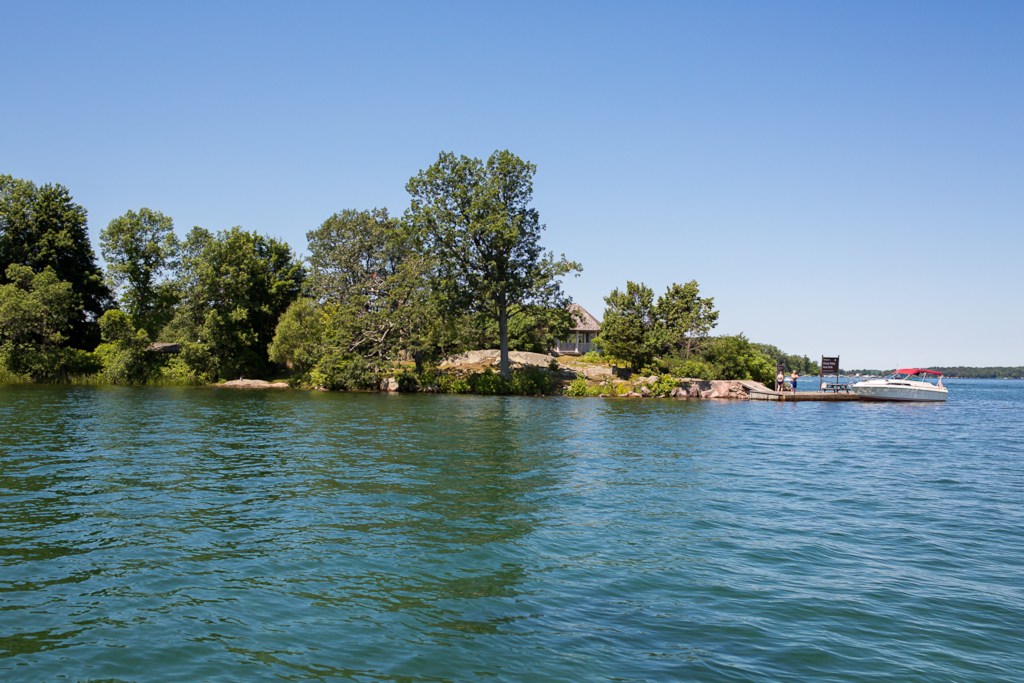
If you have a boat or have access to renting one, answer the siren song of the water and consider the benefits of staying on one of three island parks in the Thousand Islands that are only accessible by boat.
Why worry about clearing your campsite for the tent when you can enjoy a level platform? Platform camping provides a wooden deck floor for pitching your tent on a smoother and more even surface.
A camping deck inLake Taghkanic State Parkin Ancram.
The perfect place for a family reunion on the Great Lakes? Check. Lakefront luxe in the Finger Lakes for a bachelorette wine-tasting weekend? Check. Thousand Islands waterfront cabin for anglers telling fish tales about the day’s catch? Check. Memories to last a lifetime? Check, check, check.
Robert Wehle State Park’s cliffside compound, Thousand Islands region.
Robert Wehle State Park features a private setting that accommodates eight, and includes a compound with a main house, guest quarters, studio, and formal gardens set cliffside along the Lake Ontario shorefront.
A cabin porch at Betty and Wilbur Davis State Park in Schenevus near Cooperstown.
Fans of America’s pastime can stay at a cottage at Betty and Wilbur Davis State Park near Cooperstown and head to the National Baseball Hall of Fame, then go old school and listen to a game on the radio from the cottage’s front porch.
A century ago this week, thousands of people flocked by car and even horse carriage to remote, wild and forested hills in southwestern New York’s Cattaraugus County, near the border with Pennsylvania, to celebrate the opening of a new State Park.
According to a contemporary account in the local Salamanca Republican-Press newspaper, the visitors to the new Allegany State Park used a roadway that had been quickly built over the bed of a former lumbering railway in the region, which also had been part of the state’s 19th century gas and petroleum industry. With people coming in from as far as Buffalo, parking was quickly filled and some people walked a great distance to reach the dedication site, located near an old lumber camp.
Enjoying a picnic of sandwiches, doughnuts, cookies, coffee, iced tea and “milk in unlimited quantities” as reported by the newspaper, the crowd listened as Albert T. Fancher, a former state senator from the region and chairman of the new park’s commission, vowed that Allegany was poised to quickly grow, with areas nearby suitable for creation of a man-made lake and game preserve.
Another speaker, Franklin Moon, dean of the state college of forestry, said the creation of public parks like Allegany were the best remedy for “national irritability,” as he reflected some of the trepidation in the U.S. over the then-recent rise of Bolshevism in Russia.
Some of the Opening Day crowd at Allegany State Park on July 30, 1921.
Today, Allegany State Park welcomes more than 1,500,000 visitors a year to explore western New York’s premier wilderness playground, created thanks to the vision of Fancher, a petroleum industry executive who was a political force in Cattaraugus County for several decades, as well as Hamilton Ward, a Spanish-American War veteran who later founded the Erie County Park Commission and became New York State Attorney General, and Chauncey Hamlin, president of the American Association of Museums and founder of the Buffalo Museum of Science.
Fancher became the park’s first director until his death nine years later in 1930. Fancher’s original cabin, where he stayed at the park with his wife, is still there. Hamlin supported the creation of a science camp at the park.
Starting out in 1921 with about 7,100 acres purchased for $35,800 (equivalent to about a half-million dollars today, or about $70 an acre), Allegany State Park has grown over the years to encompass more than 64,800 acres and includes rare remaining portions of old growth forest with trees more than 100 years old that were left undisturbed during the area’s lumbering and petroleum boom that ran from the early 19th century to the 1920s. Park naturalists have mapped more than 5,200 acres of old growth forests of hemlocks and hardwoods, with the majority of that in the Big Basin area. Some experts believe this is the state’s largest contiguous track of old growth outside the Adirondacks.
Given the uncertainty of planning during the pandemic, the park is not holding a mass gathering like was done in 1921, but is hosting a virtual celebration on July 30th 2021 that will include a library of digital content. The park is also offering a summer series of interpretive programs highlighting the park’s history.
The virtual celebration and other digital content can be viewed HERE starting noon on July 30, 2021.
Additionally, a set of four self-guided interpretive booklets are for sale at the park which guide visitors to 100 points of interest within the park, and includes topics of interest such as early European settlement, the petroleum and lumbering industries, early ski facilities in the state, and the work of Civilian Conservation Corps crews during the Great Depression.
Now New York’s largest State Park, Allegany has a wide variety of recreational resources certain to foster tranquility and soothe any irritability. Due to its size, this sprawling park is divided into two distinct areas – Red House and Quaker Run. Red House has 133 campsites, 130 cabins, 16 full-service cottages, two group camps, five miles of paved bike paths, many miles of hiking and horse trails, and swimming at man-made Red House Lake, with boat rentals. Its historic Tudor-style administration building, completed in 1928, includes a museum of park natural history
A canoeist paddles past the park’s historic Administration Building.
One of the new cabins at Allegany State Park.
The Quaker Run Area has two lakes, 189 campsites, 230 cabins, 37 full-service cottages, two group camps, many miles of hiking trails and horse trails, swimming at Quaker Lake, a boat launch at the Allegheny Reservoir, which has 91 miles of shoreline and is popular for boating, fishing, kayaking and waterskiing. Named for Quaker missionaries and settlers who came to the area in 1798 at the invitation of Seneca Chief Cornplanter to assist with agriculture and education.
The new bathhouse at Quaker Lake.
A fishing pier on Quaker Lake.
Hikers have a wide variety of trails to choose from, with some highlights including:
Located on the park’s Quaker Run side, the Blacksnake Mountain Trail is one of the oldest trails in the park with a unique history. Parts of the trail follow the 1888 section of A&K Railroad (Allegheny & Kinzua), which is evident in the gentle slope on the north side of the three-mile loop. In 1933, the professors of the Allegany School of Natural History, also known as “the School in the Forest”, (located near Science Lake) mapped out a hiking trail they officially named the “Nature Hiking Trail” to conduct their field studies with their students. It was later renamed “Blacksnake Mountain Hiking Trail” in 1980 after Governor Blacksnake, an Iroquois Indian chief for the Seneca Nation of Indians, who allied with the United States in the War of 1812. The trail crosses several streams with new bridges, and a short steep climb leads to mature black cherry trees estimated to be between 100 and 130 years old. Cucumber magnolia, tulip trees and hemlock are other trees of interest along the way. This is a favorite trail for spring wildflower lovers. Trillium, Dutchmen’s breeches, squirrel corn, and spring beauties are just a few of the ephemerals that announce the changing of the seasons. Near the top of the trail, look for a granite milestone marker which represents the border of New York and Pennsylvania, where you can put a foot in each state.
Bear Paw Hiking Trail is named after a style of snowshoe used by Native Americans and was originally designed as an interpretive snowshoe trail in 2015 by park naturalists. The 2.4-mile trail starts at the rear of the Summit Area parking lot. Look for brown numbered markers which highlight unique flora such as ground cedar, various hardwoods, and lowbush blueberries. Halfway along Bear Paw, at the end of the loop, hikers will be treated to the masterfully built Stone Tower, an Allegany State Park landmark, constructed by the Civilian Conservation Corps in 1934. The tower offers beautiful views of large open valleys, the city of Salamanca and Red House Lake. The second half of the trail traverses the south side of the ridge, through beech and maple forests and into a meadow. Depending on the time of the year, hikers may get to sample low bush blueberries or wintergreen growing in this area. The last section has a short, steep incline that adds a bit of challenge. Bear Paw ends at the Summit Warming hut.
The 5.2-mile Robert C. Hoag Bicycle Path is named after the former Seneca Nation President and was dedicated in June 1990. Starting at the Red House entrance of the park, the path passes old apple trees and large stands of spruce and Scotch pine, along with many varieties of hardwoods, shrubs and wildflowers. The most used part of the path is around Red House Lake, where a 3.4-mile trail offers the potential to spot such wildlife as beaver, muskrat, great blue heron, and many species of waterfowl. Spurs off the trail lead to the Red House Wetland Interpretive Complex, Beehunter Cabin Trail and Camp Allegany. Several benches are located along the way to relax and enjoy the surrounding beauty.
Work on the new Quaker Multi Use Trail began in the summer of 2020 between the Taft cabin and the Quaker General Store. The second phase is in the final design stages and will continue the trail to Quaker Lake Beach. Once complete, the trail will offer five miles of accessible paths winding though woodlands and fields along ASP Route 3 and Quaker Lake, including several scenic crossings of Quaker Run.
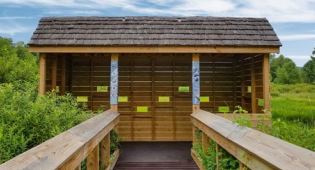
For birdwatchers, Allegany State Park contains a Bird Conservation Area, which provides breeding and migratory stopover habitat for forest-interior species such as Swainson’s Thrush, Blackburnian Warbler, and Scarlet Tanager. Of the 75 neotropical migratory songbird species that breed in New York, 64 have been observed within the park. The park supports a large breeding population of Osprey and one of the largest breeding concentrations of Cerulean Warblers found in New York, both of which are state species of special concern. The BCA also provides habitat for other state-listed species, including Bald Eagle (threatened), Northern Goshawk, Red-shouldered Hawk, Cooper’s Hawk, and Sharp-shinned Hawk (all species of special concern). Find a map of the BCA here.
A birdwatching blind in one of the park’s wetland areas.
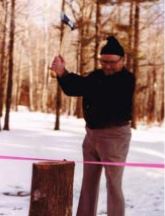
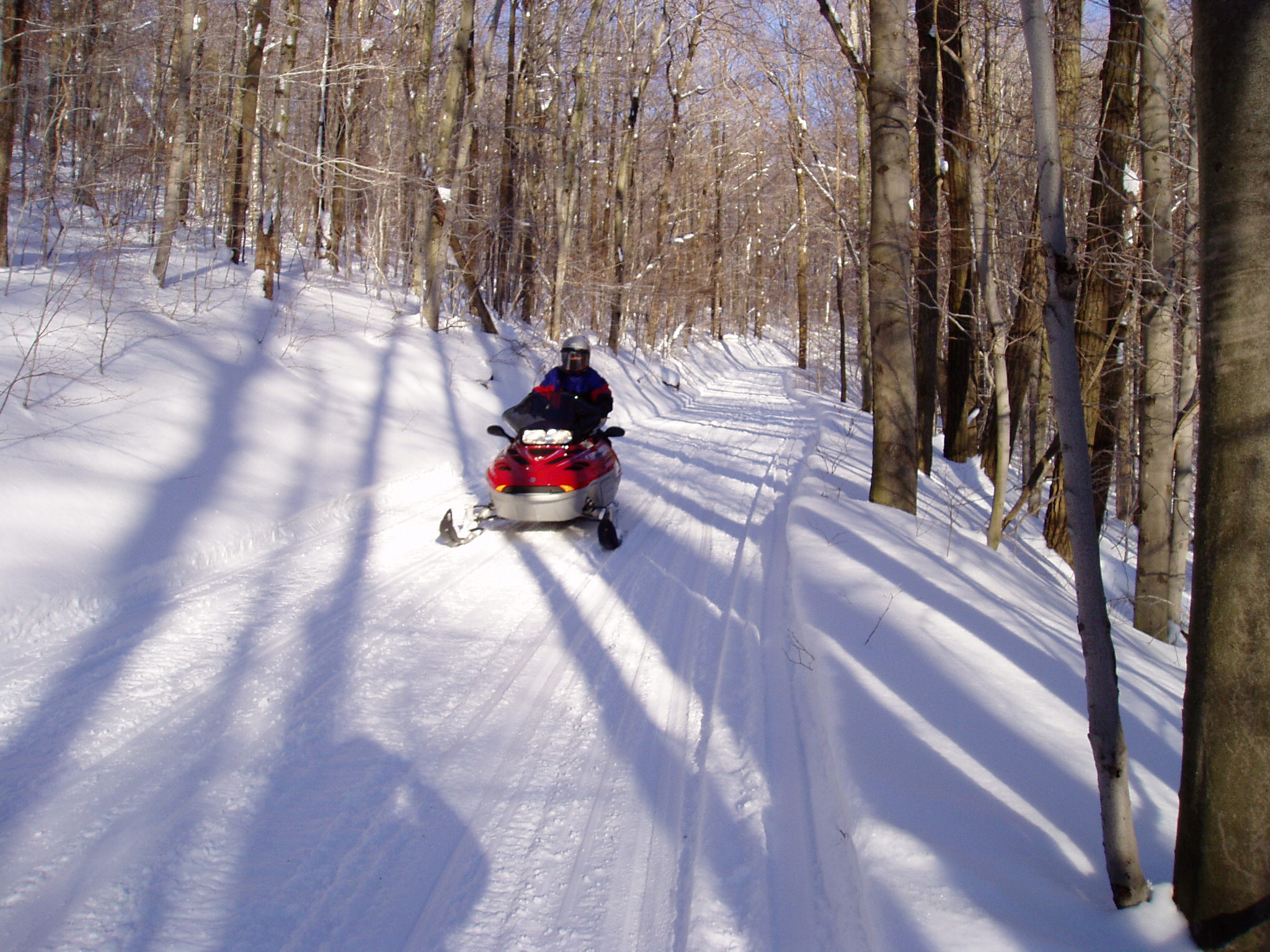
During the winter, the Art Roscoe Cross Country Ski Area boasts 26 miles of groomed cross-country ski trails. The area is named for an early park forester and ski advocate who later became assistant park manager and worked there from 1928 to 1968, earning the nickname “Father of Skiing” in western New York. For other winter sports enthusiasts, the Quaker Run and Red House areas also have a combined 90 miles of snowmobile trails.
Art Roscoe uses an axe to cut the ribbon to open up the new cross country ski trail network in 1972.
With 90 miles of snowmobile trails, Allegany State Park is popular with sledders.
Allegany also was the site of numerous fire towers, where observers would watch for signs of wildfires in the forests. One of those 60-foot towers, built in 1926 at the 2,365-foot summit of South Mountain, was restored and reopened to the public in 2006, and now offers a spectacular view of Red House Lake and the surrounding area.
The fire tower at the South Mountain summit offers panoramic views of the region.
For another gorgeous view, the Stone Tower, built between 1933-1934 by crews from the Civilian Conservation Corps, stands at 2,250 feet and overlooks the city of Salamanca. On a clear day, the view can stretch for up to 20 miles.
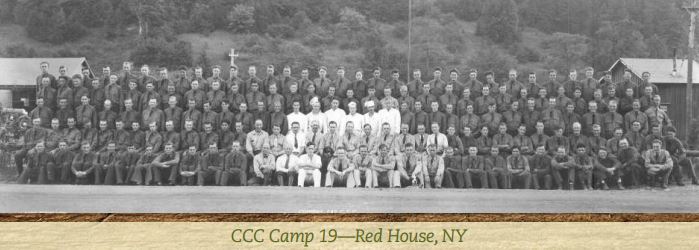
CCC crews also helped establish the park as a regional center for skiing, building a downhill ski center and two ski jumps, which allowed for competitions that would draw thousands of spectators through the 1970s, when the jumps were closed.
Top, one of the Civilian Conservation Corps crews stationed at Allegany State Park. Below, the Stone Tower that was among the projects built by CCC members.
Allegany also has a unique geological and natural history compared to elsewhere in the state. The park is part of a geological region called the Salamanca Re-entrant, which is the only area in New York that was never reached by glaciers during the last Ice Age some 12,000 years ago. This gives the region its distinctive soils, topography, surficial geology, and flora and fauna.
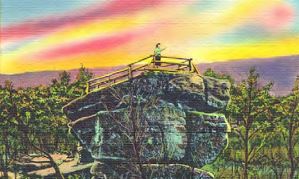
The well-known “Thunder Rocks” in the park’s Red House area may appear to casual observers to be some of the massive boulders scattered throughout much of the state by Ice Age glaciers but this unusual “rock city” is actually bits of ancient inland seabed created some 400 million years ago, and revealed through geological uplift and erosion.
Thunder Rocks are sections of an ancient inland seabed that has been exposed through geological uplift and erosion.
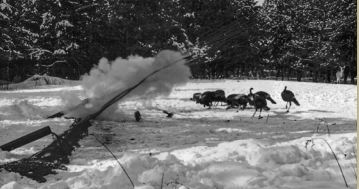
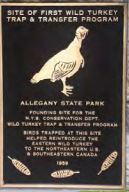
Wild turkeys, now widespread throughout New York, owe that comeback to Allegany State Park, the Regional Park Commission, and the Conservation Department. These birds were largely absent from the state by the beginning of the 20th century, due to overhunting and habitat loss, but in the 1940s, a small population of birds had come into the park, likely from Pennsylvania to the south. From the 1950s to the mid-70s, wild turkeys in the park were live trapped by wildlife officials, who used net-firing cannons to safely capture the birds, which were then taken to the Catskills, Adirondacks and elsewhere in New York state to reestablish the birds in the wild. Some turkeys were even sent to other states in the Northeast and to Canada as part of wildlife restoration efforts there.
All this only begins to scratch the surface of the park’s fascinating history and what it has to offer. So, in honor of the venerable park’s centennial and its next century to come, plan a visit to explore. Interactive maps of Allegany State Park can be found here and here.
Above, wildlife managers fire a net from a cannon to trap wild turkeys as part of restoration efforts in New York and throughout the Northeast. A plaque now marks the location of the first efforts.
Cover Shot – A colorized historic postcard of Thunder Rocks in Allegany State Park. All photos by NYS Parks.
Post by Brian Nearing, Deputy Public Information Officer, NYS Parks












 New York State Parks and Historic Sites Blog