There’s nothing quite like a New York summer! It’s peak season at New York State Parks and Historic Sites. Camping is in full swing, whether it’s in one of our cabins, or in tents or RVs. The swimming season is underway at our beaches and pools. And if you’re looking to make the most of the season, we’ve got you covered. Our expert staff members have combed the state to suggest exciting summertime experiences for everyone. There’s bound to be something new for you on this list!
Listen to the Sounds of Summer
Performances at Artpark, left, and at Saratoga Performing Arts Center on the grounds of Saratoga Spa State Park.
Summer concerts are happening all season long, and there’s an affordable live music option for everyone. Enjoy the longer days and warmer nights with festivals and performances by world-famous musical artists at Saratoga Performing Arts Center on the grounds of Saratoga Spa State Park, Jones BeachTheater at the iconic Jones Beach in Wantagh, and Artpark in Lewiston, or boogie with your favorite local bands at a state park or historic site near you. All options offer the chance to relax and enjoy the show from a blanket or chair.
– Written by Gabriela Wemple, Excelsior Service Fellow
When it comes to planning a vacation or getaway, New York State Parks has overnight options for all kinds of adventures – and budgets!
While some enjoy sleeping in tents away from it all in remote, natural settings under the stars, others crave a few more amenities. Whether you prefer booking rustic cabins and bringing your RV, staying in fully equipped cottages, or resting your head at a historic inn or resort with the comforts of home, State Parks has something for everyone.
Our Parks system includes 8,148 campsites, 967 cabins and cottages, 18 yurts, three inns, and – yes – a lighthouse. There are countless adventures for every type of stay. Get a map handy and explore highlights from some of our most interesting properties to inspire your next stay.
La Isla Bonita
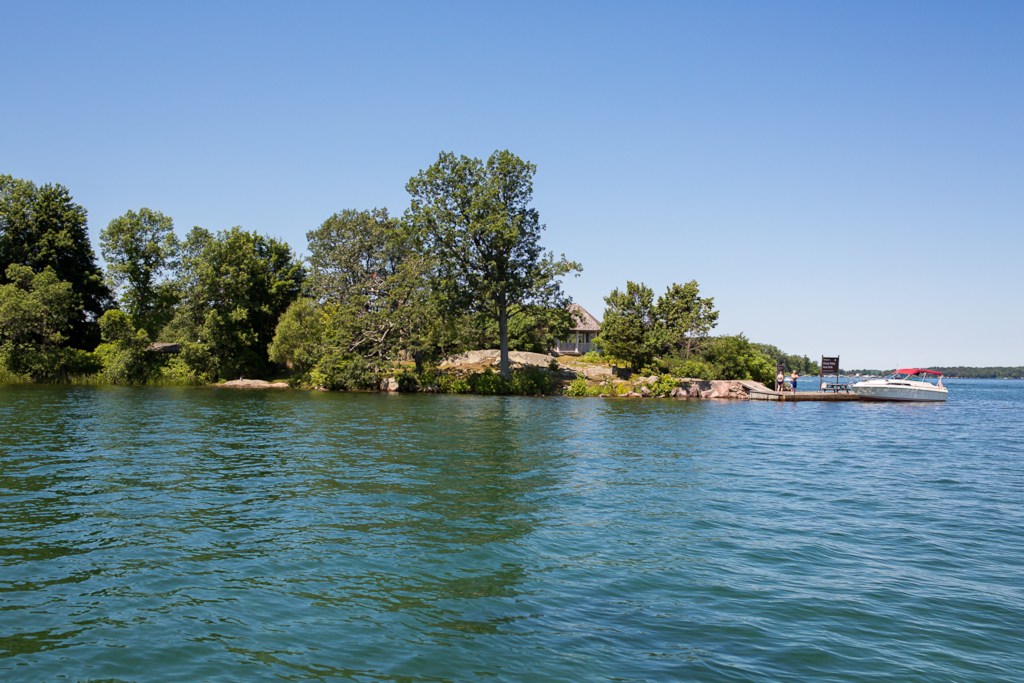
If you have a boat or have access to renting one, answer the siren song of the water and consider the benefits of staying on one of three island parks in the Thousand Islands that are only accessible by boat.
Why worry about clearing your campsite for the tent when you can enjoy a level platform? Platform camping provides a wooden deck floor for pitching your tent on a smoother and more even surface.
A camping deck inLake Taghkanic State Parkin Ancram.
The perfect place for a family reunion on the Great Lakes? Check. Lakefront luxe in the Finger Lakes for a bachelorette wine-tasting weekend? Check. Thousand Islands waterfront cabin for anglers telling fish tales about the day’s catch? Check. Memories to last a lifetime? Check, check, check.
Robert Wehle State Park’s cliffside compound, Thousand Islands region.
Robert Wehle State Park features a private setting that accommodates eight, and includes a compound with a main house, guest quarters, studio, and formal gardens set cliffside along the Lake Ontario shorefront.
A cabin porch at Betty and Wilbur Davis State Park in Schenevus near Cooperstown.
Fans of America’s pastime can stay at a cottage at Betty and Wilbur Davis State Park near Cooperstown and head to the National Baseball Hall of Fame, then go old school and listen to a game on the radio from the cottage’s front porch.
On July 22, 1997, Gonzo the Black Vulture stepped timidly onto northern soil for the first time at the Trailside Museums and Zoo at Bear Mountain State Park in the Hudson Valley. Born five years earlier at the Memphis Zoo, and later transferred to the Nashville Zoo, where he served as and education ambassador, Gonzo had made a northbound journey many members of his species would later take.
Early on in his career, Gonzo had developed a significant droop in his left wing, prompting surgery for a partial amputation to aid in his mobility. During his surgery, veterinarians discovered that Gonzo also suffered an irregular heartbeat. While it would be an early retirement from commercial zoo life, Gonzo would not be arriving alone in New York’s strange and unfamiliar landscape.
Gonzoin his enclosure at the Trailside Museums and Zoo at Bear Mountain State Park.
Like Gonzo himself, black vultures are historically southerners. They are a neotropical species ranging from South America to Virginia, which remained the case up to the mid-20th century. However, beginning in the 1980’s and increasingly ever since, black vultures have been engaging in a northward expansion.
Sixteen years prior to Gonzo’s arrival at Trailside, the first ever black vulture was recorded in New York state at Minnewaska State Park Preserve on November 1, 1981 by Dan Smiley, a resident naturalist at the nearby Mohonk Preserve. In 1997, the same year as Gonzo’s arrival, the first black vulture “nest” was recorded nearby on the eastern side of Bonticou Crag in Ulster County by Joe Bridges, a research associate with the Mohonk Preserve. The term “nest” is to be taken lightly, as black vultures aren’t much for creature comforts. Like all new world vulture species, black vultures forego building nests instead opting for hard-to-reach rocky crags and recesses in caves, hollow logs, brush piles, thickets, and abandoned buildings to lay their clutch of eggs.
For Gonzo’s first years at Trailside, his neighbors outside his enclosure would consist primarily of his slightly larger and keen-smelling counterpart, the turkey vulture, which was the dominant vulture species in the Hudson Highlands at the time. Black vultures such as Gonzo lack the turkey vulture’s sense of smell, instead relying their sharp eyesight while coasting thermals to forage for meals. Unable to smell carrion, black vultures have adapted a new strategy, relying instead on turkey vultures to do the work for them. To find food, all black vultures need to do is keep an eye on the lower-soaring turkey vultures. Once the turkey vulture descends, the black vulture follows close behind.
How to tell a black vulture from a turkey vulture
Since his early days at Trailside, Gonzo bore witness to a population boom in New York of his species, a black vulture golden age. The latest large-scale survey of New York birds was performed during 2000 to 2005, splitting the state into 5,000 geographic blocks. It confirmed black vulture nests in five blocks and reported suspected nests in 100; a significant increase since the last survey, performed during 1980 to 1985, which reported no found or suspected nests. Since then, its safe to say that the population has continued to increase as evidenced on local Christmas Bird Counts and the community science site eBird.org.
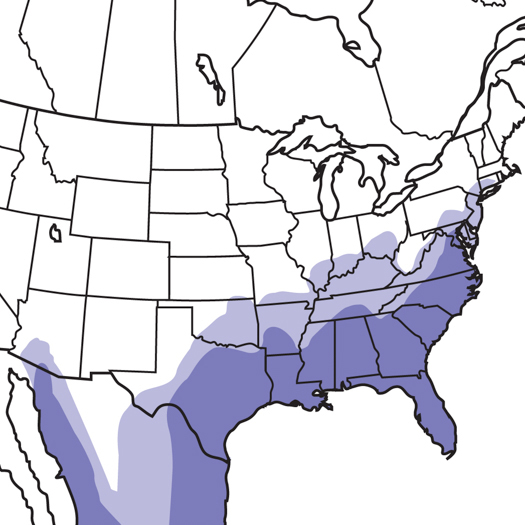
As to why the black vultures have taken up this avian manifest destiny to spread into New York, we are left only to speculate. Climate change may be a driving factor, turning New York’s colder climate into something milder and more habitable for black vultures. However, the black vulture’s range has shifted northward only along the eastern seaboard from Virginia, and along the Hudson River north to the St. Lawrence, with little change in the Midwest.
Other possible causes include an increase in deer and other mammal populations, and vehicle traffic, leading to increased food availability from roadkill, and greater tolerance of the species and increased protection under the federal Migratory Bird Treaty Act.
The range of the black vulture in North America is extending northward. The darker purple regions is where the birds are common, while the lighter regions are where the vultures are spreading, but less commonly found. (Photo credit – Audubon Society)
Despite being called “vultures”, black vultures and other new world species bear little similarity to old world species. Their common characteristics are a result of convergent evolution, or traits selected for a similar lifestyle. Both share bald featherless heads, perfect for rooting around in carcasses without ruffling any feathers. Both share similar circular flight patterns, utilizing the energy saving tactic of coasting on thermals. And both share the same highly corrosive digestive system; the PH of a black vulture’s stomach acid rests just above 0, akin to car battery acid and nearly 100 times as concentrated as human stomach acid.
Black vultures are instead more closely related to storks with whom they share an interesting, yet effective means of thermoregulation[1]. If a warming climate is the culprit behind the black vulture’s expansion, they will, without a doubt, continue to thrive in warmer climates thanks to urohidrosis; or the habit in some birds of defecating onto the scaly portion of the legs as a cooling method, using evaporative cooling of the fluids.
[1] Thermoregulation is the ability of an organism to keep its body temperature within certain boundaries, even when the surrounding temperatures is very different
Additionally, keeping in mind that a black vulture’s stomach acid is highly acidic, they produce a sterile excrement which cleanses their feet of bacteria and parasites, which may accumulate due to their scavenger lifestyle. Two birds with one stone, if you will
Black vultures will also simultaneously thermoregulate and sanitize through the process of sunbathing. Often observed with wings out and backs to the sun, these birds are warming their bodies while utilizing the UV radiation from sunlight to kill bacteria and parasites on their feathers.
As adults, black vultures experience few predators. Their main threat comes in the form of nest predation either by raccoons or foxes. Despite their relative safety, vultures still maintain a gruesome defense mechanism against predation; defensive vomiting. Utilizing their stomach acid once more, black vultures are able to produce a foul smelling and corrosive vomit that acts as a deterrent and mace for predators.
In addition to clever adaptations, black vultures themselves are undoubtedly intelligent birds, this trait being readily observable in Gonzo and other captive black vultures. Gonzo observed and interacted with the world around him with great curiosity. Behind his soulful brown eyes, there was a spectacular presence, a timid and gentle personality with an almost irrefutable perception and understanding.
The social intelligence hypothesis posits that human “intelligence” has evolved in order to adapt to complex interpersonal relations and is generally accepted in the current theory of evolution. It is believed that as the size of the group increases, it becomes necessary to adapt to more complex social relationships within the group, driving the selective pressures for increased neocortex size. Black vultures are not exempt from this theory, belonging to flocks largely composed of family units and roosting in large masses in the evening.
At Trailside, where the black vultures seemed to have designated the bear exhibit as their daytime roost, their community engagements can be observed through mutual preening, playful chasing, food sharing, and the occasional scuffle. But perhaps the best example of their sociality was seen with Gonzo.
Confined to his exhibit, Gonzo began receiving vulture visitors, and over the years they grew in number to the point which on any given day a sizeable flock of wild black vultures could be seen mingling with Gonzo. Perhaps they were assessing the mystery as to why this member of their species was captive, putting their bald little heads together in a sort of vulture think-tank, or perhaps, lacking his own flock, the wild vultures assimilated him into their own.
Keepers at Trailside have observed on numerous occasions, the passing of food between cage bars to the flock; perhaps, an altruistic sharing of of a captive bird’s bounty. Food sharing in wild vultures is typically only observed within members of the same family. Perhaps Gonzo viewed this flock as a sort of family. Between shared mice and fish, did the vultures swap tales of harsh winters, open skies, and a northbound journey? Voiceless secrets told hushed through throats lacking a syrinx[2]
[2] The syrinx is the lower larynx or voice organ in birds, situated at or near the junction of the trachea and bronchi and well developed in songbirds
Because Black vultures lack the organ responsible for birdsong in many species, their vocal repertoire consists mainly of huffs, grunts, and hisses. Click here to hear a recording of a black vulture from the The Cornell Lab of Ornithology Macaulay Library.
On the black vulture’s sociability, Charles Darwin wrote:
“These vultures certainly may be called gregarious, for they seem to have pleasure in society, and are not solely brought together by the attraction of a common prey. On a fine day a flock may often be observed at a great height, each bird wheeling round and round without closing its wings, in the most graceful evolutions. This is clearly performed for the mere pleasure of the exercise, or perhaps is connected with their matrimonial alliances.”
It certainly does appear that black vultures perform many activities through the sheer pleasure the action brings. Play is widely regarded as a hallmark of intelligence in birds, observable in both crows and ravens. It is an activity which helps an individual gain information regarding its environment; and play in many forms can be observed in the vultures of Bear Mountain. In the bear den and along the zoo trail, black vultures can be seen taking turns chasing each other, tossing about hay, playing with sticks and feathers, ripping apart paper bags, tugging on the mesh of exhibits.
Trailside’s resident black bear, Sadie, shares her exhibit with a wild black vulture.
Play is also one of the reasons many Hudson Valley residents are at odds with vultures. In their exploration of this world, it turns out black vultures can be quite destructive. Their favorite pastimes including tearing rubber from windshield wipers, and shingles from roofs.
Several years ago the Bear Mountain Inn experienced nearly $10,000 in roofing damage by black vultures and, as of 2017, black vultures are estimated to have cause nearly $75,000 in damages statewide. Much like teenagers, if you have enough black vultures in one place without enough to do, they’re bound to get up to trouble. As a consequence, many Hudson Valley businesses and residents are now flying in face of the Migratory Bird Treaty Act and federal law, taking up arms against the vultures. Several methods of deterrence include lasers, sprinklers, pyrotechnics, trapping and effigies; but with a population on the rise, conflict with humans is only more likely to increase.
On the other side of the coin, black vultures are a necessary asset to our ecosystem, serving as “nature’s cleanup crew” feeding on the dead and diseased other carnivores wouldn’t dare venture near, their stomach acid allowing them to safely digest putrid carcasses infected with rabies, botulinum toxin, hog cholera bacteria, and anthrax bacteria that would be lethal to other scavengers. Their work halts the further transmission of these diseases between humans and other wildlife, a role which, in the age of a zoonotic pandemic like COVID-19, is paramount.
For all those still at odds with the black vulture, Gonzo served as a shining exemplar of his species positive qualities, and magnificent beauty, connecting the black vulture in the minds of many to a handsome bird, with a quiet, yet inquisitive personality.
Gonzo passed away at Trailside on Tuesday, June 22, 2021 at 29 ½ years old. While longevity records for black vultures are scarce, Gonzo may have well been one of the oldest specimens in captivity. He leaves behind the legacy of being one of New York’s pioneer black vultures, who instilled a passion and understanding for his species in many visitors.
Gonzo is survived by his flock, a family he made all his own, the wild vultures of Trailside. Months later, the occasional solemn vulture could still be seen idling outside what was once his aviary, wearing all black feathers, dressed as if for mourning.
Gonzo gives himself a health sunbath.
Post and photographs by Malerie Muratori, Student Conservation Association intern at Trailside Zoo.
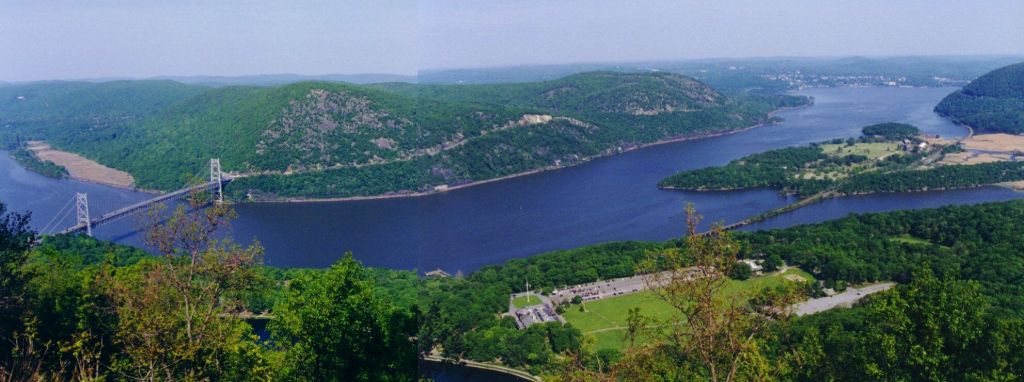
With autumn leaves now turned, hiking in the Palisades region of State Parks offers spectacular views of the Hudson Valley and the Catskills to go with a fascinating history that includes an outlaw’s lair, the state’s early iron industry, and a traitor’s secret meeting place.
Located
on the west side of the Hudson River, this region between the Capital Region
and New York City stretches through Rockland, Orange, Ulster and Sullivan
counties, and contains 23 parks and seven historic
sites.
As
with all hikes, there are few things to remember beyond carrying a mobile
phone. Wear sturdy yet comfortable shoes or boots, bring water and snacks, and
perhaps carry a camera, to capture what you see. Be mindful of hikes on steep
terrain or that go near cliff tops. Having a small first-aid kit available in case
of emergency is never a bad idea
Hiking
poles are useful, and can transfer some of the stress of hiking from your knees
and legs to your arms and back. And use a trail map, which is available online
at each park website at https://parks.ny.gov/ and at the
main office at each park. Check the park’s individual website to see if its
maps can be downloaded to your iOS Apple or Android device, but a paper map is
a good backup in the event of device failure.
These
maps include Park facilities such as parking, park offices, nature centers,
campsites, and boat launches in addition to the location, name and distance of
each designated trail in the park. For some facilities, data is available as a
Google Earth KML file or a map is available to download to your iOS Apple and
Android mobile devices in the free PDF-Maps app. Learn more…
For the Palisades region, more information on hikes is also available online from the New York-New Jersey Trail Conference, and at the bookstore near Exit 17 on the Palisades Interstate Parkway.
It’s smart to know how long a trail is and how long it ought to take to finish. Since daylight is not an unlimited resource, especially in fall as days grow shorter, tossing a flashlight or headlamp into your backpack is a good form of insurance, should you unexpectedly find yourself on the trail as dusk approaches.
And,
as the incidents of tick-borne diseases surge in the state, it is always
important to check yourself for ticks after being outside, even if it is only
time spent in your own backyard.
Rockland County
Rockland Lake State Park, 299 Rockland Lake Road, Valley Cottage, (845) 268-3020: The Nyack River Trail runs along the western short of the Hudson River between Haverstraw Beach State Park and Nyack Beach State Park. About five miles long, the level trail offers excellent river views. It is lined with crushed stone, and so is easy on the knees for a run, and also makes for an excellent bike ride or walk with a dog (must be leashed per NYS Parks rules). This trail also passes a county historical marker for the infamous “Treason Site,” where during the American Revolution in 1780 American General Benedict Arnold meet secretly with British spy Major John Andre to hand over plans for the capture of the strategic Patriot fortress at West Point. Thankfully, the plot was thwarted, with Arnold becoming one of the fledgling nation’s most despised figures.
A historical marker for the Treason Site erected by the Rockland County Historical Society (Photo from Wikipedia Commons.)
Harriman State Park,
Seven Lakes Drive/Bear Mountain Circle, Ramapo, (845) 947-2444: At more than
47,500 acres, the second-largest State Park has more than 200 miles of hiking
trails. At its northeastern edge, it borders Bear Mountain State Park as well as the
U.S. Military Academy’s forest reserve. To the southwest lies the 18,000-acre
Sterling Forest State Park. This vast park includes a large rocky shelter that
was the remote hideout for a bandit named Claudius Smith, who led a gang
of pro-British marauders during the American Revolution, known at the time by
terrified local residents as “Cowboys.” To find it, go to the parking lot at
the end of Old Johnstown Road, and look for the Blue Trail. Follow this steep
trail to the top of Dater Mountain for its views, and then continue until you
reach the rocky den, which had enough room to shelter both the gang and their
horses. After taking in the panoramic views, which allowed the gang to see
anyone coming, head down on the Tuxedo-Mount Ivy Trail to return to the parking
lot. The hike is a five-mile trip, with one very steep section.
A vintage photograph of hikers exploring Claudius Smith’s Den.
Ulster County
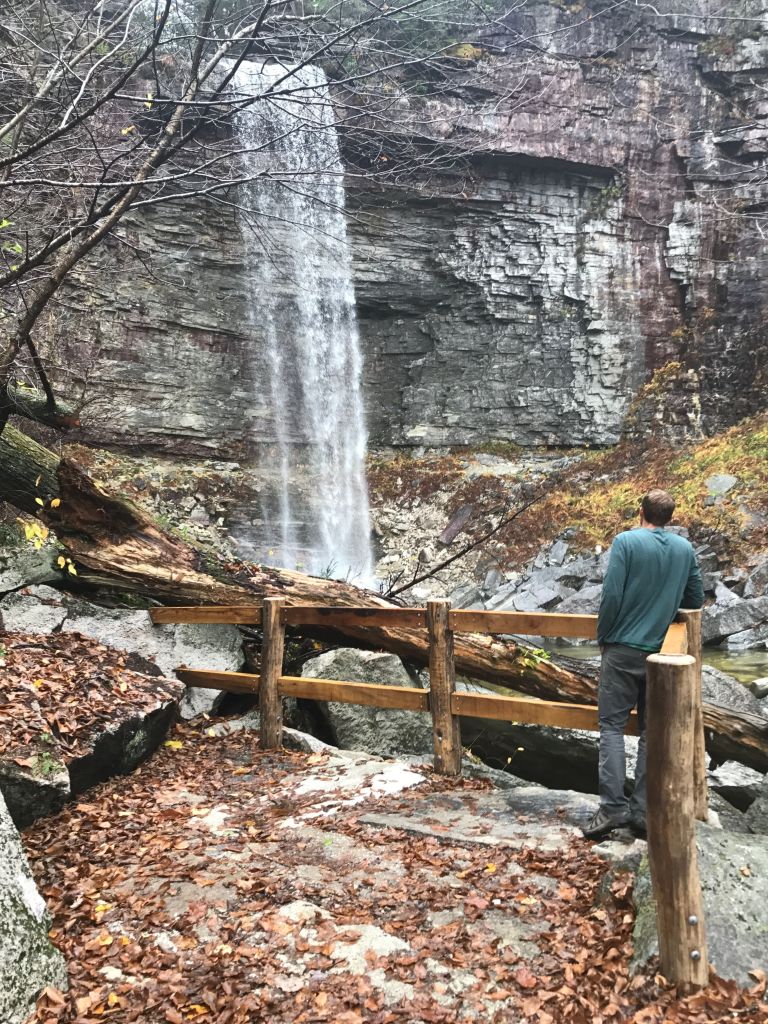
Minnewaska State Park Preserve, 5281 Route 44-55, Kerhonkson, (845) 255-0752: Take in Catskills from atop the Stony Kills Falls at the northwestern edge of the park on this short, but challenging one-mile hike. Start at the parking area at the end of Shaft 2A Road and follow the gravel trail that crosses two wooden bridges on its way to the base of the 78-foot waterfall. Follow a set of stone stairs upward, using iron hand holds and railings for safety, to reach the top of the falls and its sweeping northerly views. You can either backtrack to the parking lot, or connect to the Stony Kill Falls carriage road atop the Shawangunk escarpment to make a longer hike.
Bear Mountain State Park, Palisades Parkway or Route 9W North, Bear Mountain,
(845) 786-2701: Take
in the view of four states and even glimpse the Manhattan skyline from the
Perkins Memorial Tower atop 1,289-foot Bear Mountain. Take the completely
rebuilt Appalachian Trail, which features about 1,000 stone steps along a steep
granite face. It took crews, including members of the New York-New
Jersey Trail Conference, seven years of arduous labor to renovate the 1.5
mile trail up to the top. There is a new wooden bench at one of the lookouts
for those who might find themselves in need of a breather on the way up.
The view from the top.
Also
at Harriman, photographers will enjoy the trail to West Mountain that starts at
the Anthony Wayne
Recreation Area.
Start on the Fawn Trail to the Timp-Torn Trail, which takes you to the mountain
ridge to the West Mountain Shelter. From there, return using Timp-Torn to the
intersection of the Appalachian Trail westbound, which will lead to Beechy
Bottom Road that returns to the main parking area. The moderate hike is about
five miles.
Sterling Forest State Park, 116 Old Forge Road, Tuxedo, (845) 351-5907: For larger groups
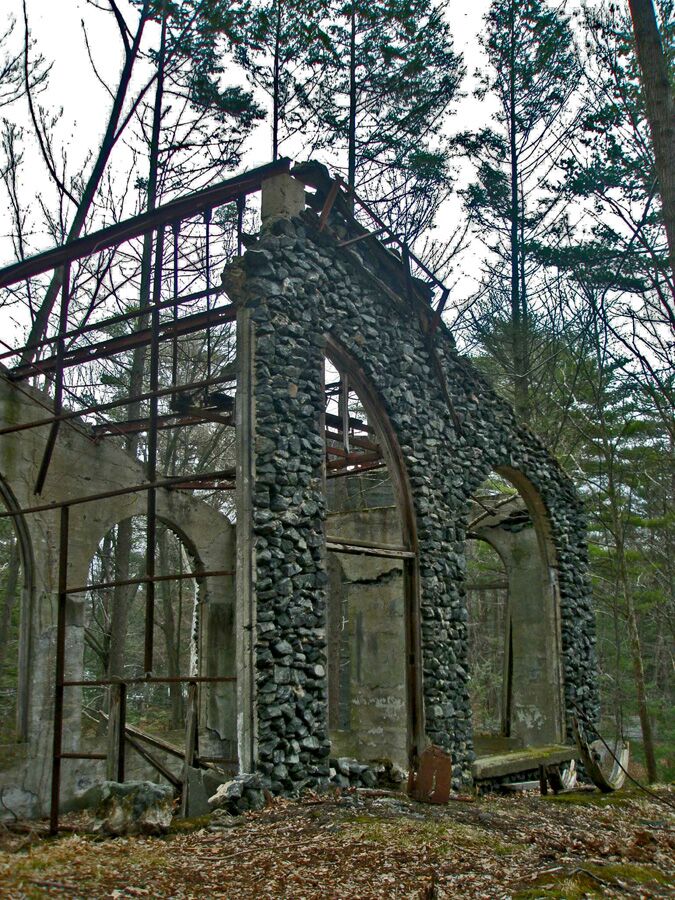
or school trips, there is the Lakeville Ironworks Trail Loop, which takes in
the remains of an iron industry that once dominated the area. At about a mile
long, the easy loop includes views of Sterling Furnace, the Lake Mine, and
other mining remnants. This trail is among more than 30 trails, including the
Appalachian Trail, within a 21,935-acre park in the midst of the nation’s most
densely populated areas.
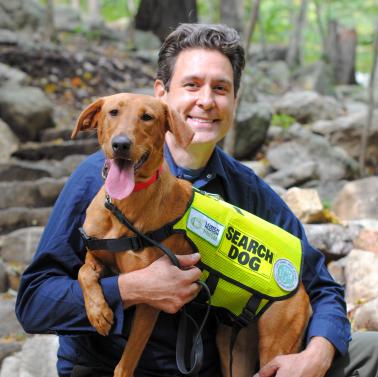
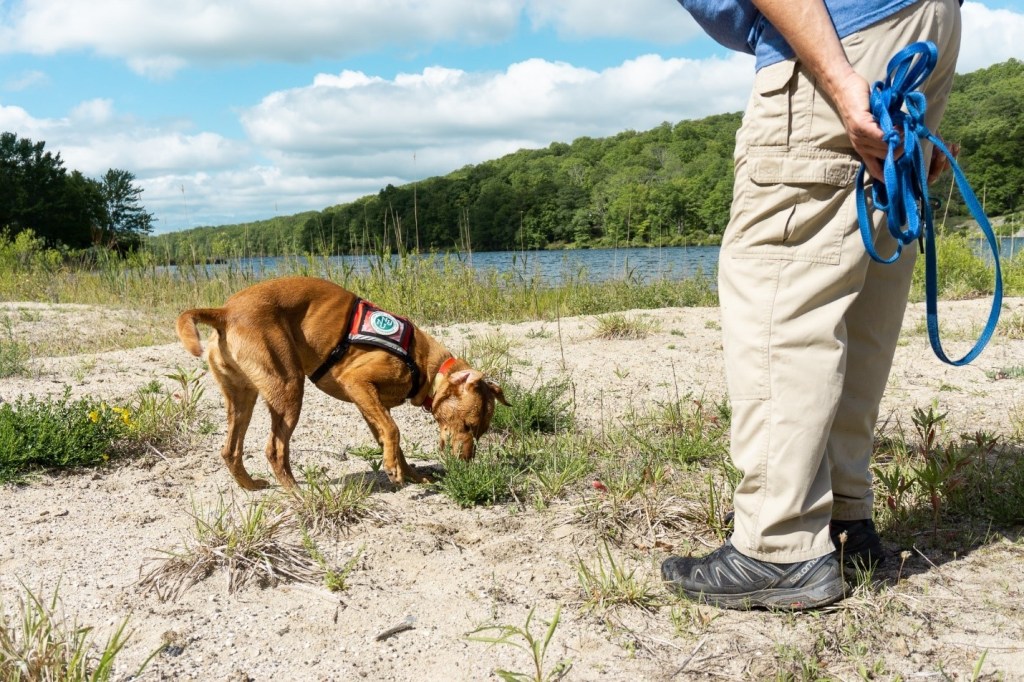
One sniff at a time, an energetic Labrador retriever named Dia is changing the way we combat invasive species in New York State Parks.
Along with her handler Joshua Beese, this invasives-fighting team from the nonprofit New York-New Jersey Trail Conference is on the hunt for Scotch broom, a threat to the native ecosystems in Bear Mountain and Harriman state parks in the Lower Hudson Valley.
Dia uses her powerful sense of smell to help find small and sparsely distributed invasive species that might be missed by human searchers. Since November 2018, her incredible nose has been specially trained to sniff out the invasive plant Scotch broom.
Joshua Beese with Dia. Photo by nynjtc.org
Scotch
broom (Cytisus
scoparius)is one of the most destructive invasives on the Pacific
Coast, where it has had costly implications for agricultural industries. When
it began showing up in New York’s parks, land managers became concerned. Scotch
broom forms dense clusters that can displace native plant species and reduce
biodiversity that is essential for a healthy ecosystem.
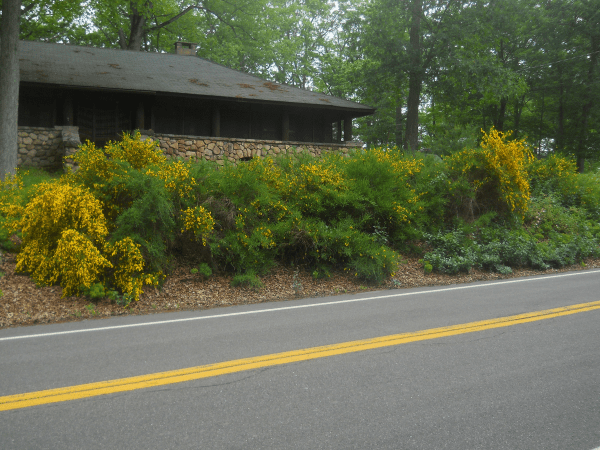
Scotch broom plant in flower on May 2015 at Harriman State Park. Photo by Shelby Timm, nynjtc.org.
The New York
State Parks Invasive Species Strike Team and the Trail Conference’s
Invasives Strike Force (ISF) Crew of AmeriCorps members, volunteers, and
interns have collaborated over the past several years in a bid to eradicate
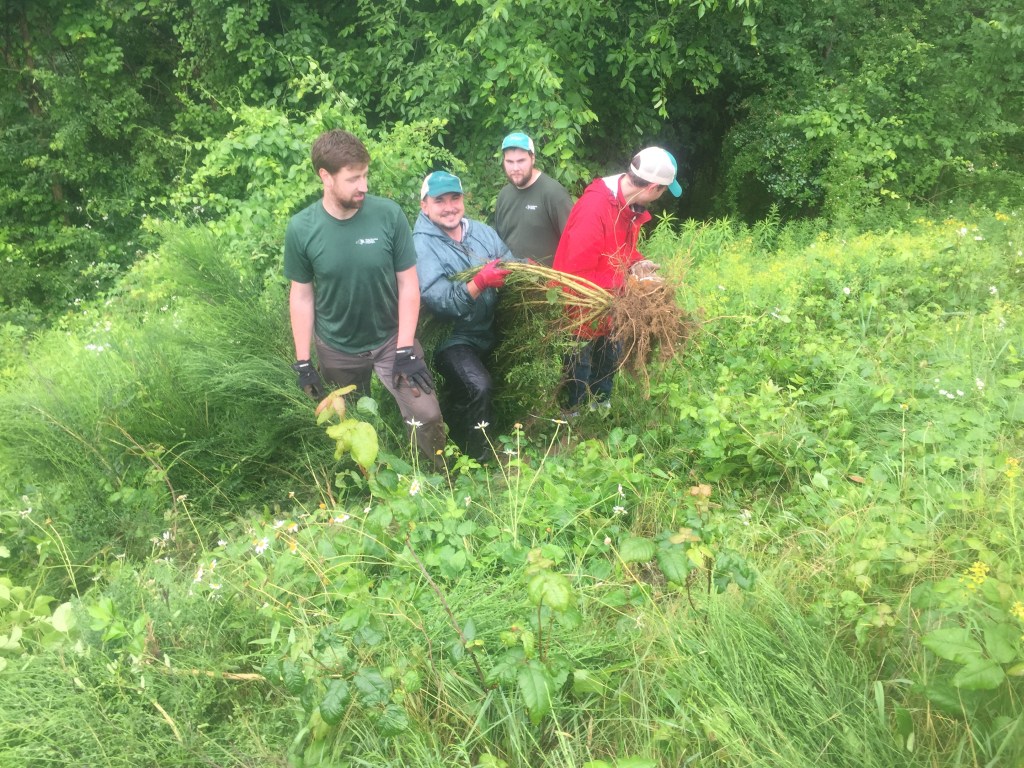
Scotch broom in the region. The ISF Crew has been finding and removing Scotch
broom in state parks since 2014, when 37 separate populations were recorded at
Bear Mountain and Harriman.
A Scotch broom infestation at Harriman State Park in 2014. Photo by Jennifer Breen, nynjtc.orgAfter the Scotch broom removal . Photo by Jennifer Breen, nynjtc.org
While a few locations no longer have any plants, other locations are harder to manage. It becomes challenging to find the few remaining individuals among all the other vegetation, which means this destructive plant could still propagate. That’s where Dia comes in!
“Dia first comes
into the field with her nose up, smelling what’s in the air, working to detect
the Scotch broom scent,” explains handler Beese. “She’s using what are called
scent cones; she works her way into a cone and uses that cone to help her
narrow down the source.”
Once in a cone,
she will search until she gets to the source and put her nose to the ground to
sniff out smaller plants that may be tiny and low to the ground. She alerts
Beese that she’s found the species by standing or sitting. “The most important
thing is that she’s committed to an area where she’s detected the plant until I
come and reward her,” Beese says. “Then we can mark it and remove it.”
Dia’s reward: Her ball on a rope with a game
of tug and fetch. See Dia in action by following her on Instagram @diasavestheforest.
Dia on the hunt for invasives. Photo by Arden Blumenthal, nynjtc.org
Utilizing their
exceptional sense of smell, dogs have been commonly used for search and rescue,
as well as weapons and narcotics detection. These tracking and detection skills
are now being used to protect our wild spaces. In 2010, the journal Invasive
Plant Science and Management published a study that concluded trained dogs
could smell and detect twice the number of invasive plants that humans could
observe with their eyes.
Although other
groups have used dogs for short projects to detect of invasive species, the
Trail Conference’s Conservation Dog Program is the first permanent program of
its kind in the Northeast.
This is Dia’s
first season in the field; she has already been on more than 20 surveying
trips. In several instances, the Trail Conference’s Invasives Strike Force Crew
had been to a site and completely removed every plant they were able to find—and
then Dia found a few more.
Trail Conference Conservation Corps members removing Scotch broom plants in 2016. The flags indicate where plants have been removed. Photo by Matt Simonelli, nynjtc.org
Dia came to the Trail Conference from a farm in
Wisconsin that breeds dogs for hunting competitions. She was selected for the
program by Beese, an experienced search and rescue dog handler, who is assisted
by volunteer Arden Blumenthal. He has trained Dia with the mentorship of Aimee
Hurt from Working Dogs for Conservation in Montana, an organization that has been working with dogs on
conservation projects for more than 20 years.
In a metropolitan region highly prone to
invasive infestations, early detection when populations are small is a key
component of successful invasive species management. Not only does Dia make
search-and-destroy efforts more thorough within infestations, she is also able
to find stray plants outside the known boundaries where people had focused
their searches. Dia helps make sure the area is really cleared to reduce the
potential for reinfestation or further spread. With better search efficiency,
it should be possible to declare New York State parks Scotch broom-free in the
near future.
Crew from New York State Parks Invasive Species Strike Team removing a Scotch broom plant. Phot by Linda Rohleder, nynjtc.org
Up next for Dia is slender false
brome (Brachypodium sylvaticum), an
invasive grass that can outcompete existing vegetation, including threatened
and endangered species, and harm wildlife populations by altering food sources.
Slender false brome has recently been found in Letchworth State Park, and this location will serve as a
training ground for Dia.
***UPDATE: Dia and her team recently went to Letchworth State Park, where they did find the invasive slender false brome in areas where surveyors had missed it.
Conservation dogs can learn to detect up to
three new species each year, meaning Dia’s incredible talents will continue to
develop. “In three or four years,” Beese says, “we’ll be pushing forward the
science on what can be done with invasive species detection using dogs.”
New York-New Jersey Trail Conference Conservation Dog team, from left, Arden Blumenthal, Dia, and Joshua Beese. Photo by Heather Darley, nynjtc.org
Post by Linda Rohleder, Director of Land Stewardship, New York – New Jersey Trail Conference and Coordinator, Lower Hudson Partnership for Regional Invasive Species Management (PRISM)














 New York State Parks and Historic Sites Blog