The nation’s oldest State Fair has come a long way since it started in 1841 as a two-day event in Syracuse _ with highlights that included a plowing contest, which was no doubt of interest to an audience that was very familiar with farm life.
Drawing about 15,000 visitors then, the Fair has grown over the decades and last year, set a record with about 1.3 million visitors at the 13-day event.
This year’s fair will run from Wednesday, Aug. 21, through Sept. 2, and feature more than 80 live concerts spread across five stages, 200 food vendors, 70 rides, and more than 10,000 animals.
A $120 million plan by Gov. Andrew Cuomo to revitalize the fairgrounds wrapped up last year, when the 136,000-square-foot Expo Center, the largest indoor events space north of New York City between Boston and Cleveland, was unveiled.
Earlier work at the fairgrounds included a full-service RV park for 313 campers, a larger, relocated Midway area, a new Main Gate entrance, a new exhibit area for the New York State Police, and the Sky Ride, a 1,400-foot long chairlift ride. The Indian Village, a part of the Fair since 1928, also received renovations to its Turtle Mound, the home of cultural performances..
Last year’s turnout ranked New York as the fourth-largest state fair in the nation, behind Texas (2 million), Minnesota (2 million) and New England (1.5 million).
Present-day attendance is about double what the Fair was drawing during the 1950s and 1960s, as New York and the rest of the U.S. basked in a post-war economic boom tinged by a bit of Cold War angst.
So take a little trip in the time machine, and see the State Fair as it was then, contrasted with as it is today. All photographs courtesy of the New York State Fair. Click to the first picture to start the slideshow…
And will you be seen at the Fair this year?
Former Governor Nelson Rockefeller samples a New York State apple.
Newspaper account of attendance figures during the 1950s.
Gov. Andrew Cuomo greets a young visitor to the State Fair.
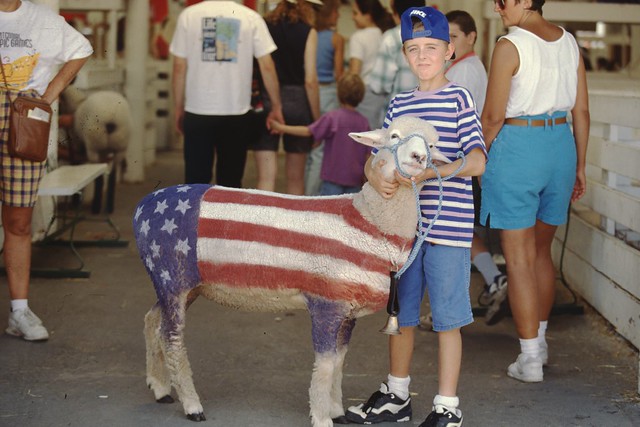
How patriotic are “ewe?”
In this undated photo, “Miss Electra,” who was there to promote modern electical appliances, greets some local beauty contestants.
A chainsaw artist wields the power.
Former Gov. Mario Cuomo at a fair event in the early 90s to promote an early electric car company.
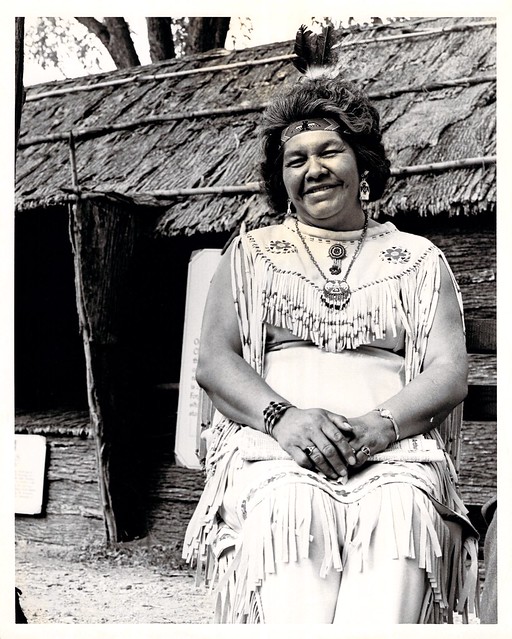
Native Americans became part of the fair starting in 1928 when the Indian Village was added.
Angeline Nuller at the Indian Village at the State Fair.
Armed forces members at the fair.
Fair crowds inspect an early model of a military helicopter that anyone who has watched the Korean War TV series M*A*S*H will recognize.
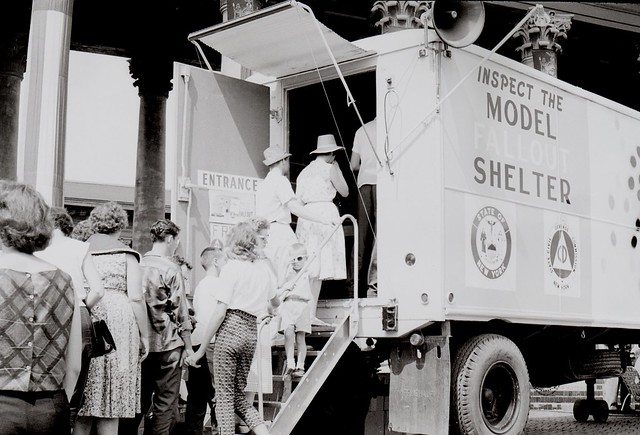
Amid Cold War fears, a model fall-out shelter to protect from an atomic blast is on display.
The merry-go-round is a popular attraction whatever the year.
Trying a hand at making the hay bale fly.
Frank Sinatra Jr. performs at the Fair.
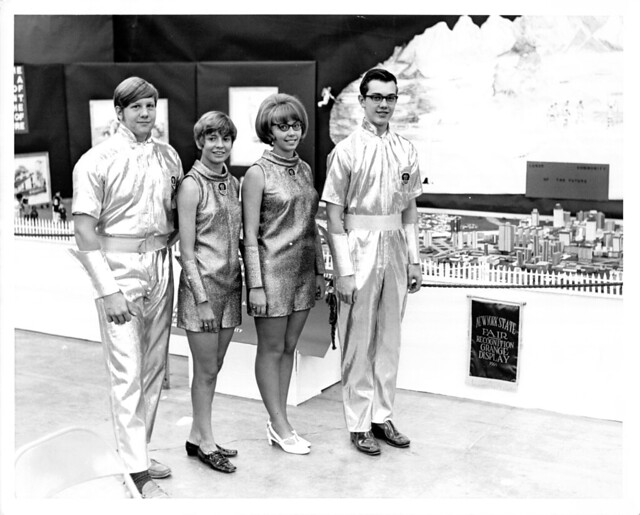
Anyone ready for some Space Age “chic” circa 1960s?
The demolition derby tests the durability of man and machine.
A dog shows its moves in retrieval from the water.
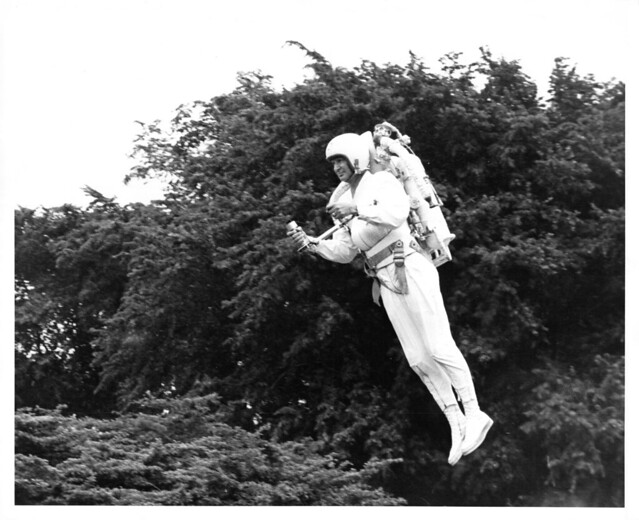
A jet pack on display at the Fair.
A display of 1950s U.S. armored fighting vehicles draws curious crowds.
Up close and personal with a Monarch butterfly.
One of many performers who has entertained over the years.
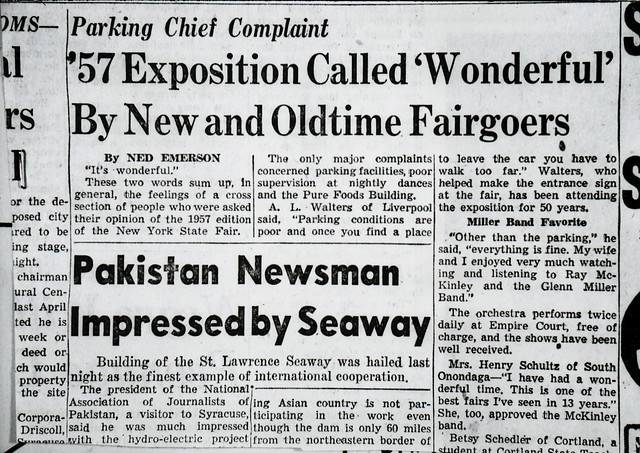
The 1957 Fair gets positive newspaper reviews.
A word of warnng on the “perils of the midway” from one newspaper reporter.
The new Exposition Center at the Fair.
Think milking a cow is easy? Some visitors give it a try…
A citizenship swearing-in ceremony for new citizens held at the Fair.
A member of The Greatest Generation shows the colors.
Bringing home the blue ribbon at the State Fair!
Posted by Brian Nearing, deputy public information officer
With more than 2,000 miles of marked trails across New York, the State Parks have something for hikers of every ability. That includes the beautiful Taconic Region, located on the east side of the Hudson River and stretching through Columbia, Dutchess, Putnam and Westchester counties.
Palatial estates, highland trails, Hudson River vistas and woodland campgrounds define some of the exceptional treasures to be found in a region with 14 parks and eight historic sites.
If you are new to hiking or have not yet explored hikes in this region, named for the Taconic Mountain range that runs north-to-south along the state border with Connecticut, Massachusetts and Vermont, here are some suggestions to start you out.
As with all hikes, there are few things to remember beyond carrying a mobile phone. Wear sturdy yet comfortable shoes or boots, bring water and snacks, and perhaps carry a camera, to capture what you see. Be mindful of hikes on steep terrain or that go near cliff tops. Having a small first-aid kit available in case of emergency is never a bad idea.
Hiking poles are useful, and can transfer some of the stress of hiking from your knees and legs to your arms and back. And use a trail map, which is available online at each park website at https://parks.ny.gov/ and at the main office at each park. Check the park’s individual website to see if its maps can be downloaded to your iOS Apple or Android device.
These maps include Park facilities such as parking, park offices, nature centers, campsites, and boat launches in addition to the location, name and distance of each designated trail in the park. For some facilities, data is available as a Google Earth KML file or a map is available to download to your iOS Apple and Android mobile devices in the free PDF-Maps app. Learn more…
It never hurts to know how long a trail is and how long it ought to take to finish it. Since daylight is not an unlimited resource, tossing a flashlight or headlamp into your backpack is a good form of insurance, should you unexpectedly find yourself on the trail as dusk approaches.
Westchester County
Rockefeller State Park Preserve, 125 Phelps Way, Pleasantville, (914) 631-1470: With 55 miles of crushed stone carriage roads that crisscross the former country estates of petroleum tycoons John D. Rockefeller and William Rockefeller, the preserve offers a wide variety of hikes for any ability, with the carriage trails offering a consistent, predictable surface. After parking at the preserve office, follow the markers for Brother’s Path, a 1.1-mile loop around scenic Swan Lake. Heading south on the Brother’s Path, there a connection on the right to the .9-mile Overlook Path, a gentle climb and a good place to spot Eastern Bluebirds and get a beautiful view of Swan Lake. The preserve is home to more than 180 different species of birds and 120 different species of native bees.
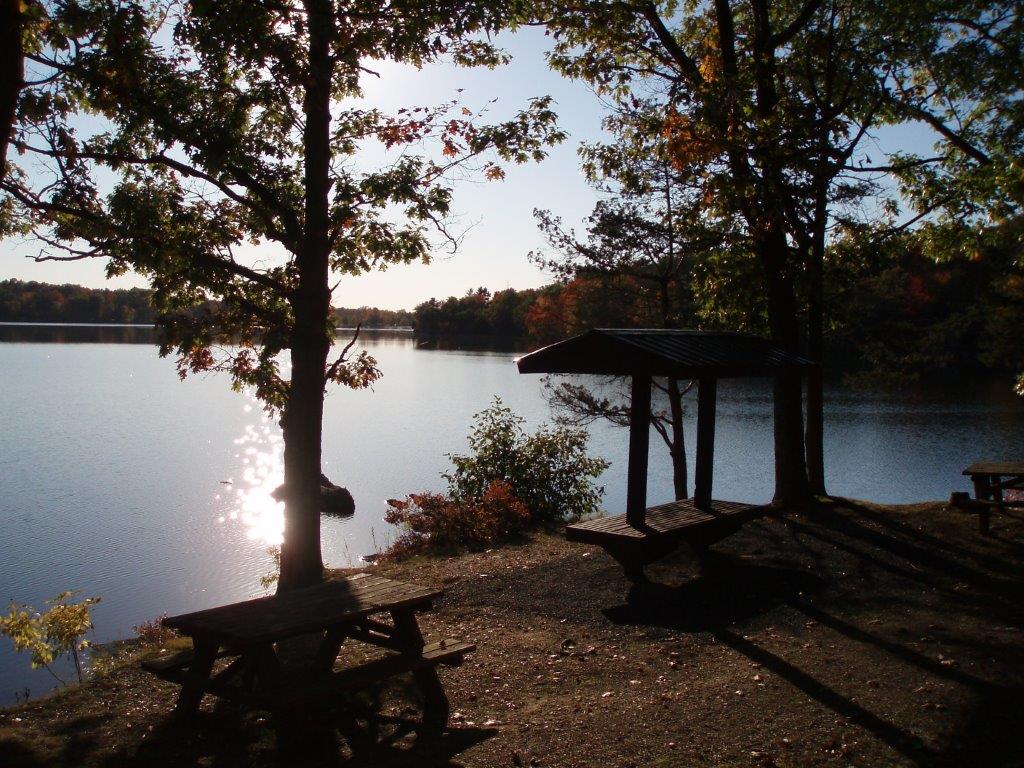
Franklin D. Roosevelt State Park, 2957 Crompond Road, Yorktown Heights, (914) 245-4434 : This is a short hike in the woods on level terrain leaving to a small pond. From the parking lot for the swimming pool, take the white-marked trail, turning onto the blue-marked, 1.2-mile trail for Crom Pond. At the end, turn around, or continue on the orange-marked, .7-mile Mohansic Trailway through more woods before turning around.
Franklin D. Roosevelt State Park in Yorktown Heights.
Putnam County
Fahnestock State Park, 1498 Route 301, Carmel, (845) 225-7207: Hike, sunbathe and swim all at one location. Start at the Canopus Beach Parking Lot, where you can pick up the blue blazed AT Connector Trail from the north corner of Canopus Beach. A short 0.3-mile hike passing along the edge of Canopus lake will lead you to the famous Appalachian Trail. Turn right and take the white blazed AT trail northbound. A steep section of trail will lead you to a beautiful viewpoint over Upper and Lower Canopus lakes. Continue north and after one mile on the AT turn right and head south onto another blue blazed AT connector trail. A rolling 0.75-mile hike will lead you back to the Canopus Beach Parking Lot and all the other activities.
The view from the South Taconic Trail, looking toward Mount Brace, at Taconic State Park in Millerton/Copake Falls.
Mills Norrie State Park, 9 Old Post Road, Staatsburg, (845) 889-4646: This park has a very scenic hike along the Hudson River. Turn onto Norrie Point Way and follow signs for the Marina, where you find signs for the White Trail. If you brought a kayak or canoe, you can put it into the river there. The White Trail is approximately two miles long and and leads to Staatsburgh State Historic Site, the elegant 65-room country mansion of Ogden Mills and his wife Ruth Livingston Mills. You can choose to take the White Trail back along the river, or the Blue Trail. Along this wooded trail you can view the historic Hoyt House and Carriage Barns. While at Staatsburgh, catch a view of the 148-year-old Esopus Meadows Lighthouse on the river. If you plan to visit by boat, the Mills Norrie State Park marina has 145 boat slips.
Kayaking on the Hudson River in Mills Norrie State Park.
Columbia County
Lake Taghkanic State Park, 1528 Route 82, Ancram, (518) 851-3631: Start at the parking lot at the swimming beach, and pick up the white-marked Lakeview Trail, which goes about 5 miles around the lake but is not a loop. It can be hiked as an out-and-back by going either north or south on the trail, which is mostly level and good for all abilities.
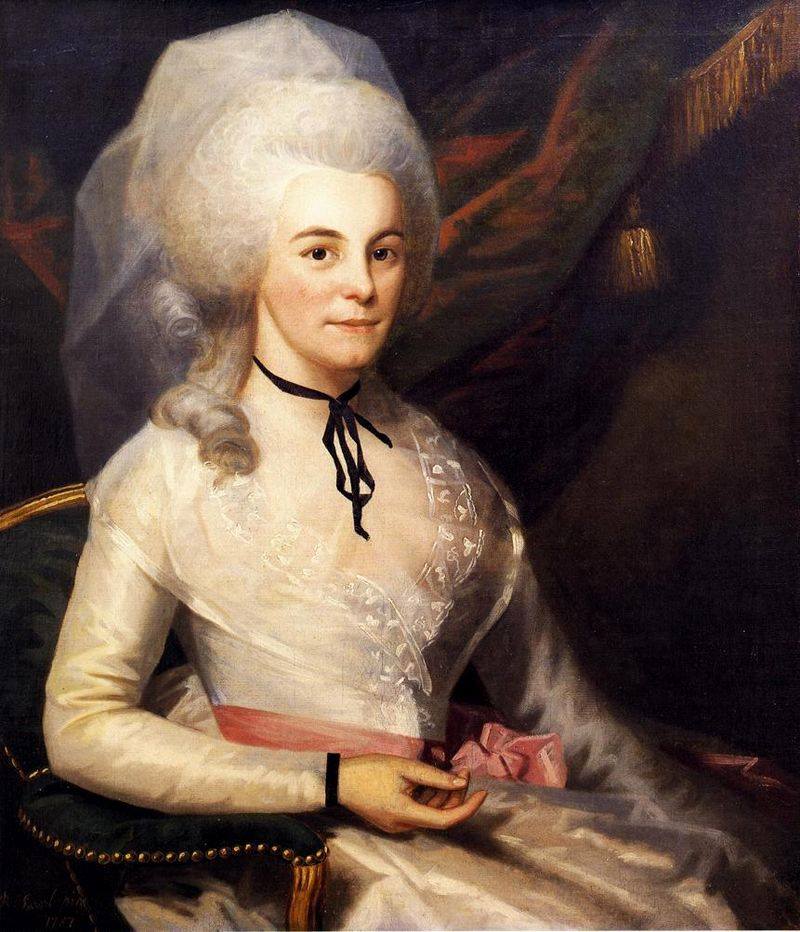
When Alexander Hamilton was married at Schuyler family mansion in Albany, the residence was a pinnacle of style in Colonial America.
Home to one of the region’s richest families, the Georgian-styled mansion was decorated with luxurious wallpaper, rich fabrics, and even an ornamental papier maché ceiling that had been custom made and imported from England around 1760.
This ornate ceiling graced the mansion’s Best Parlor, where Hamilton married Elizabeth Schuyler in December 1780, as the Revolutionary War raged into its fifth year.
Alexander Hamilton and his wife, Elizabeth Schuyler. The couple have new-found popularity from the successful Broadway musical play Hamilton. Source: Friends of Schuyler Mansion
To get his decorative ceiling, Philip Schuyler had simply selected designs from a catalog, provided room dimensions with his order and a complete ceiling was shipped ready to install. Schuyler could have chosen from birds, flowers, shells, moldings, festoons, musical instruments — images that represented his interests and image.
This was not made with the papier maché that people might recall making in school — no newspaper and white glue. This was cotton rag pulp and papier maché that was mixed with water into a oatmeal-like slurry, and then pressed into a variety of hand-carved wooden molds to dry and set.
The resulting super-light and slightly flexible ornaments were inexpensive to ship and easy to install. After a little glue and few tacks to set the ornaments in place, a ceiling was ready for painting. Once done, it gave a stylish look similar to more expensive plaster ornamentation.
During the years, the parlor ceiling at Schuyler Mansion State Historic Site was removed and lost for reasons unknown. But Historic Site Manager Heidi Hill wanted it back after part of efforts to restore mansion for its 100th anniversary as a State Historic Site.
The challenge to the Peebles Island-based Bureau of Historic Site and Park Services, part of the NY State Parks Division for Historic Preservation, was how to recreate something that has not been commercially produced in 150 years.
Making new hand-carved molds was out of the question; it would take too much time and cost too much money.
However, the team at State Parks had an amazing resource — an existing, rare and wonderful example of a mid-18th century papier maché ceiling at the Philipse Manor Hall State Historic Site in Yonkers, Westchester County. This mansion has the only complete surviving example of this type of ceiling in the United States.
However, this ceiling was too significant and too fragile to risk being damaged by the pressure and stress of taking contact from a traditional mold. This is where laser-based, 3D imaging technology came to the rescue.
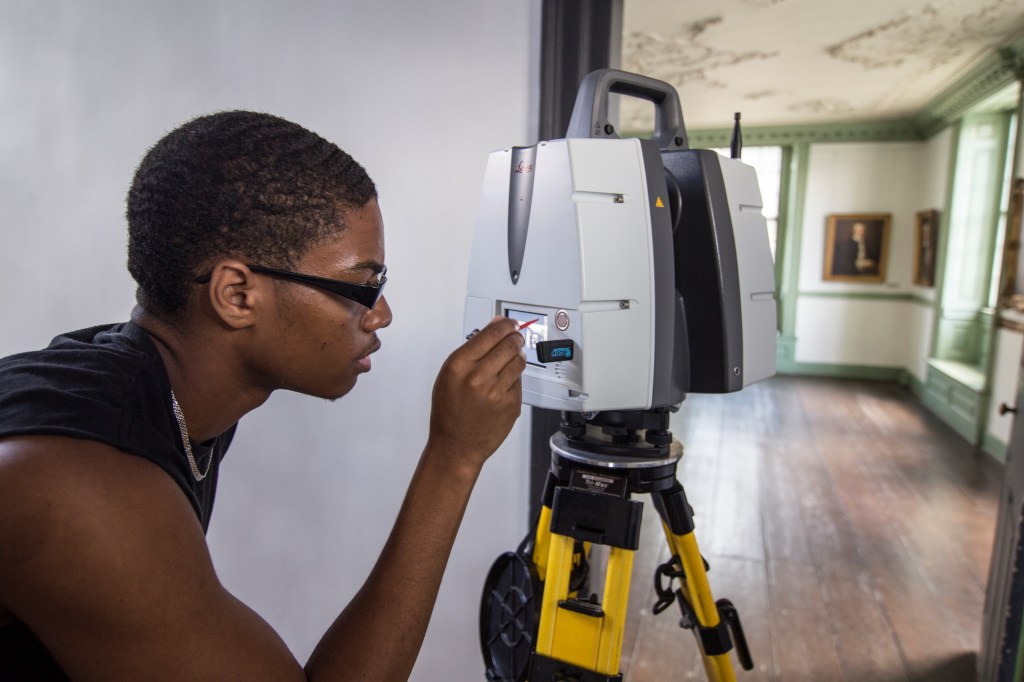
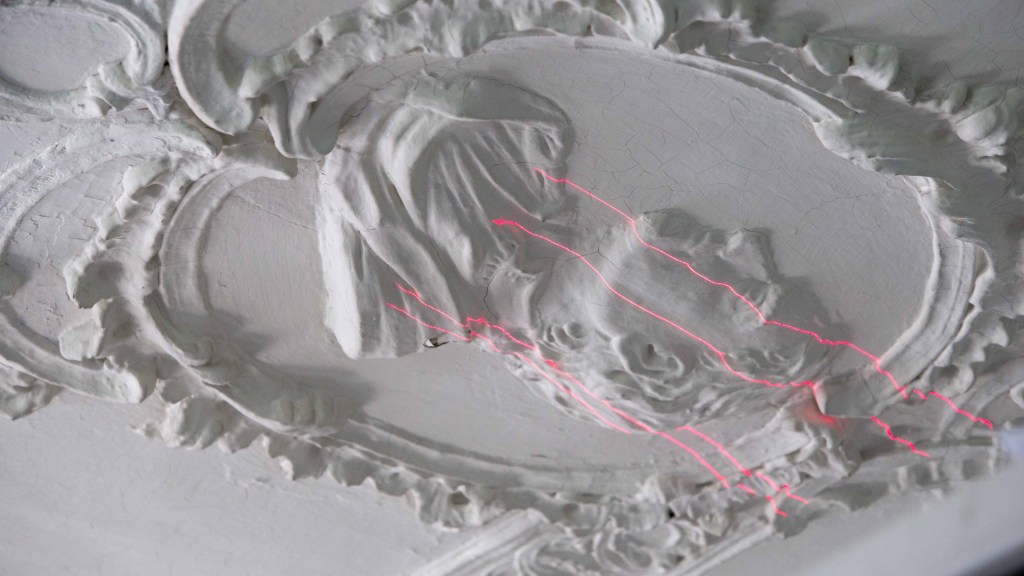
In a pioneering project, State Parks partnered with Ithaca College’s Physics and Astronomy Department and the Friends of Schuyler Mansion to have the Philipse Manor Hall ceiling 3D scanned by portable laser units that fire pulses of light up to one million times a second. Light is then reflected back to a receiver, which measures how long the light took to return, using the data to create high-resolution scans that captured details down to 100 microns or 4/1,000th of an inch.
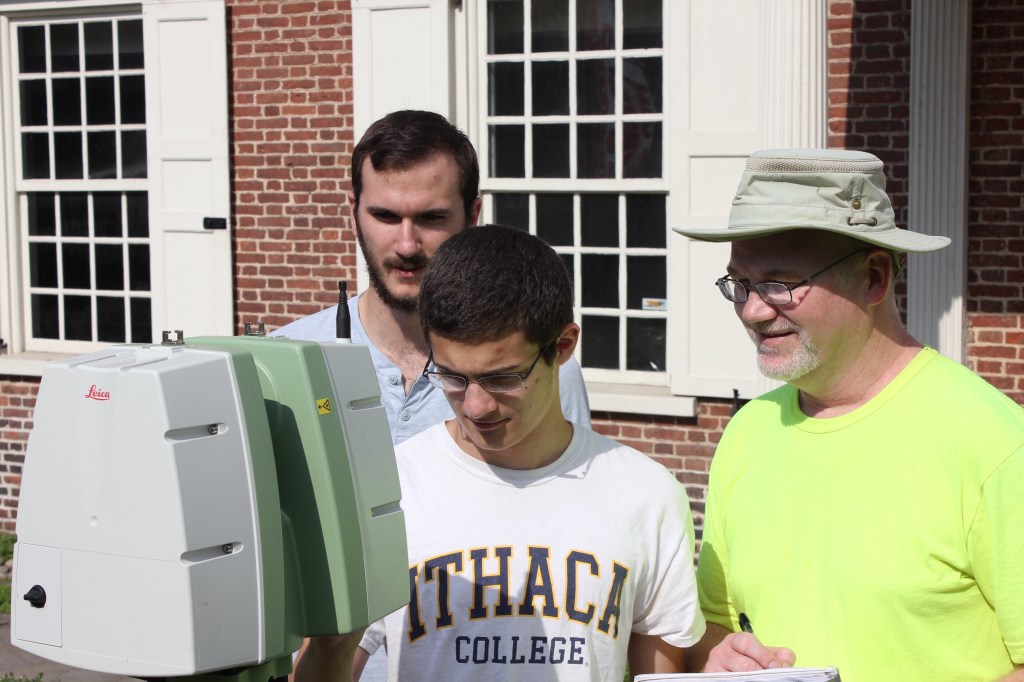
Headed by Professor Michael “Bodhi’ Rogers, the Ithaca College team 3D scanned nearly the entire interior and exterior of the historic Philipse Manor Hall, said Charles Casimiro, an historic site assistant there.
Professor Michael “Bodhi” Rogers, right, with Ithaca College students Evan van de Wall and Ryan Fedora, using laser scanner at Philipse Manor Hall. Courtesy of Michael “Bodhi” Rogers.
“This effort for Schuyler Mansion was a very exciting project to work on … we were using this technology to do something that had never been done before,” said Rogers, who recently became the new chairman of the Physics Department at the University of Colorado at Denver.
It took three visits to Philipse Manor Hall between 2015 and 2017 to get all the scans, he said. With the newest scanner, students could use a hand-held device, wave it around the room and watch the image on the computer as it filled in, “kind of like painting with your hand,” said Rogers.
Ithaca College student Demitri Hector sets up a laser scanner at Philipse Manor Hall. Courtesy of Michael “Bodhi’ Rogers.Lasers scan a ceiling bust of Sir Issac Newton. Courtesy of Michael “Bodhi’ RogersThe scans are rendered into an image on the computer. Courtesy of Michael “Bodhi” Rogers.Ithaca College student Kevin Pomer uses a hand-held scanner on the ceiling at Philipse Manor Hall. Courtesy of Michael “Bodhi” Rogers.
The scanning of Grant’s Cottage, where Civil War General Ulysses S. Grant spent the final six weeks of his life writing his memoirs, is now being used to help protect the 1870s structure from fire, said Ben Kemp, site manager for the Friends of Grant Cottage. He said the data is being used to help design a modern fire detection and suppression system.
Rogers said this kind of scanning technology also will help in the rebuilding of fire-damaged Notre Dame Cathedral in Paris, which was scanned in 2015.
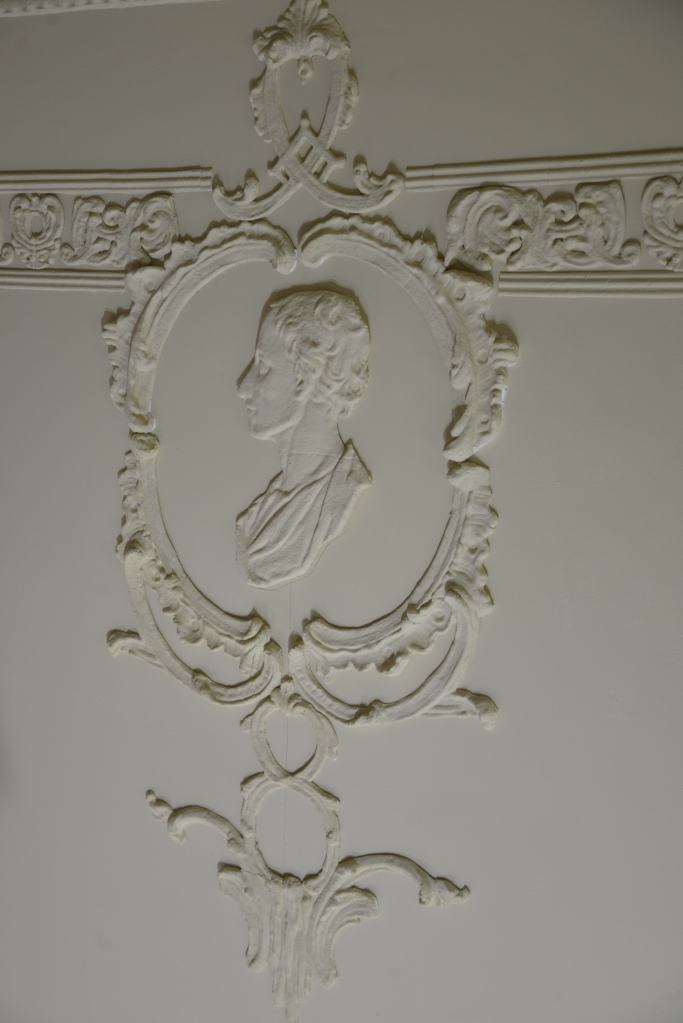
When the laser scans at Philipse Manor Hall were completed, State Parks had computer images that revealed every paint brush stroke, age crack and tiny detail on the manor’s 250-year-old ceiling, which features images of lute players, bagpipers and singers, as well as busts of Sir Isaac Newton and poet Alexander Pope .
A drawing based on the 3D laser scan of the ornate ceiling design at Philipse Manor Hall State Historic Site
To reproduce this ceiling in Schuyler Mansion, the original idea was to use the scans for a 3D printer to create each unique ornament in plastic. The Bureau of Historic Sites would then use traditional molding and casting methods to make new molds, which would then be used to produce the papier maché ornaments.
But Rogers’ team then figured out how to use the 3D imagery to create computer commands for the State Parks printer to instead make the concave molds used to receive the papier maché . A total of 55 unique molds were needed to recreate the Philipse Manor ceiling.
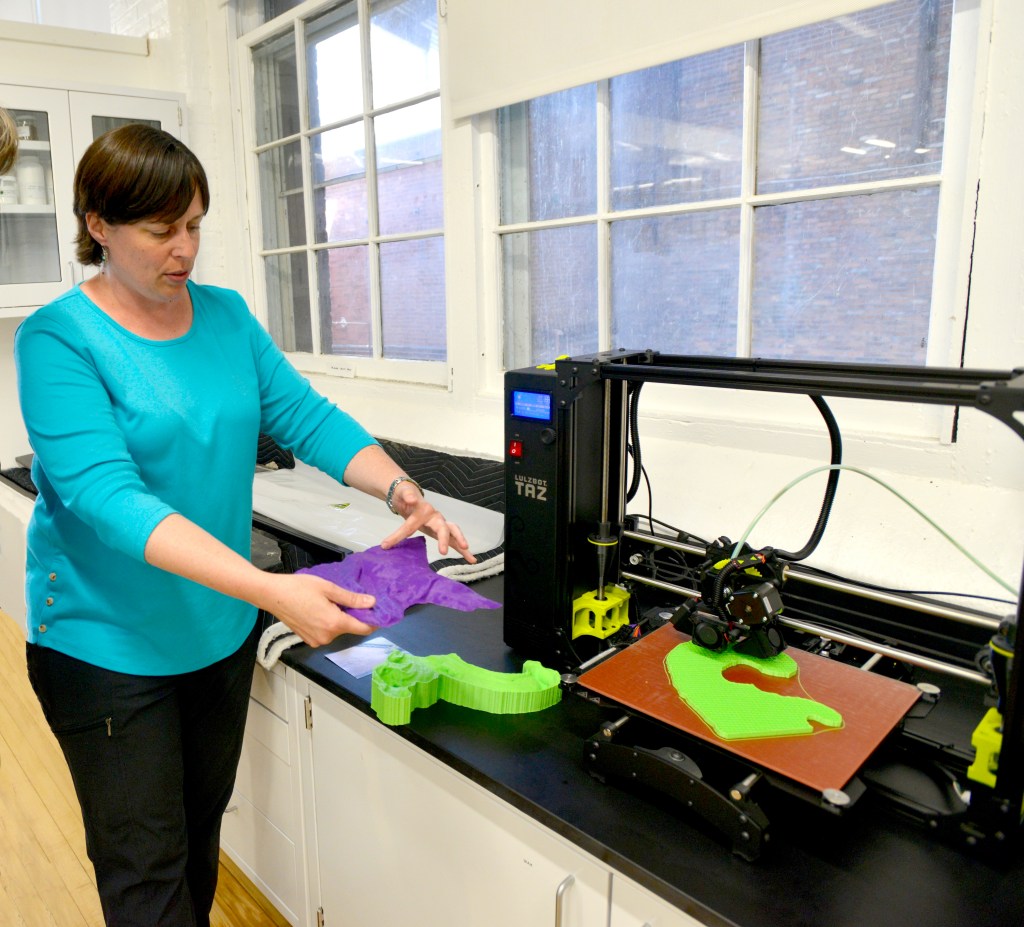
These molds were printed in Peebles Island’s Architectural Conservation lab at the Bureau of Historic Sites & Park Services. A printer works using a spool of bioplastic filament, which is heated into a liquid and then fed through a printer head that created the molds layer by layer.
State Parks Architectural Conservator Erin Moroney making molds on a 3D printer at her Peebles Island offices.
Many molds were too large to fit the printer bed, and so were digitally rendered into smaller pieces and then physically welded together later with a high-temperature 3D pen.
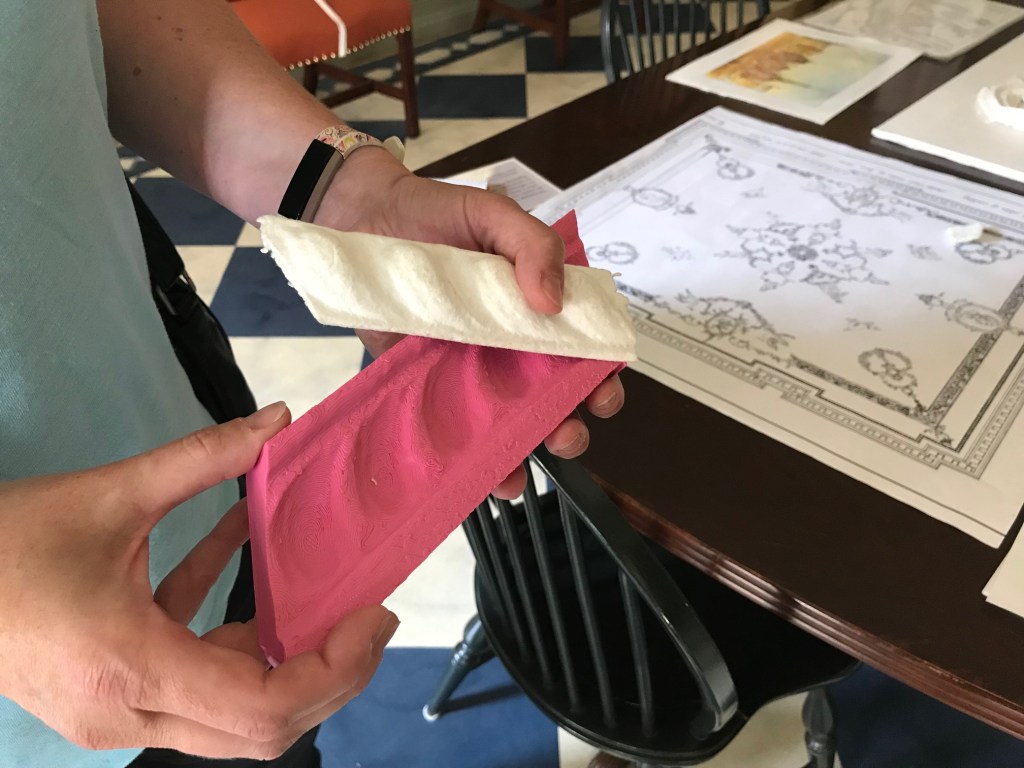
With molds ready, we started making papier maché. Traditional cotton rag papier pulp was pressed into the molds and the water squeezed out with large sponges.
A section of papier maché ornament with its mold.
More than 300 pieces were cast to make the ceiling, using over 500 pounds of paper pulp. The edges of each casting were hand trimmed. Each piece of ornament was then primed and boxed up for installation.
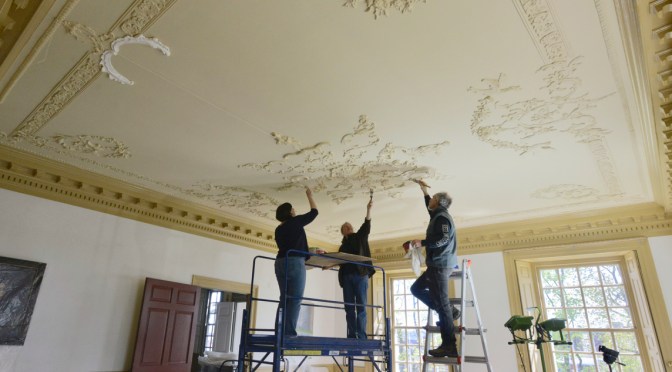
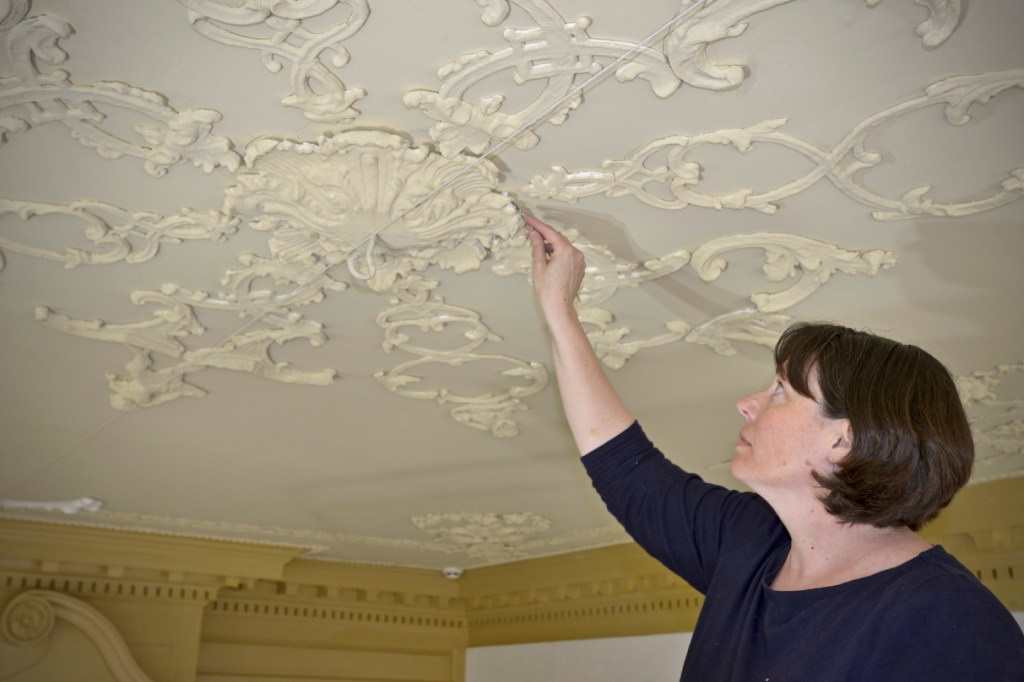
More than 98 percent of the ceiling was installed by three State Parks staffers in under a week. Hot glue was used to adhere the ornament to the ceiling. The ornament edges were then caulked where necessary and the entire ceiling painted. Once finished, the ornamental ceiling now looks like it has always been there.
Now installed at Philip Schuyler Mansion, this is only the second complete papier maché ceiling in the Unite States.
Erin Moroney and Bill VonAtzingen install the new ceiling at Philip Schuyler Mansion.Erin Moroney paints the new ceiling at Philip Schuyler Mansion.Bill VonAtzingen, a State Parks restoration carpenter, paints papier maché ornaments for installation.
See the complete process, from 3D printing of molds, to installation of the ceiling.
A detail from the ceiling at Philip Schuyler Mansion.
A 360-degree view of the restored ceiling.
Over the next few weeks the Parlor also received a crystal chandelier, an imported English loomed carpet and new custom-made drapes. The result is amazing. For the first time in over a century—the grandeur of the Best Parlor is restored to the time of the Hamilton wedding, from the floor to the ceiling.
Philip Schuyler Mansion State Historic Site.
Post by Erin E. Moroney, architectural conservator, Bureau of Historic Site & Park Services.


























 New York State Parks and Historic Sites Blog