I Love My Park Day (ILMPD) started in 2012 when 49 New York state parks and historic sites were helped by thousands of volunteers, including Governor Andrew Cuomo. These volunteers worked on a variety of projects including cleaning up park lands and beaches, planting trees and gardens, restoring trails and wildlife habitat, removing invasive species, and working on various site-improvement projects. In 2015 ILMPD grew to 6,500 volunteers who helped with 200 projects in 95 state parks and historic sites across the state.
In 2016, I Love My Park Day is Saturday May 7 with events planned at 110 parks and historic sites across the state. Find a place to help here (or at nysparks.com/events). From Hither Hills State Park in eastern Long Island, to Point au Roche State Park on Lake Champlain, Sonnenberg Gardens & Mansion State Historic Site in the Finger Lakes, Mine Kill State Park in the Catskills, Two Rivers State Park Recreation Area in the southern tier, Walkway Over The Hudson State Historic Park in the Hudson Valley, and more – there is something for everyone. ILMPD also expanded this year to include DEC properties in the Adirondacks and Catskills as well as local and federal parks in New York. ILMPD is a great opportunity to get outside, enjoy the camaraderie of old and new friends, and give back to your favorite park.
I Love My Park Day is a joint program organized by Parks and Trails NY (PTNY) in partnership with State Parks, and local park Friends groups.
We hope to see you on May 7 for a day of fun and stewardship in New York’s backyard that is open to everyone – State Parks!
When ten endangered Chittenango Ovate Amber snails (COAS), located in only one known location in the world: Chittenango Falls State Park, were brought into an SUNY College of Environmental Science and Forestry (ESF) lab for captive breeding and did not reproduce over the summer of 2014, graduate student Cody Gilbertson and advisor Rebecca Rundell knew they had to adjust something. Eventually the ten COAS were released, but as luck would have it, during the trial, a stowaway baby COAS came in on vegetation that was offered to COAS adults. The tiny snail on the plant was placed in an enclosure to monitor closely. This was the beginning of a rapid learning curve for Gilbertson on the food preferences of COAS. New York State Department of Environmental Conservation (in charge of endangered species permitting) granted permission for them to keep the one snail over winter and raise it alone in the lab. From this blessing in disguise, Gilbertson was able to figure out the specific species of leaves this one snail she named “Hatch” preferred to eat – dead cherry leaves! Cherry leaves collected in the spring were consumed regularly and “Hatch” began to grow rapidly. Gilbertson knew it was risky keeping a small hatchling snail because in the past, 80% of hatchlings would die within the first two weeks of life in captivity. She thought it was unlikely “Hatch” would live, but this one snail persisted and survived in the lab showing her what it most preferred to eat, and she watched closely. It turns out this was a very practical way of finding out what COAS needs without harming individuals.
“Hatch” at 8mm (slightly longer that 1/4″), photo by Cody Gilbertson
“Hatch” active and growing approximately 12mm (about a 1/2″) in shell length. photo by Cody Gilbertson
The famous “Hatch” 21mm long! (about 13/16″) photo by Cody Gilbertson
When Gilbertson brought two more COAS in from the wild during summer 2015, adults flourished on the improved diet and reproduction occurred resulting in over 600 baby COAS in just two months! The two snails mated with each other and about seven days after mating, egg masses were laid. A total of about six egg masses were laid by each snail with about 33 eggs in each egg mass. About 270 of these snails were released back to their wild habitat to help expand the wild population of COAS. The other 300+ snails are still in our lab and are thriving. Over 130 snails have reached maturity (over 14mm in shell length) and over 30 egg masses from the captive born snails have been produced so far.
Snails in the lab are kept in a variety of plastic Tupperware within and incubator which protects them from drying out or getting too hot. photo by Cody Gilbertson
This COAS snail is laying an egg mass! photo by Cody Gilbertson
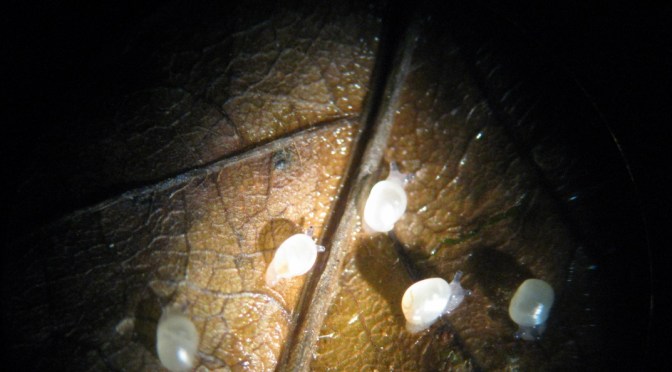
1 mm adorable baby COAS snails on a leaf. photo by Cody Gilbertson
This research, supported by United States Fish and Wildlife Service, has pushed the recovery of COAS species forward with some very large steps:
1) Researchers have performed a first ever release of captive snails back to the wild
2) Scientists now have information about what COAS eat and what they may need to survive in the wild and in captivity
3) Over 300 snails remain in captivity for assisting in securing this species existence.
However, there is still much to learn about this unique and rare species in our upstate NY backyard. Scientists will need to monitor and care for both the wild and captive populations over time for us to tell if this work is successful long term. But they have certainly put their best foot forward!
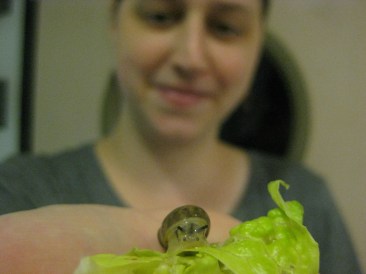
Gilbertson with “Hatch,” photo by Cody Gilbertson
Post and photos by Cody Gilbertson, graduate student SUNY College of Environmental Science and Forestry
In this second year of Nature Times we have gotten to know snapping turtles, carnivorous plants, black squirrels, and Sammi, Trailside Museums’ 36 year old bald eagle. We’ve learned how trails are mapped, how a flock of sheep and goats have become one of State Parks’ 21st century mowing crews, and ways to explore State Parks on foot, in kayaks, on snowmobiles, and on frozen lakes. The stories have featured all kinds of work that State Parks staff and volunteers do throughout the year to help preserve and protect some of New York’s unique and exceptional places. These range from protecting sand dunes on Lake Ontario and old-growth forest at Allegany, to creating native grasslands at Ganondagan State Historic Site, and monitoring invasive species infestations and removing invasive species both on land and water.
This slideshow requires JavaScript.
We mark this second birthday with 61 new followers and over 24,000 page hits! And we thank the 32 staff, interns, and partner organizations who have shared their passion for State Parks through the blogs that they have written. We also want to recognize our partnership with the New York Natural Heritage Program who helped in initiating this feature and continues to provide support.
We look forward to continuing our celebration of State Parks in the months to come in Nature Times. Hope to see you soon at one of our Parks or Historic Sites!
Imagine yourself hiking next to a babbling creek. You come to a small waterfall surrounded by rocks. The rocks glisten from the spray of the falls. You walk closer and see dozens of small snake like creatures slithering over the wet rocks. You watch them move from the top of the rock pile to the bottom. Then they slide back into the creek.
You saw the American eel utilizing one of its unique adaptations. Their bodies are coated in a mucus layer, providing protection and a way to absorb oxygen through their skin. This mucus, in combination with their muscular bodies, allows them to move out of water and across land to avoid barriers. This, and other adaptations, makes the American eel able to live in more diverse habitats compared to most other fish species.
American eels are fish, despite their snake like appearance, and the only species of eel that live in North America. They are catadromous, migrating from the saltwater of the Sargasso Sea to the freshwater of streams and lakes. The Sargasso Sea spans a part of the Atlantic Ocean between Bermuda and Puerto Rico. Once they reach maturity, they journey back there to spawn.
The vastness of the Sargasso Sea makes it tough for researchers to locate and observe eels spawning in the wild. At this point, observations of spawning eels remain to be made, although one silver eel was tracked to the Sargasso Sea. Researchers believe the eels die right after spawning. Some mystery surrounds the final life stages of the American eel.
What happens as they grow?
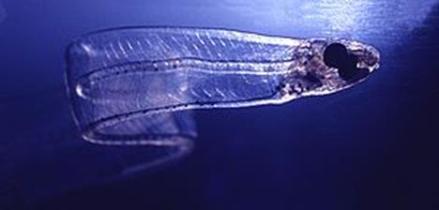
Let us review the known information about the life stages of the eel. The eel’s life begins in the Sargasso Sea. First, they resemble a willow leaf. These small, oblong, transparent fish, called leptocephali, lack the snake like form of adult eels. They are about one inch long and rely on the ocean currents to bring them to the east coast. This journey takes about one year.
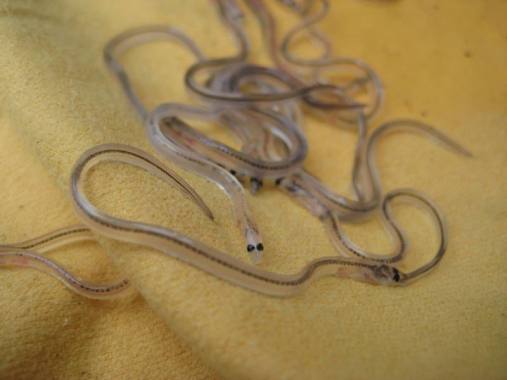
The beginning life stage of the American Eel is called a leptocephalus and these leptocephali use the current to travel to the East Coast. Kils at the English language Wikipedia [GFDL (http://www.gnu.org/copyleft/fdl.html) or CC-BY-SA-3.0 (http://creativecommons.org/licenses/by-sa/3.0/)%5D, via Wikimedia CommonsNow they resemble vermicelli or rice noodles. At two inches long and still transparent, they are called glass eels. They make their way into estuaries which connect saltwater to freshwater. Many of them find themselves in water bodies of local New York State parks along the Hudson River. Once in freshwater, they develop a brown coloration. This signifies the shift to their next life stage as elvers.
The American eel in their glass eel life stage as they arrive to the coast. Chris Bowser
As the elvers grow longer over the next few years, they enter their yellow eel stage. They live in this stage right before they reach full maturity. Their size varies based on sex. Males can grow to two feet long whereas females can reach sizes of four feet. Their size in each life stage is based on their surrounding environment. They become silver eels when they reach full maturity to start their migration.
This silver eel stage happens to be the most understudied of all the life stages. There is no set age that eels are known to reach full maturity and age cannot be determined from external characteristics. Researchers look to study silver eels right before they begin their migration.
What kind of research?
Sarah’s motivation to study silver eels stemmed from her previous experiences working with them in their other life stages. Her work with eels started with a summer project at Bard College, eight years ago. After graduation she continued to work with glass eels, elvers, and yellow eels as a Student Conservation Association (SCA) intern at the Hudson River National Estuarine Research Reserve and Estuary Program. Studying silver eels seemed like the next logical and exciting step for her. Sarah Mount at the SUNY College of Environmental Science and Forestry conducted research on yellow and silver eels. Her research led to a model that sorts yellow and silver eels into different maturity classes. The model relies on external characteristics such as the length, weight, eye diameter, pectoral fin length, head length, head width, and body depth of the eels to differentiate maturity classes. This means that future researchers can utilize this model to study the relative age of eels with a capture and release method that does not harm the fish.
With the guidance of Karin Limburg at SUNY College of Environmental Science and Forestry, she developed her research ideas into a master’s level study. With the help of colleagues at the Hudson River Research Reserve, she spent two summers and two autumns collecting yellow and silver eels from the streams of the Hudson River estuary.
SCA interns at the Hudson River Research Reserve help Sarah set up a silver eel fyke net. Chris Bowser
Silver eels migrate at night during rain events in the autumn. To catch them, Sarah set up a fyke net the day before a predicted rain storm. This v-shaped net spanned the width of the stream and was removed the next morning.
The final life stages of the American eel still remain a mystery. Sarah Mount’s research begins to solve it both for future research and for herself. Her model will help future researchers understand when eels reach their full maturity to begin their migration. When asked about her next steps she said, “Now the only missing piece left is the ocean, I’ve got to get out to the Sargasso Sea sometime.”
Post by Brianna Rosamilia, Master of Science candidate in Environmental Interpretation at SUNY College of Environmental Science and Forestry
As temperatures rise, spring rains roll in, and the ground thaws, the amphibians of New York are preparing themselves for a great migration. On the 10th of March, a group of about 30 volunteers congregated near Hop Field at Thacher State Park armed with flashlights and buckets. With great excitement they looked along the road edges for salamanders and frogs, hoping to help them cross the road as the amphibians migrated to woodland pools. Throughout most of the year, mole salamanders and woodland frogs spend their time burrowed under rocks and leaves on the forest floor, but each spring salamanders and frogs can migrate up to a quarter mile to woodland pools to breed. The mass migrations to the vernal pools occur during spring rainstorms with temperatures above 40 degrees.
The rain was intermittent that night, and although spring peepers and leopard frogs were escorted across the road, no salamanders were found. The migrations typically happen in late March and early April, so there is still hope! On nights when the conditions are right, many nature enthusiasts can be seen on roadways close to wetlands helping the amphibians safely cross the road. If you are interested in getting involved in preventing vehicle related deaths during these mass migrations, contact your local State Park or local DEC office. These organizations sometimes coordinate volunteers to come together on rainy nights to help salamanders cross busy roads. The more volunteers there are to help, the more amphibians will successfully breed! Before you help the amphibians, be sure to brush up on your identification! Here is a sampling of the native amphibians that you could see in New York.
Mole Salamanders:
Blue spotted Salamander, By Greg Schechter [CC BY 2.0 (http://creativecommons.org/licenses/by/2.0)%5D, via Wikimedia CommonsThe blue spotted salamander is black with pale blue flecks all over its body. It can grow from 3.5 to 5.5 inches long. They are frequently seen in woodlands.
Spotted Salamander
Spotted Salamander Congress by Hannah Long, SCA Environmental Educator Member Thacher State Park, 2016
The spotted salamander is black and has yellow spots. It can grow up to 8 inches long. It is one of the most common salamanders in the area, and if you go out on a migration night there is a good chance that you will see it!
Jefferson Salamander, By Unspecified (Vermont Biology Technical Note 1) [Public domain], via Wikimedia CommonsThe Jefferson salamander is dark brown and has pale blue spots on its limbs and lower sides. The blue speckling is best seen on younger salamanders. It can crossbreed with the blue spotted salamander and usually grows to 4.5 to 7 inches long.
Red Eft, By Jason Quinn (Own work) [CC BY-SA 3.0 (http://creativecommons.org/licenses/by-sa/3.0)%5D, via Wikimedia CommonsThis red eft/ red spotted newt can secrete poisonous toxins. When it is on land in its juvenile stage, it is orange. However, in its aquatic adult stage it is an olive brown color and has a wide paddle like tail.
Frogs:
Wood Frog, By USFWS Mountain-Prairie (Wood Frog) [CC BY 2.0 (http://creativecommons.org/licenses/by/2.0)%5D, via Wikimedia CommonsThe wood frog has an extremely high freeze tolerance and can live in a variety of habitats including forests, tundra, and bogs. It has the nickname “Lone Ranger” because the coloration on its face resembles a mask. Last year a bill was proposed by a class of 3rd graders to declare the wood frog the State Amphibian of New York. To see the bill’s progress check out this website.
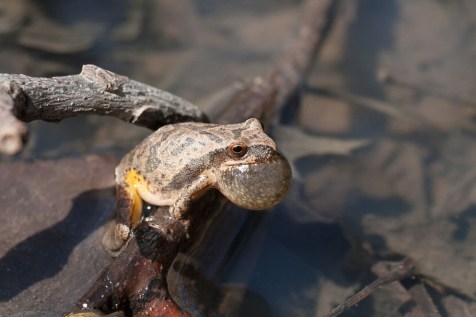
Spring Peeper, By Justin Meissen [CC BY-SA 2.0 (http://creativecommons.org/licenses/by-sa/2.0)%5D, via Wikimedia CommonsThe spring peeper has large vocal sacs that it uses to create high pitched tones during the spring mating season. It typically grows to about one inch long and has a dark X marking on its back. Listen to the call of a male spring peeper.
Leopard Frog, By Douglas Wilhelm Harder (Own work) [CC BY-SA 3.0 (http://creativecommons.org/licenses/by-sa/3.0)%5D, via Wikimedia CommonsThe leopard frog gets its name from the irregularly shaped dark patches on its legs and back and can grow to be 3 to 5 inches long. They were once the most abundant frog species in North America, but they suffered large population declines in the 1970s.
Recommended Links:
“Salamander Migration Extraordinaire” Check out this naturalist’s blog post that has videos of spotted salamanders and Jefferson salamanders migrating to a vernal pool. There is amazing underwater footage of the salamanders at the breeding site!
Check out this video of Ranger Eric Powers from Your Connection to Nature to learn more information about vernal ponds and the animals that rely on them!
Post written by: Emily Crampe, SCA Member, Thacher State Park









 New York State Parks and Historic Sites Blog