Category Archives: Stewardship

The Glory of Goldenrod

With fall almost here, now is the perfect time to enjoy the brilliant goldenrods and discover the array of interesting insects that visit them. There are many different kinds of goldenrod, but most are late-bloomers that don’t come into full bloom until late summer and fall.

Goldenrod continues blooming until the frost, which in New York ranges from late September to October, depending on location. As one of the few groups of wildflowers in peak flower at this time, many insects depend on these plants for food, feasting on the nectar and pollen.

There are more than two dozen species of goldenrod native to New York State. They are a member of the Aster family (Asteraceae) and most are in the Genus Solidago, but a few are in the Genus Euthamia and Oligoneuron. All but one species are deep golden yellow (silverrod, Solidago bicolor is white), with hundreds of tiny flowers making up the “inflorescence” or flower head.

If you are interested in learning more about insects, this is one of the easiest ways to get an up-close look at all different kinds.

Giant or swamp goldenrod (Solidago gigantea) is very showy and grows up to seven feet tall. Common eastern bumble bee (Bombus impatiens, shown here) is the most common bumble bee in New York State and the species you are most likely to see feeding on the tiny golden flowers.

You can find goldenrods in a variety of habitats from roadsides, fields, alongside open trails and bike paths, in the dunes of the ocean and Great Lakes shores, and on rocky summits. In almost every State Park you can find goldenrods, and perhaps you will discover you have some in your backyard, neighborhood garden or vacant lots.

State Park’s pollinator habitat initiative has also helped create areas for goldenrods, asters, milkweeds and native grasses by reducing mowing along some roadsides and fields


Common flat-topped goldenrod (Euthamia graminifolia) growing with boneset (Eupatorium sp.) in a coastal grassland at Heckscher State Park.

Many insects are attracted to the goldenrod flowers. Take a close look and be patient. You may find a variety of bees from bumble bees, carpenter bees, tiny mason bees and sweat bees. On a cool morning, the insects are often a bit sluggish which means they are less likely to fly away while you get in close. In fact, in morning or evenings, look for bumblebees sleeping upside-down under the goldenrod flower branches!
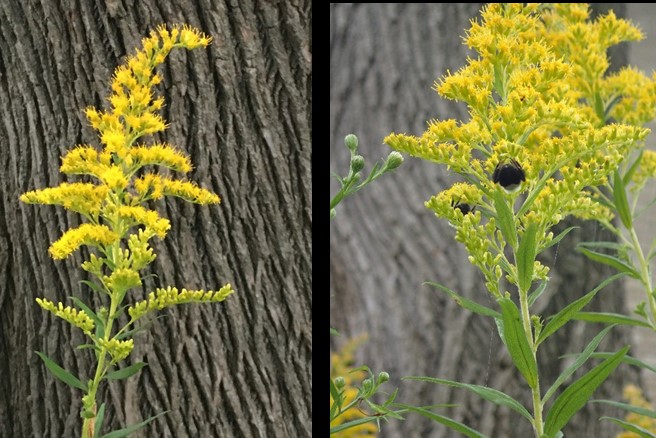
Canada goldenrod (Solidago canadensis) is among the species with a tidy cone-shaped top, this one complete with sleeping bumble bees.

Beetles are another common visitor, like the ladybugs, lightening and flower beetles. Perhaps you will find an inch-worm or another kind of caterpillar.

A close-up look at the goldenrod flowers and one of a species of long-horned flower beetles.

On sunny days, goldenrod patches are a good place to watch for butterflies like painted lady, monarch and viceroy across the state. On the coast, large numbers of monarch butterflies follow the path of the seaside goldenrod that grows in abundance on the dunes and upper edges of the beach. Without this vast food supply, many of those monarchs would not survive their long journey of up to 3,000 miles.

A Monarch butterfly feeding on seaside goldenrod (Solidago sempervirens).
Seaside goldenrod (Solidago sempervirens), common at state parks like Orient Point, Jones Beach, Napeague and Hither Hills in Long Island, is a key food source for Monarch butterflies migrating south along the Atlantic coast on the way to wintering grounds in Mexico.

In addition to protecting the habitats where goldenrod thrives in the wild, this hardy perennial can also be a beautiful and important part of a pollinator garden or habitat, where birds and small mammals also benefit from the seeds. If you want to add some to your garden or landscape, some plant nurseries carry them, but check the New York Flora Atlas to make sure that the species is native to New York state and not listed as rare or invasive in New York.

Learning to appreciate goldenrods is a great way to support a whole suite of native flora and fauna.


Resources:

NY Flora Atlas http://newyork.plantatlas.usf.edu  (search for Solidago or Euthamia)

GoBotany (a good source plant identification) https://gobotany.nativeplanttrust.org

Check out the other pollinator blogs at NY State Parks Blog too.

Post and photos by Julie Lundgren, New York Natural Heritage Program (nynhp.org)
A View from the Treetops: life as a forest health specialist

My name is Abigail Pierson and I am a Forest Health Specialist for NYS Parks. The scope of my work covers almost all the state parks in the western half of New York state, making each week always something new and exciting.

My week begins with the usual desk work of contacting park managers and anything else to ensure a smooth work week. However, by 10 a.m. my coworker and I are hopping in the work van and traveling to a state park. Once we’ve arrived, my partner and I begin setting up our tents and going over our schedule for the week. When the work day comes to end, it’s time for arguably the most intricate task of the day, dinner.

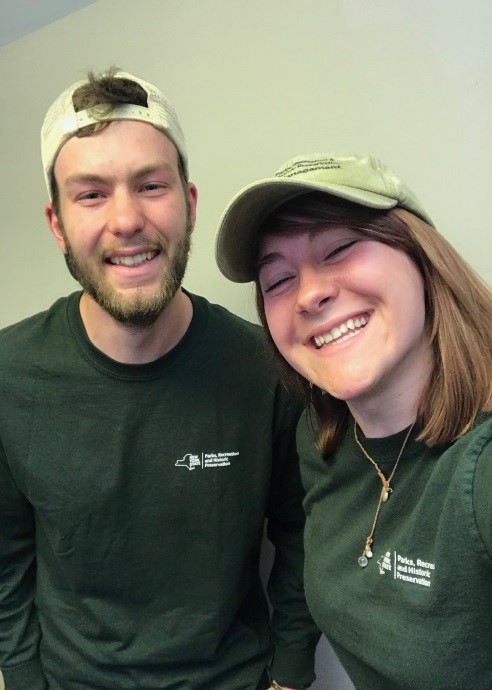
Abby and her current NYS Parks staffer and climbing partner, James Boyd.

Our meals are cooked on a two-burner camp stove, so chaos usually ensues when we are both starving and trying to prepare full course meals. Trying to make a full meal on one burner each serves as a microcosm of the balance of respect, teamwork, trust, and cooperation needed for the success of our team.  We spend every morning, afternoon, and night together for five days of the week. This job requires a lot of trust. We are climbing tall trees for research purposes, so our safety depends on each other. It is amazing to have a job/life experience like this where your co-worker becomes such an integral part of your life.

It’s always interesting climbing out of our dew-covered tents each morning; seeing everything in nature slowly coming to life all around us. Our days move by very fast. I eat a quick breakfast, after which I grab my climbing gear and data collection tools and begin the hike into a hemlock stand.

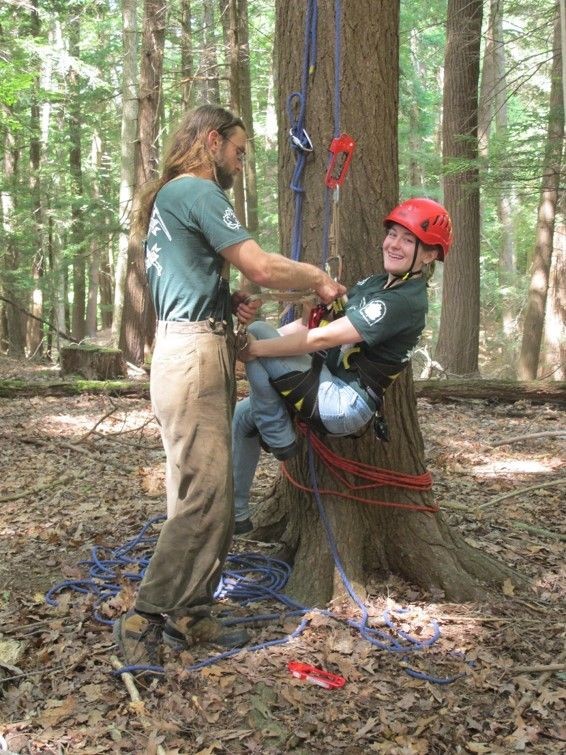
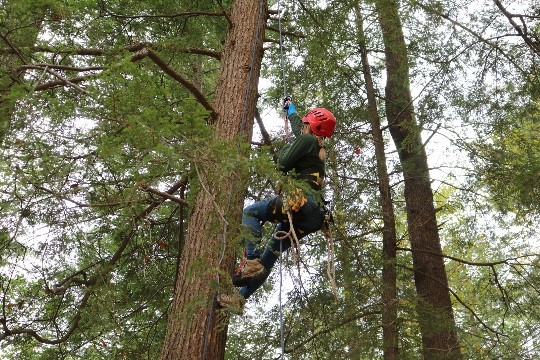
We are monitoring for hemlock wooly adelgid (HWA) an invasive insect species native to Japan that can kill entire hemlock stands in 4 to 10 years. Our hikes to these hemlock stands can range from a half mile to three miles, and this is where the real fun begins. We put on our helmets and safety glasses and begin sending our rope up and over one of the branches in the middle canopy of the tree. Once we have our single rope set up and secured on the tree, one of us straps on our climbing harness and begins the ascent, which can be a hundred feet or more up into the air.

Abby gears up with NYS Parks staffer Jake Sidey during a 2016 climb.
Abby having fun a phone app with NYS Parks staffer and 2017/18 climbing partner Ben Jablonski.

A beautiful thing about our climbing setup is we cause no damage to the tree. Our goal is to save these majestic giants, not injure them. Once I reach the top section of the rope, I attach myself directly to the tree using a flip line. A flip line is a short adjustable section of rope that goes around the trunk of the tree and attaches to both sides of my harness.

It’s a good thing I’m a tree hugger because I must hug the tree as I use flip lines to ascend to the top canopy of the tree. It is a very intense experience being on flip lines because it is up to myself and this tree to keep me safe. In many ways, we are trusting the trees with our lives just as much as the trees are trusting us with theirs.

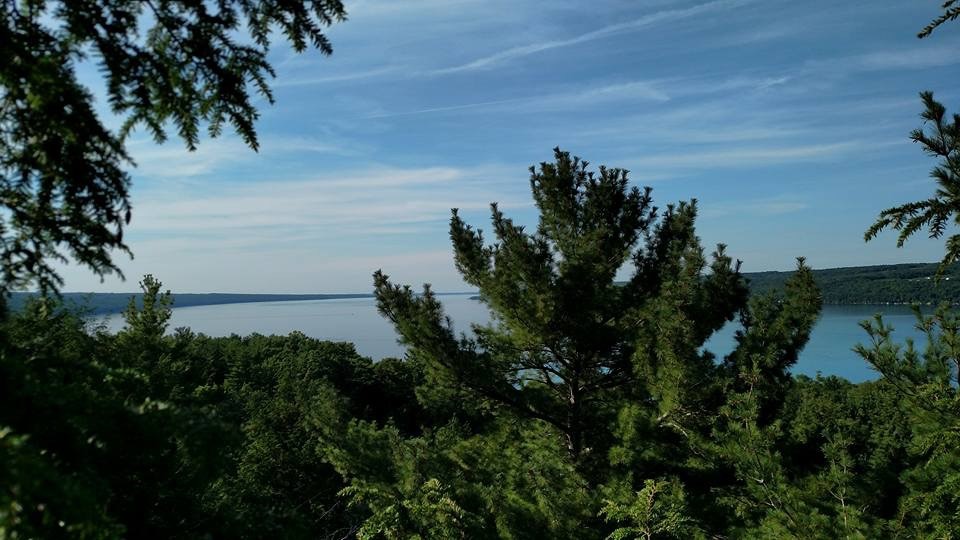
Climbing to the very top canopy of a tree that usually towers over the rest of the forest canopy is an indescribable experience. It feels as if, for a moment, you are larger than the forest itself. After all that hard work of getting to the top canopy I always take a moment to take in the beauty of nature that is surrounding me.

The View from the Top.

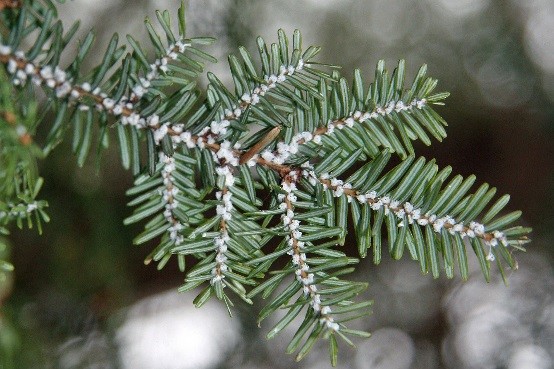
Once I’ve taken in the view it is right back to work. I take a small sample of a branch from the top canopy and put it into a labeled Baggie. As I descend back down the tree, I take samples from the middle and lower canopies. These samples allow us to identify if the tree is healthy or its level of infestation by HWA, a tiny aphid-like insect that gradually kills hemlocks by feeding on the juices in their needles.

The information that we gather helps show how widespread HWA is in the state and which hemlocks might still have the potential to be saved.

Here, and below, A close up of the telltale fluffy white insect egg masses that indicate HWA infestation.

If left unchecked, HWA could wipe out the majority of eastern hemlocks in New York, a species that is the third most common tree in the state. Hence the importance of slowing or even stopping its spread as quickly as possible. Widespread hemlock mortality would have a lasting impact on ecosystems, streams, flora and fauna, and even the look of the landscape.

Hemlock mortality in parks especially is a scary thing for me to imagine as patrons would no longer be able to enjoy the parks the same way that they can now. Some of our most well-known parks, including Letchworth, Allegany, Watkins Glen, and others like Stonybrook and Thacher, feature hemlocks along most major trails and vista points. Campgrounds and picnic areas of many parks enjoy cooling shade courtesy of hemlocks. If those hemlock stands were to die back the park would look barren, be unsafe due to erosion and dead limbs, and the internal ecosystems would be negatively impacted as well.

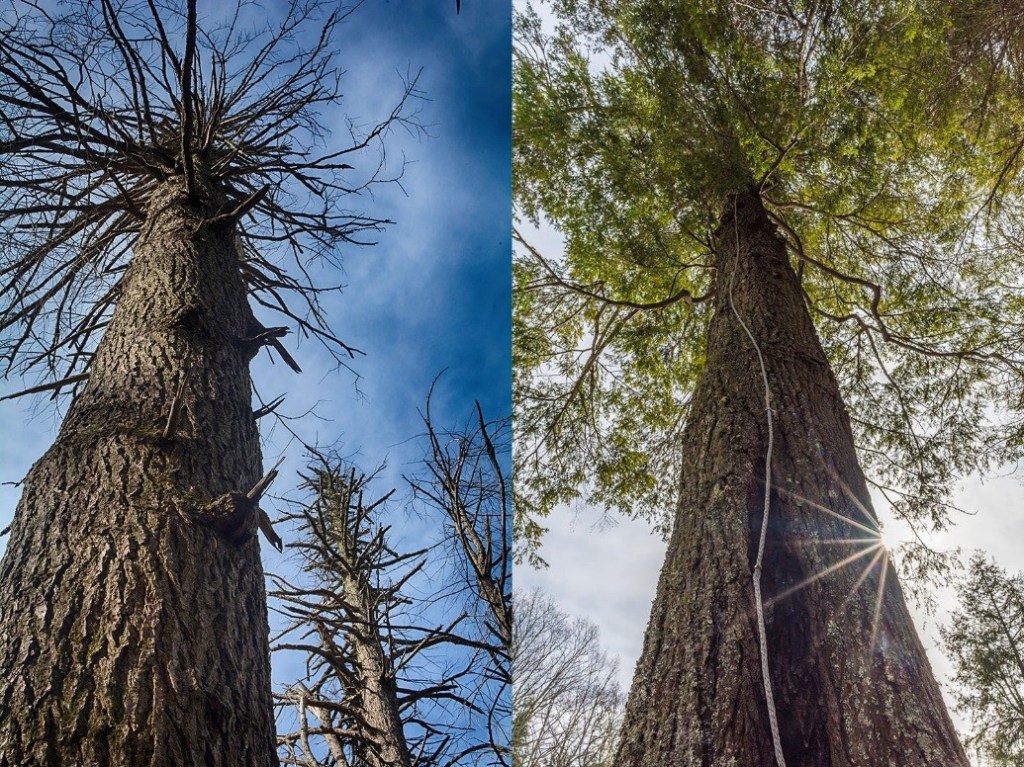
On the left, hemlock trees killed by HWA. On the right, a healthy, uninfested hemlock.

Click here for a map showing how HWA has spread in New York State.

What can you do to help? According to the state Department of Environmental Conservation, if you believe you have found HWA:

  • Take pictures of the infestation signs (include something for scale such as a coin or ruler).
  • Note the location (intersecting roads, landmarks or GPS coordinates).
  • Fill out the hemlock woolly adelgid survey form.
  • Email report and photos to DEC Forest Health foresthealth@dec.ny.gov or call the Forest Health Information Line at 1-866-640-0652.
  • Contact your local Partnership for Regional Invasive Species Management (PRISM) by visiting http://www.nyis.info/.
  • Report the infestation at iMapInvasives.
  • Slow the spread of HWA in our forests by cleaning equipment or gear after it has been near an infestation, and by leaving infested material where it was found.

Overall, tree climbing is a phenomenal experience that allows us to experience the sheer beauty of the hemlock tree and surrounding forest, while also allowing us make the in-depth assessment needed to ensure that the natural beauty is preserved.

Helping to save the amazing environment we live in, educating the public on invasive species, and being up close and personal with nature every day is an amazing gift. This job allows me to fulfill all my strongest passions simultaneously and I could not be luckier to have this opportunity.

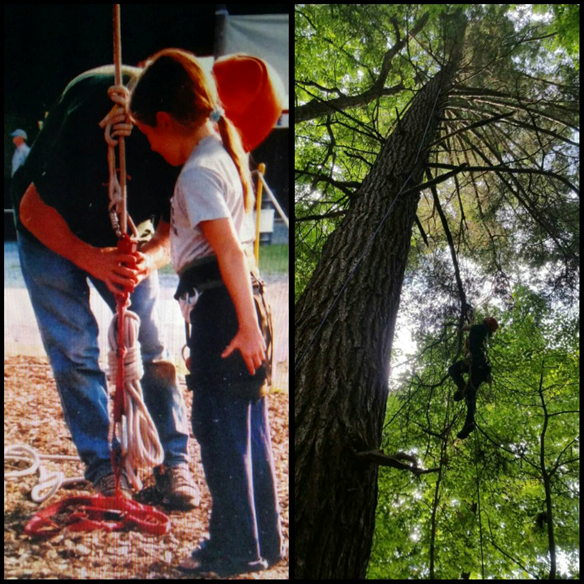
Born to climb: A young Abby is geared up for tree climbing up by her father, Dr. Timothy G. Pierson, during Penn State Agricultural Progress Days. Abby later got her bachelor’s degree in environmental science/biology from Penn State, where her father worked as a forester.

Post by Abigail Pierson, Forest Health Specialist

Efforts to Control Invasive Species in Parks Gain a Four-Footed Team Member

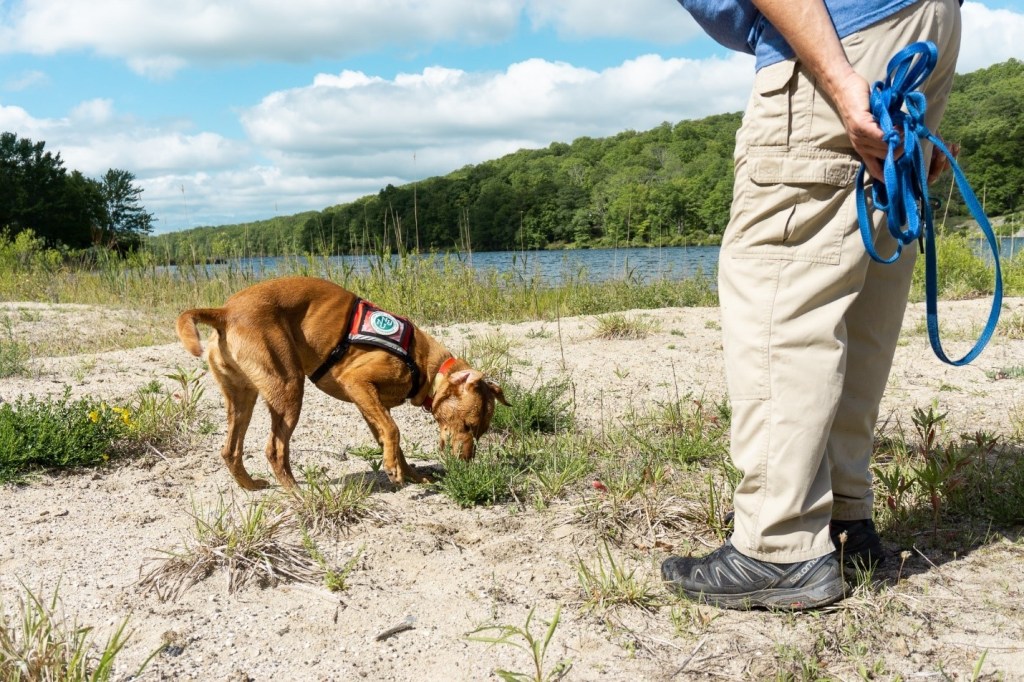
One sniff at a time, an energetic Labrador retriever named Dia is changing the way we combat invasive species in New York State Parks.

Along with her handler Joshua Beese, this invasives-fighting team from the nonprofit New York-New Jersey Trail Conference is on the hunt for Scotch broom, a threat to the native ecosystems in Bear Mountain and Harriman state parks in the Lower Hudson Valley.

Dia uses her powerful sense of smell to help find small and sparsely distributed invasive species that might be missed by human searchers. Since November 2018, her incredible nose has been specially trained to sniff out the invasive plant Scotch broom.

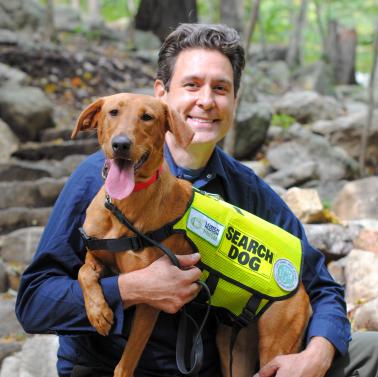
Joshua Beese with Dia. Photo by nynjtc.org

Scotch broom (Cytisus scoparius)is one of the most destructive invasives on the Pacific Coast, where it has had costly implications for agricultural industries. When it began showing up in New York’s parks, land managers became concerned. Scotch broom forms dense clusters that can displace native plant species and reduce biodiversity that is essential for a healthy ecosystem.

The Lower Hudson Partnership for Regional Invasive Species Management (LHPRISM), which works to minimize the harm caused by invasives, ranks Scotch broom as a tier 2 priority invasive species. That means it is present in such low numbers in the Lower Hudson Valley that with proper action it could be completely eradicated from the area before the population becomes established.

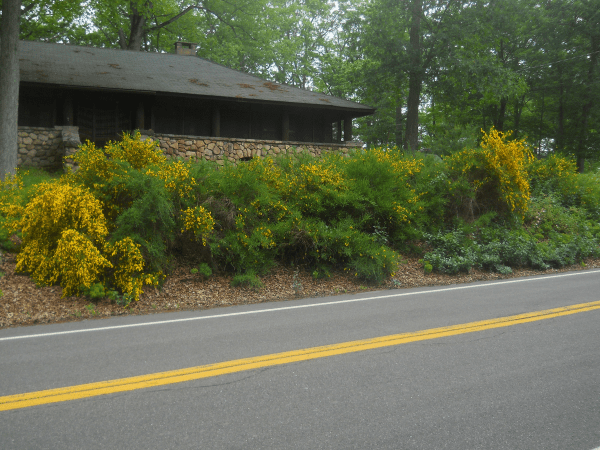
Scotch broom plant in flower on May 2015 at Harriman State Park. Photo by Shelby Timm, nynjtc.org.

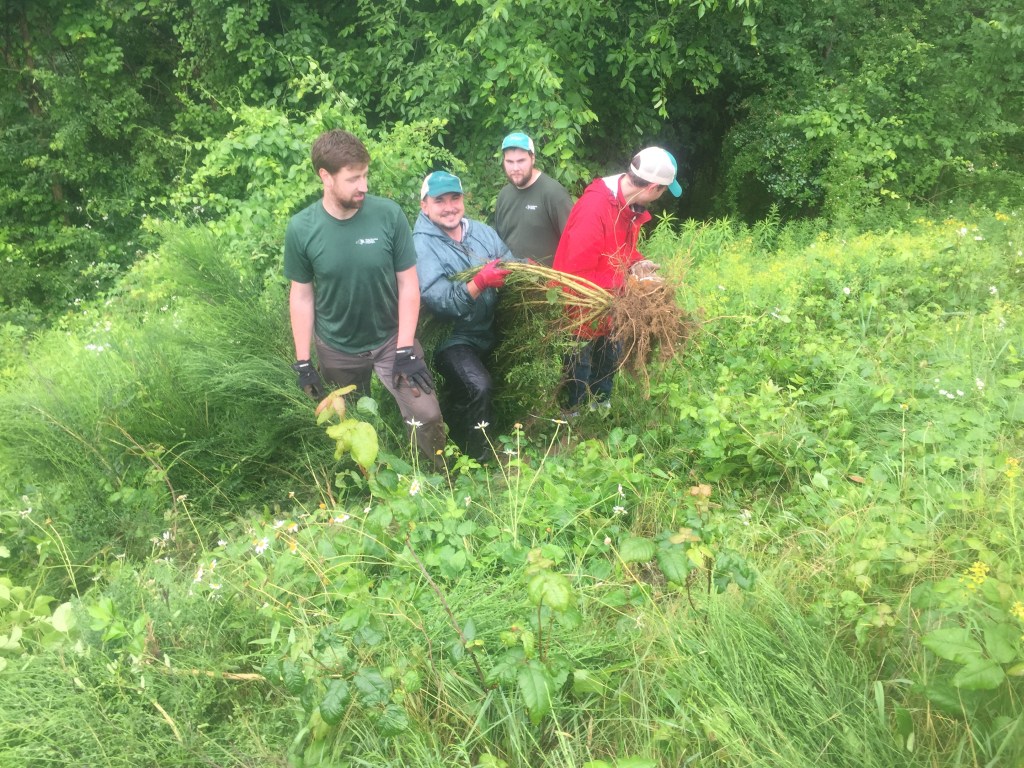
The New York State Parks Invasive Species Strike Team and the Trail Conference’s Invasives Strike Force (ISF) Crew of AmeriCorps members, volunteers, and interns have collaborated over the past several years in a bid to eradicate Scotch broom in the region. The ISF Crew has been finding and removing Scotch broom in state parks since 2014, when 37 separate populations were recorded at Bear Mountain and Harriman.

A Scotch broom infestation at Harriman State Park in 2014. Photo by Jennifer Breen, nynjtc.org
After the Scotch broom removal . Photo by Jennifer Breen, nynjtc.org

While a few locations no longer have any plants, other locations are harder to manage. It becomes challenging to find the few remaining individuals among all the other vegetation, which means this destructive plant could still propagate. That’s where Dia comes in!

“Dia first comes into the field with her nose up, smelling what’s in the air, working to detect the Scotch broom scent,” explains handler Beese. “She’s using what are called scent cones; she works her way into a cone and uses that cone to help her narrow down the source.”

Once in a cone, she will search until she gets to the source and put her nose to the ground to sniff out smaller plants that may be tiny and low to the ground. She alerts Beese that she’s found the species by standing or sitting. “The most important thing is that she’s committed to an area where she’s detected the plant until I come and reward her,” Beese says. “Then we can mark it and remove it.”

Dia’s reward: Her ball on a rope with a game of tug and fetch. See Dia in action by following her on Instagram @diasavestheforest.

Dia on the hunt for invasives. Photo by Arden Blumenthal, nynjtc.org

Utilizing their exceptional sense of smell, dogs have been commonly used for search and rescue, as well as weapons and narcotics detection. These tracking and detection skills are now being used to protect our wild spaces. In 2010, the journal Invasive Plant Science and Management published a study that concluded trained dogs could smell and detect twice the number of invasive plants that humans could observe with their eyes.

Although other groups have used dogs for short projects to detect of invasive species, the Trail Conference’s Conservation Dog Program is the first permanent program of its kind in the Northeast.

This is Dia’s first season in the field; she has already been on more than 20 surveying trips. In several instances, the Trail Conference’s Invasives Strike Force Crew had been to a site and completely removed every plant they were able to find—and then Dia found a few more.

Trail Conference Conservation Corps members removing Scotch broom plants in 2016. The flags indicate where plants have been removed. Photo by Matt Simonelli, nynjtc.org

Dia came to the Trail Conference from a farm in Wisconsin that breeds dogs for hunting competitions. She was selected for the program by Beese, an experienced search and rescue dog handler, who is assisted by volunteer Arden Blumenthal. He has trained Dia with the mentorship of Aimee Hurt from Working Dogs for Conservation in Montana, an organization that has been working with dogs on conservation projects for more than 20 years.

In a metropolitan region highly prone to invasive infestations, early detection when populations are small is a key component of successful invasive species management. Not only does Dia make search-and-destroy efforts more thorough within infestations, she is also able to find stray plants outside the known boundaries where people had focused their searches. Dia helps make sure the area is really cleared to reduce the potential for reinfestation or further spread. With better search efficiency, it should be possible to declare New York State parks Scotch broom-free in the near future. 

Crew from New York State Parks Invasive Species Strike Team removing a Scotch broom plant. Phot by Linda Rohleder, nynjtc.org

Up next for Dia is slender false brome (Brachypodium sylvaticum), an invasive grass that can outcompete existing vegetation, including threatened and endangered species, and harm wildlife populations by altering food sources. Slender false brome has recently been found in Letchworth State Park, and this location will serve as a training ground for Dia.

***UPDATE: Dia and her team recently went to Letchworth State Park, where they did find the invasive slender false brome in areas where surveyors had missed it.

Conservation dogs can learn to detect up to three new species each year, meaning Dia’s incredible talents will continue to develop. “In three or four years,” Beese says, “we’ll be pushing forward the science on what can be done with invasive species detection using dogs.”

New York-New Jersey Trail Conference Conservation Dog team, from left, Arden Blumenthal, Dia, and Joshua Beese. Photo by Heather Darley, nynjtc.org

Post by Linda Rohleder, Director of Land Stewardship, New York – New Jersey Trail Conference and Coordinator, Lower Hudson Partnership for Regional Invasive Species Management (PRISM)

Green Lakes State Park – Home to a National Natural Landmark and More!

New York’s State Parks are home to many unique natural features. Green Lakes State Park, near Syracuse, is the home of a National Natural Landmark. The Landmark found here is Round Lake, which is one of 28 such sites found in the state. A National Natural Landmark (NNL) is a natural area that has been designated by the Secretary of the Interior in recognition that the site contains significant examples of the nation’s biological and/or geological features. Round Lake is a rare meromictic lake surrounded by a forest that includes about 20 acres of diverse, old-growth forest. These two components led to Round Lake’s designation as a National Natural Landmark in 1973. The maple-basswood rich mesic forest and the meromictic lakes at Green Lakes State Park have also been recognized as being of statewide significance by the NY Natural Heritage Program (2018) in addition to Round Lake’s designation as a NNL.

NNLPlaqueWQ
The plaque at Round Lake dedicating it as a National Natural Landmark.

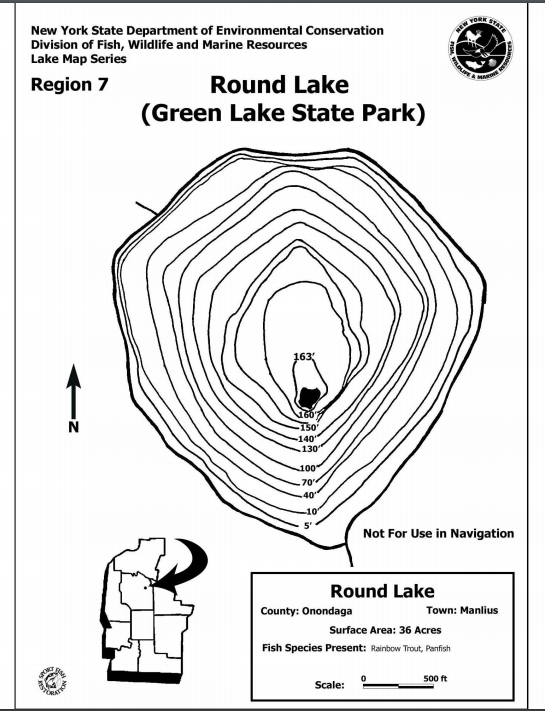
You may be asking yourself, what is a meromictic lake? A meromictic lake is a lake that does not have complete mixing of the surface and bottom waters. This is due to the lake being very deep without a large surface area: Round Lake is over 163 feet deep with a diameter of about 700 feet or 36 acres (see below).  The most common type of lake mixing is a dimictic lake which mixes twice a year, once in the summer and once in the fall. To learn more about lakes and their seasons (they have them too!), please see this blog.

MapDEC
This contour map was obtained by NYS DEC

Meromictic lakes remain chemically stratified throughout the year which makes it very hard for organisms to live there especially in the deepest layers of the lake. Chemical stratification refers to the layering of the water within the lake based on chemicals such as dissolved salts and oxygen. Because of this, there is no oxygen and there tends to be lots of dissolved salts in the lower layers as the salts increase the density, or weight, of the water which makes it sink to the bottom of the lake. These conditions make species diversity in a meromictic lake very low. The few fish that occur here are confined to live in the epilimnion, the top layer of water, because that is where there is enough oxygen for them. Snails, zooplankton and phytoplankton (microscopic aquatic critters and plants) are the more abundant species in these lakes.

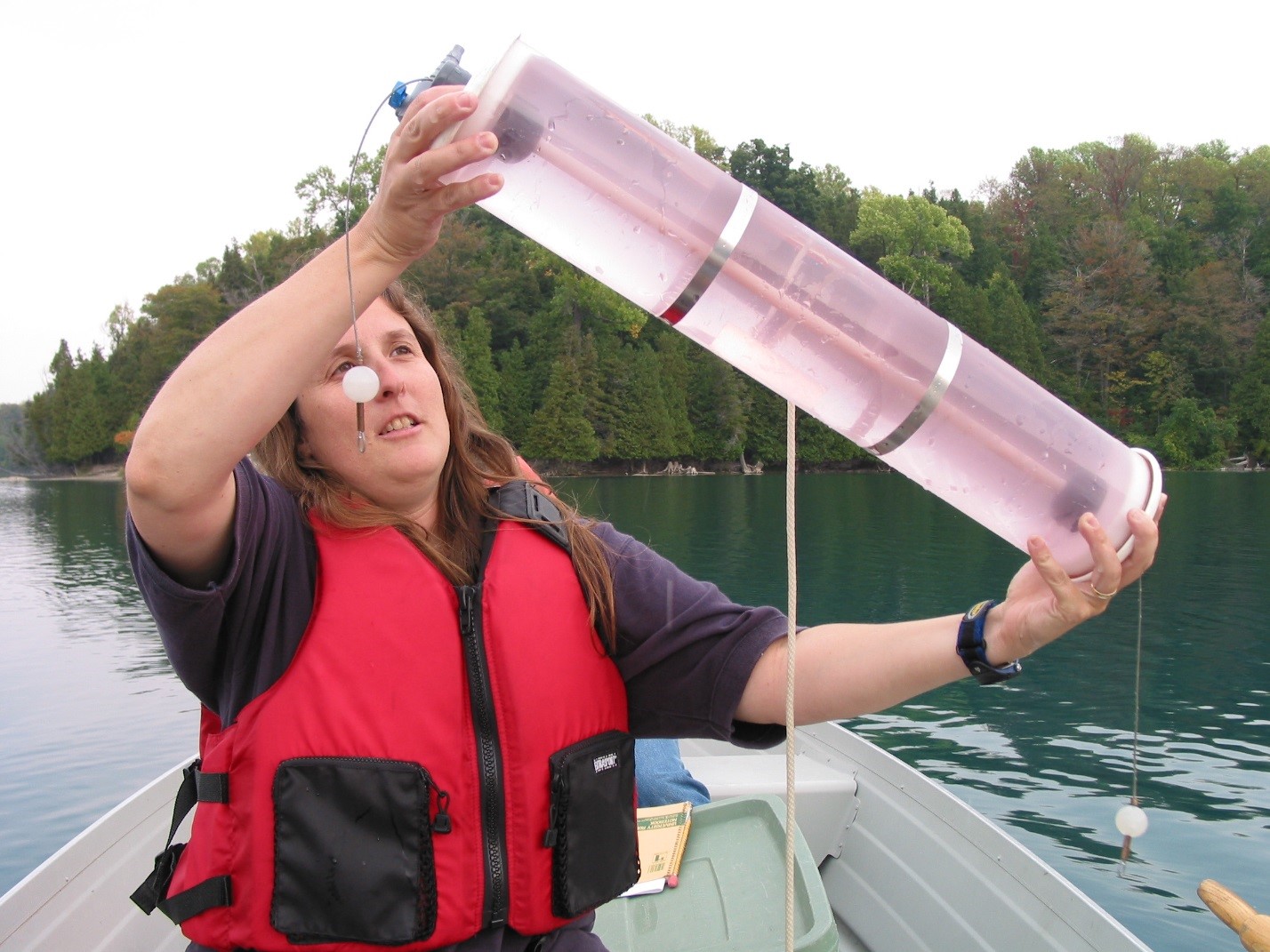
One exception to the lack of life in the depths of a meromictic lake is the presence of several interesting types of bacteria, for example those in the other lake on the park’s property, Green Lake. Green Lake has a characteristic purple sulfur bacterium that resides in the deep waters. If you pull a water sample from that layer of water, the sample that comes up is this purple-pink color and it smells like rotten eggs. This color and smell comes from the purple sulfur bacteria that resides in the water, which has been studied by many researchers such as those at SUNY College of Environmental Science and Forestry (see picture below). Although Green Lake is also a meromictic lake, it is not included in the Natural Landmark due to the higher use and less natural surroundings than Round Lake.

Sampling_KimSchulzESF
A water sample showing the purple sulfur bacteria at Green Lake. Photo by Kim Schulz, a professor at SUNY-ESF.

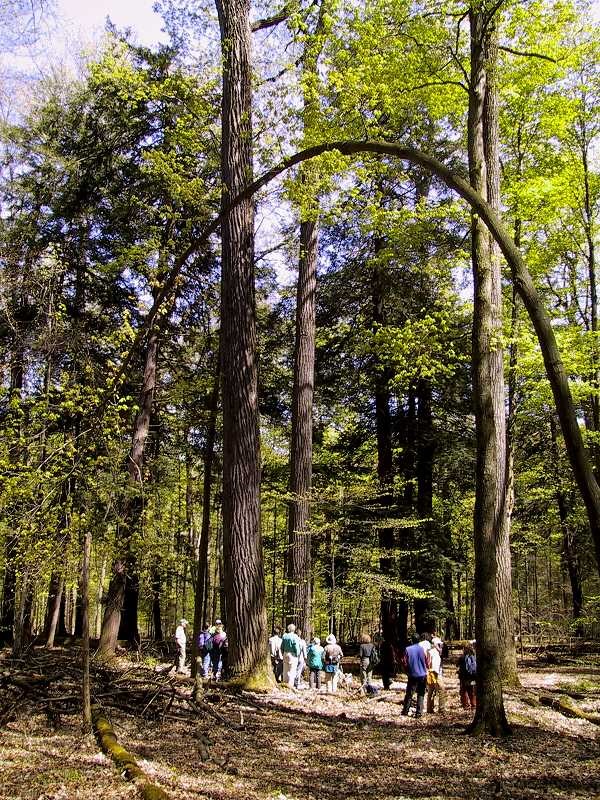
The other major component that makes Round Lake a National Natural Landmark is the old-growth forest that surrounds the lake. The Landmark is described as containing 20 acres of “virgin mesophytic forest”. The term “virgin forest” typically describes sites that have never been cut, which is not quite the case here, but the site is exceptional in having minimal cutting over the past few centuries and now supports trees that range from 100 to nearly 400 years old. Mesophytic is an ecological term that describes the vegetation characteristic of rich, moist, well-drained soils. NY Natural Heritage Program describes this forest as a maple-basswood rich mesic forest (2014) and maps roughly 130 acres in the park as old-growth forest – a good place to see some very old trees! There are some particularly old (and very tall) specimens of tuliptrees, bitternut hickory, sugar maple, hemlock and basswood within the Tuliptree Cathedral southwest of Round Lake. The largest tree measured there was 147 ft in 2011, one of the many tuliptrees to be found in this forest.

TuliptreeCathedral_DianeWheelock
Above is a picture of the Tuliptree Cathedral renamed as such following extensive surveys of the old-growth forests in 2001-2002. Photo by Diane Wheelock.

NY State Parks contain many more exceptional sites to see beyond Round Lake! To learn more about other National Natural Landmarks located within State Parks, please see these blogs on the Ellenville Fault Ice Caves and the Iona Marsh.

Post by April Brun, State Parks

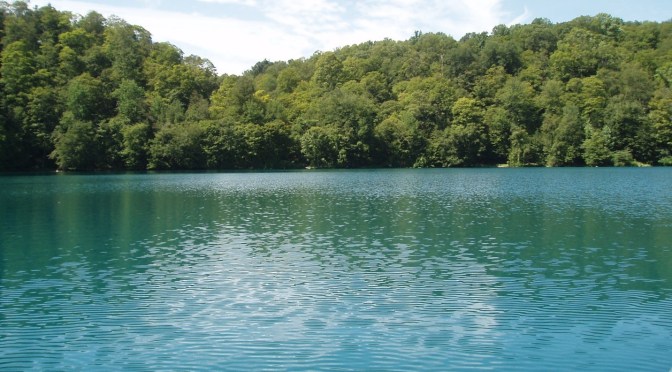
Featured Photo taken by Parks Water Quality Unit looking at the western shoreline of the lake.

Resources:

New York Natural Heritage Program. March 2014. Ecological Communities of New York State.

New York Natural Heritage Program. 2018. Significant Natural Community Occurrences. Biotics database. NY Natural Heritage Program Albany NY.

National Park Service. n.d. Round Lake National Natural Landmark.

Marsh Madness: Restoration of Iona Marsh from Invasive Phragmites

Iona Island, located along an elbow of the Hudson River in Bear Mountain State Park, is technically an archipelago of three islands connected by marshlands. Iona has had many owners in its storied history, prior to being bought by New York State in the 1960s. The Island was host to Native American tribes for thousands of years, who took advantage of the plentiful shellfish along its shores. In the last few hundred years, it has been the site of an unsuccessful vineyard, a hotel and weekend destination for NYC residents, a U.S. Navy arsenal, and a partially built park recreation area. The eastern side of the island past the railroad tracks has been closed to the public since the 1980s, but a small portion of the island consisting of the five remaining Navy buildings is used for storage for the Palisades Interstate Park system. The rest of the island has returned to a more natural state of woods, meadows, and rocky outcroppings and serves as a sanctuary for wintering bald eagles.  The island achieved National Natural Landmark status in 1974, and was designated a NYS Bird Conservation Area and Audubon Important Bird Area shortly thereafter.

A key natural feature at Iona is the extensive marshlands, 153 acres in all, flanking its western side.  Part of the Hudson River National Estuarine Research Reserve (HRNERR), this brackish tidal marsh (marshes with water that has different concentrations of salt depending on the tides) teams with life including fish, waterfowl, waterbirds, plants, and crustaceans. In recent times, the rich biodiversity of the marsh, including a number of state rare species, has been threatened by Phragmites australis, or as it is more widely known, common reed.

Common reed (Phragmites australis) is a plant that was likely brought to the US from Europe and Asia in the 1800s through ship ballast or the water taken in by ships to allow them to balance on long voyages. Commonly referred to as just Phragmites, this non-native plant is invasive in the U.S., displacing and crowding out native plant species, such as cattails, rushes, asters, and many others. In turn, the presence of this species has undermined the complex web of marsh dependent organisms.

The non-native Phragmites is identifiable by its tall stature, dark blue-green leaves, and tendency to form dense stands, with little to no possibility for native species to grow in the areas that they occupy. A native species of phragmites (Phragmites americanus) occurs in NY as well, but this smaller plant with reddish stems grows with less density so it does not crowd out other flora.

Pre20018 Iona
Iona Island Marsh in 2008 before treatment. Phragmites dominate the background.

The phragmites problem at Iona Marsh began in the early 1960s, when the first small colony appeared near a pipe draining into the marsh. Over the next 40 years, phragmites steadily expanded until it covered nearly 80 percent of the marsh area. Researchers tracking these changes noted a concurrent decline in marsh specialist birds and specialized brackish marsh plants, including state rarities.  In an effort to reverse these trends, the Palisades Interstate Park Commission, while partnering with Hudson River National Estuarine Research Reserve and the Highlands Environmental Research Institute, started a New York State Department of Environmental Conservation (NYSDEC) funded management program in 2008 focused on a 10-acre test area. The goal was to reduce the invasive phragmites, and make room for native plants to once again occupy the area. If the program was successful in this small area (1/15th of the marsh), it could be expanded to additional marshlands.

A multi-faceted control and monitoring program has been developed and implemented and the results have been dramatic. More than 90% of the phragmites was eliminated within one year and nearly 97% by the third year. Researchers saw the return of huge meadows of annual native marsh plants, including some state-threatened species, followed by perennial cattail stands. Marsh specialist birds such as Virginia rail, least bittern (State-threatened), and marsh wren followed soon thereafter.  Based on this success, the project was expanded to an adjacent 32-acre area of the marsh known as Ring Meadow. Both areas now have less than five percent Phragmites cover, an overall success on the journey to reestablish native vegetation.

2017 Image
Map of the Iona Island Marsh Treatment Areas

While complete eradication of the Phragmites may be impossible to achieve, success can be maintained through continued monitoring and spot treating remaining and new patches.  Bird and vegetation surveys are conducted annually, as are measurements of sediment build-up on the marsh surface, as it relates to sea level rise.  The goal remains to restore the native plant communities in the marsh to promote biodiversity. A healthy, native marsh community will lead to increased productivity and habitats for fish, birds, and mammals – many of them specially adapted to the brackish conditions at Iona.  With continued management, the long-term outlook is positive for this Hudson River jewel, one of only four large brackish marshes on the Hudson.

RingMeadow
Ring Meadow in 2016. Cattail and blooming Rose Mallow have regrown where phragmites once were.

Interested in seeing Iona Marsh for yourself? While public canoeing and kayaking are not allowed in the marsh itself to protect this unique place, through collaboration with the State Parks, NYS DEC offers free public canoe programs each summer.  Not a fan of getting on the water? Iona Island is accessible by road. There is a parking lot approximately ½ mile onto the island, right before the railroad tracks (the boundary of the public accessible areas), where you can park and view the marsh. Lucky visitors may spot waterfowl, muskrats, frogs, turtles, wetland birds, deer, or even bald eagles!

Photo credit:   PIPC Archives

Dr. Ed McGowan,  2017 Annual Report Iona Island Marsh

Post by Jesse Predmore, SCA

Edited by: Dr. Ed McGowan & Chris O’Sullivan

Featured image: lulun & kame accessed from Flickr