Kudzu along the Old Croton Aqueduct State Historic Park in Yonkers, photo courtesy of Shawn Gorman, Friends of Old Croton Aqueduct
Name: Kudzu (Pueraria montana)
Origin: Kudzu was first introduced to the southern US in the late 1800’s as an ornamental plant to shade porches. In the early 1900s, farmers were encouraged to plant kudzu for erosion control and in the 1930’s the Civilian Conservation Corps (CCC) planted thousands of acres of it along hillsides for that same purpose. Kudzu wasn’t recognized as an invasive species by the USDA until 1953.
NYS Presence: Lower Hudson Valley and Long Island
Species Profile: Kudzu is a perennial, semi-woody, climbing vine that can reach up to 100 feet in length! Kudzu leaves are compound (i.e., made up of three separate leaflets) and are oval to heart-shaped. In the late summer, vertically growing stems produce fragrant purple flowers that are followed by the production of hairy, brown, flattened seed pods. Kudzu can grow up to one foot per day, which makes it capable of outgrowing almost anything! This fast-growing plant competes with native trees and plants for sunlight, water and nutrients from the soil.
Note the leaves are in clusters of three, photo courtesy of Shawn Gorman, Friend of Old Croton Aqueduct.
8″ – 10″ fragrant flowers can be seen in mid-summer, photo by Forest & Kim Star, Bugwood.org
Roughly 2 million acres of forests in the southern US are covered with kudzu! Let’s prevent this from happening in NY. If found, please report findings to iMapInvasives. Take note of your location, photograph the species and then upload!
A dense stand of kudzu along the Old Croton Aqueduct State Historic Park, photo courtesy of Shawn Gorman, Friends of Old Croton Aqueduct.
Dense stands of kudzu along the Old Croton Aqueduct State Historic Park in Yonkers were removed in 2016 by State Parks Invasive Species Strike Team, photo courtesy of Shawn Gorman, Friends of Old Croton Aqueduct State Historic Park.
State Parks Invasive Species Strike Team removes kudzu along the Old Croton Aqueduct State Historic Park, photo courtesy of Shawn Gorman, Friends of Old Croton Aqueduct State Historic Park.
Reminder: Poison ivy is another species with three leaflets, so be sure to brush up on your plant ID before handling these species.
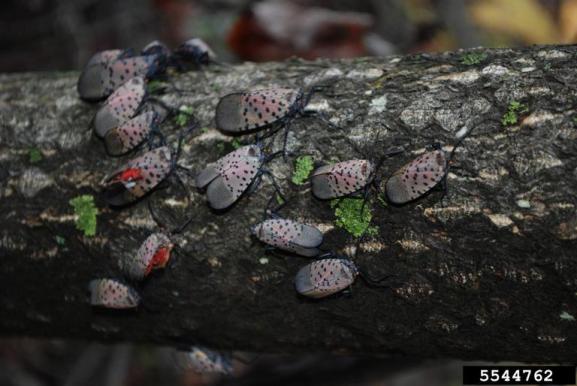
The spotted lanternfly (SLF) is an invasive pest from Asia that primarily feeds on tree of heaven (Ailanthus altissima) but can also feed on a wide variety of plants such as grapevine, hops, maple, walnut, fruit trees and others. This insect could impact New York’s forests as well as the state’s agricultural and tourism industries.
Identification
Nymphs are black with white spots and turn red before transitioning into adults. They can be seen as early as April. Adults begin to appear in July and are approximately 1 inch long and ½ inch wide at rest, with eyecatching wings. Their forewings are grayish with black spots. The lower portions of their hindwings are red with black spots, and the upper portions are dark with a white stripe. In the fall, adults lay 1-inch-long egg masses on nearly anything from tree trunks and rocks to vehicles and firewood. They are smooth and brownish-gray with a shiny, waxy coating when first laid.
Early spotted lantern fly nymph, photo by Lawrence Barringer, Pennsylvania Department of Agriculture, Bugwood.org
Second stage spotted lantern fly nymph, Lawrence Barringer, Pennsylvania Department of Agriculture, Bugwood.org
Late instar, or final stage nymph, spotted lantern fly, Lawrence Barringer, Pennsylvania Department of Agriculture, Bugwood.org
Where are they located?
SLF were first discovered in Pennsylvania in 2014 and have since been found in New Jersey, Delaware and Virginia. As of spring 2018, New York has no infestations, though it’s possible they are present in low numbers and have not been detected yet. Given the proximity of the Pennsylvania infestation, it is expected to be found in New York eventually.
Hatched spotted lantern fly eggs, photo by Kenneth R. Law, Bugwood.org
What is the risk to NYS?
SLF pose a significant threat to New York’s agricultural and forest health. Adults and nymphs use their sucking mouthparts to feed on the sap of more than 70 plant species. Feeding by sometimes-thousands of SLF stresses plants, making them vulnerable to disease and attacks from other insects. SLF also excrete large amounts of sticky “honeydew,” which attracts sooty molds that interfere with plant photosynthesis, negatively affecting the growth and fruit yield of plants. New York’s annual yield of apples and grapes, with a combined value of $358.4 million, could be impacted if SLF enters New York. The full extent of economic damage this insect could cause is unknown at this time. Although native insects also secrete honeydew, the size of SLF and the large populations that congregate in an area result in large accumulations of it. The sticky mess and the swarms of insects it attracts can significantly hinder outdoor activities. In Pennsylvania, where SLF populations are the densest, people can’t be outside without getting honeydew on their hair, clothes, and other belongings.
A cluster of adult spotted lantern flies, photo by Lawrence Barringer, Pennsylvania Department of Agriculture, Bugwood.org
How do they spread to new areas?
While SLF can jump and fly short distances, they spread primarily through human activity. They often hitch rides to new areas when they lay their eggs on vehicles, firewood, outdoor furniture, stones, etc. and are inadvertently transported long distances.
Fungal mat at the base of a tree that is infested with spotted lantern flies, photo by Lawrence Barringer, Pennsylvania Department of Agriculture, Bugwood.org
What are the signs of an infestation?
Sap oozing or weeping from tiny open wounds on tree trunks, which appears wet and may give off fermented odors.
One-inch-long egg masses that are brownish-gray, waxy and mudlike when new. Old egg masses are brown and scaly.
Massive honeydew build-up under plants, sometimes with black sooty mold.
What is being done?
NY Dept. of Conservation, DEC, is working with the NYS Department of Agriculture and Markets and the US Department of Agriculture to address SLF. Since it is less expensive and easier to deal with a pest before it becomes widespread, the goal is to find SLF early or prevent it from entering NY altogether. A plan has been developed that describes how the agencies will prevent and detect SLF in New York. Extensive trapping surveys will be conducted in high risk areas throughout the state as well as inspections of nursery stock, stone shipments, commercial transports, etc. from Pennsylvania and New Jersey. DEC and partner organizations encourage everyone to be on the lookout for this pest. State Parks and others are also mapping locations of tree of heaven, an invasive tree that is a known host of SLF to target places to look for SLF. Where feasible, reducing populations of tree of heaven may also be beneficial.
What can I do?
Learn how to identify SLF.
Inspect outdoor items such as firewood, vehicles, and furniture for egg masses.
If you visit states with SLF, be sure to check all equipment and gear before leaving. Scrape off any egg masses. Visit agriculture.pa.gov for more information on SLF in PA.
Hydrilla is one of the highest priority invasive plants in New York State. It outcompetes native plants and causes destruction in our aquatic habitats. It can invade the deeper waters where many of our natives cannot and can aggressively grow up to an inch per day. This allows hydrilla to form thick mats at the top of the surface blocking sunlight for the native plants below. Oxygen is then depleted leading to a decrease in the amount of oxygen in the water and potential fish kills. Sportfish weight and size can decrease due to the loss of open water and natural vegetation and their spawning habitats can be eliminated by hydrilla. The species also causes obstructions for boating, swimming, and fishing. The large dense mats of vegetation can cause property value to decrease, creating problems for homeowners and communities. Hydrilla not only affects our native habitat but also our local communities and businesses.
Sprouting hydrilla seeds, photo by Leslie J. Mehrhoff, University of Connecticut, Bugwood.org
Hydrilla plant, photo by Leslie J. Mehrhoff, University of Connecticut, Bugwood.org
Hydrilla is a perennial plant. It grows in springs, marshes, lakes, canals, and rivers. This plant can tolerate low and high nutrient conditions and up to 7% salinity. There are two kinds of hydrilla; a southern population which is comprised of mostly dioecious females (meaning the plants only have female flowers), and northern populations which are monoecious (meaning the plants have both male and female flowers). The dioecious females overwinter as perennials. The monoecious plants set fertile seed and depend on their tubers for overwintering. Hydrilla can reproduce four different ways, including fragmentation, tubers, turions, and seeds. Fragmented pieces with one node are able to sprout into a whole new plant. Tubers are formed on the rhizome of the plant and each one can produce up to 6,000 new tubers! These tubers can lay dormant for over four years before sprouting into a new plant. Turions, or dormant buds, form in the leaf axil of the plant and then break off and settle into the sediment to produce a new plant. Seed dispersal is the least important reproductive method for the species and is often facilitated by ingestion and subsequent dropping of migratory birds. These plants can grow in low light conditions, deep depths and can photosynthesize earlier in the morning than their native competitors. At its beginning stages it can grow up to an inch a day until it reaches the surface of the water.
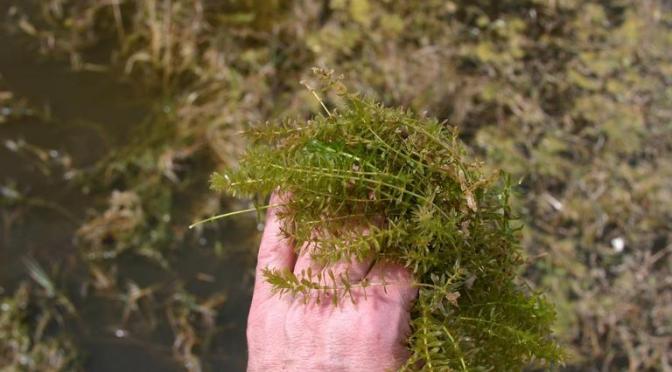
Note how small the hydrilla leaves are, photo by Leslie J. Mehrhoff, University of Connecticut, Bugwood.org
Identifying hydrilla can be very tricky at times because it looks similar to a native plant, American elodea, and another invasive plant, Brazilian elodea. There are a few distinguishing characteristics that set hydrilla apart from the other two aforementioned species. The leaves are 5/8 inches long and they grow in whorls of 3-10, 5 leaves per whorl being most common. The leaves have distinct serrated edges. A key feature is the dull-white to yellowish, potato like tuber that grow 2-12 inches below the sediment.
A dense mat of hydrilla, photo by Leslie J. Mehrhoff, University of Connecticut, Bugwood.org
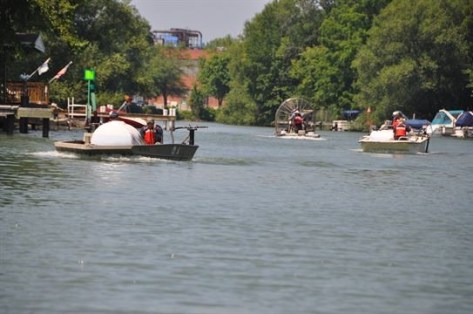
Hydrilla is thought to have originated from the island of Sri Lanka and possibly the southern mainland of India, but it arrived in the United States from Korea as a popular aquarium plant. Colonies were first identified in canals in Miami and Tampa, Florida. Hydrilla fragments made their way up to New York by attaching to boats, their trailers, and live wells. Boat motors, oars, and other equipment break the plant into fragments, facilitating its spread throughout the affected water body and into nearby water bodies that are hydrologically connected. Hydrilla can spread between water bodies that are separated by geographic distance by “hitching a ride” on watercraft trailers and other recreational equipment. The first time hydrilla was discovered in New York was in August 2011, when Jordan Stark found the species in Cayuga Inlet in the Finger Lakes In September of 2012, the species was found in the Erie Canal in North Tonawanda by a U.S. Fish and Wildlife biologist. It has also since been found in Long Island, including Caleb Smith State Park Preserve in Phillips Mill Pond. Since the introduction of hydrilla in New York, a coalition of partners, which includes many state agencies, non-profit organizations, and businesses have taken quick action to help prevent its further spread. After a population of hydrilla is found, partners mobilize resources to conduct a focused education and outreach campaign and survey the area where hydrilla was found to understand the full extent of the population. Once surveying is completed a management plan is implemented, which includes aquatic herbicide application. To learn more about best management practices, please go to http://hydrillacollaborative.com.
Want to help manage this unruly aquatic plant? Learn how to properly identify hydrilla. If you think you found hydrilla take pictures, mark your location, and contact your regional DEC office or submit your observation with pictures on the iMapInvasives mobile app or website. Also, it is important to clean, drain, and dry your boats and any fishing or recreational equipment!
It was a beautiful Monday morning as my fellow Student Conservation Association Hudson Valley AmeriCorps members and I made the trek to the Sam’s Point Area of Minnewaska State Park Preserve. Members were coming from as far north as Moreau Lake State Park (near the Adirondacks) and as far south as Jones Beach State Park on Long Island. I had come to Sam’s Point before to volunteer with bird surveys, so I was thrilled to return to this spot for our service project. We had gathered at what would be our home base for the next three days – us in a circle, cars in the background, and a spectacular view of Sam’s Point itself. We had gathered here for the 9/11 Patriots’ Day of Remembrance and held a moment of silence to reflect on that day 16 years ago, as well as the service we would be providing for the parks.
Before we could get started, some orientation was in order, as there was a lot of information to cover. Sam’s Point has a rare population of ridgetop dwarf pitch pine barrens, supporting wildlife such as birds, fishers (small mammals related to weasels), and porcupines. In April 2016, a wildfire broke out in the area, and efforts are underway to study the resilience of this ecosystem. We were able to see more of the area by hiking up to the scenic overlook as well as to the super cool ice caves!
Some of the invasive species removal crew
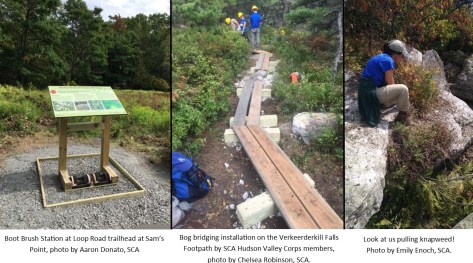
There were multiple projects being done in our three days of service. Two crews worked on erosion control devices on the Verkeerderkill Falls Footpath. One crew worked on making water bars, trail structures that take the water off the trail. Another crew worked on building bog bridges, low wooden bridge structures that raise the trail out of the water or other sensitive area. The third crew was constructing invasive plant boot brush stations at various entrances around the park preserve. I was part of the invasive species crew for the service project. Our main focus was removing spotted knapweed, a purple flower that grew on the edge of the Loop Road. We had been out in the sun working hard on knapweed removal, and towards the end of the day, decided to move in the shade to work on stilt grass.
On the trail in Sam’s Point Area.
While pulling knapweed for many hours at a time, SCA members were able to have some fun. We had started to play the game Murder on the Trail, which is where the “killer” would stick out their tongue at a person, and five minutes, later the “victim” had to die dramatically. Aaron (one of the program managers) came to check in on us and did not know we were playing this game – he wasn’t sure what was happening when someone dropped to the ground. Other fun things included exploring Lake Maratanza and finding baby snakes! From the beginning of the trail at the bottom of the ridge, all the way to the top, past Sam’s Point towards Lake Maratanza, we pulled almost half a mile of knapweed. That’s a lot of knapweed!
The other teams worked hard and played hard too! The bog bridging crew installed over 170 feet of new bog bridges and the water bar crew improved almost a quarter mile of trail on one of the park preserve’s most popular trails. The boot brush crew installed three new boot brush stations to educate the public about invasive species and help stop the spread of invasive plant seeds.’
After three days of hard work and camping out at Sam’s Point, it was time for all of us to return to our homes in the Hudson valley. We had done great work for the park and I was happy to be a part of it.
Thank you to the SCA, SCA members, State Parks, and the staff of Sam’s Point. Until next time!
Post by Emily Enoch, SCA Hudson Valley AmeriCorps Member
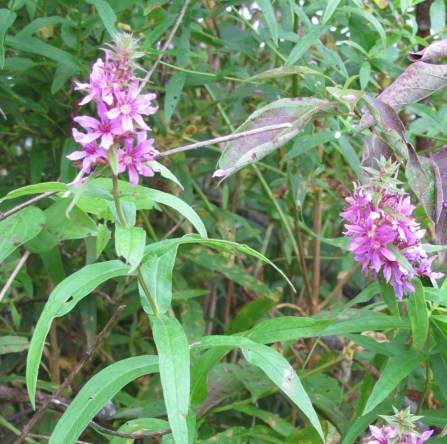
Purple loosestrife (Lythrum salicaria) is an invasive plant from Europe and Asia that can overcrowd native wetland plants. It is easily recognized by its tall and showy purple spike of flowers in the summer, lance-shaped leaves and square stems. As an invasive species, it lacks its natural predators and can spread quickly, producing as many as 2.7 million seeds a year.
Purple loosestrife flower spikes at Silver Lake State Park. Photo by Amy McGinnis
Wetlands are rich habitats that support a diversity of plant, insect and animal species, such as marsh marigold (Caltha palustris,) twelve-spotted skimmer dragonfly (Libellula pulchella,) painted turtle (Chrysemys picta,) green heron (Butorides virescens.) The introduction and spread of purple loosestrife has resulted in the loss of native plant and animals that depend on wetland habitats. In addition, purple loosestrife limits the growth of rare plants and can clog drainage ways and ditches, negatively affecting adjacent land and crops.
Purple loosestrife plants in bloom at Silver Lake State Park. Photo by Amy McGinnis, State Parks
Since purple loosestrife grows in wetlands, methods to control this plant and promote native biodiversity aren’t always easy. Small young infestations can be removed using hand tools, but care must be taken to dig out all of the root portions to avoid regrowth. This may not be feasible for larger, more established infestations. The flower heads cut be cut, bagged and disposed of to prevent seed production and the spread of this plant. Chemical herbicides can be utilized by licensed applicators that follow strict protocols to avoid contaminating water bodies and non-target native species. However, there is an easier way to fight this invasive: biological control or biocontrol. Biocontrol is the control of an invasive species by introducing a natural predator of that species following very specific federal and state regulations and testing to make sure there will be no other negative impacts on the ecosystem. In this case, the biocontrol is the small purple loosestrife beetle, a beetle of the genus Galerucella. These are native to Europe and Asia and feed on purple loosestrife in its native range, keeping the plant in check.
Scientists must thoroughly test any biocontrol species to make sure they only affect the target invasive species and don’t negatively impact native species. In the U.S., studies have shown the beetles to be very host-specific, feeding and reproducing predominately on purple loosestrife. The beetles do not completely eradicate purple loosestrife, but they suppress the plants’ growth and ability to reproduce by feeding on its stems, buds and leaves. Thus, they reduce the plants’ dominance and impact within the ecosystem. Since 1992, biologists working under state and federal permits have released millions of these beetles at numerous sites across the northeast, including at several New York State Parks, such as Silver Lake State Park in western NY. In NY, the Department of Environmental Conservation continues to monitor the numbers and effectiveness of the beetles and to ensure there are no unforeseen problems.
The beetles are released in the summer when loosestrife is actively growing. They overwinter in the soil near the host plants and emerge in the spring to reproduce, with females laying eggs from May to June. When they hatch, the larvae feed on the loosestrife’s young growth and work their way down the plant where they eventually enter the soil to pupate. They emerge as adults in the summer and the cycle continues. Though they are not strong fliers, occasionally the beetles have been found 10-12 miles away from the initial release site.
Release sites for the beetles are determined by the dominance of purple loosestrife. These sites usually have a high percentage of loosestrife plants where hand removal of them is difficult. Biologists must submit an application to the Department of Environmental Conservation to justify the need for the beetles and receive a permit. The number of beetles depends on the size of the purple loosestrife infestation. Silver Lake State Park is one location where the beetles have been used as a biocontrol for this invasive plant. Silver Lake has an approximate 40 acre wetland with a purple loosestrife population of about 15%. In 2010, 800 Galerucella beetles were released in an effort to control the loosestrife. One meter by one meter plots were established in order to monitor the survivorship of the beetles and the defoliation, or the loss of leaves, stems and flowers, of the plants where the beetles have fed on them. Each summer after the beetles have emerged, the plots are assessed to determine the effectiveness of the beetles and if any more should be released. This is done by looking at the number of loosestrife plants that are defoliated (eaten, not flowering) vs. the number that are flowering, as well as the number of beetles that are seen. More beetles have been released at Silver Lake State Park since the initial 800 in 2010; the purple loosestrife plants have remained contained to that area and their growth has been restricted. In 2016, State Parks biologists expanded the program to Letchworth State Park.
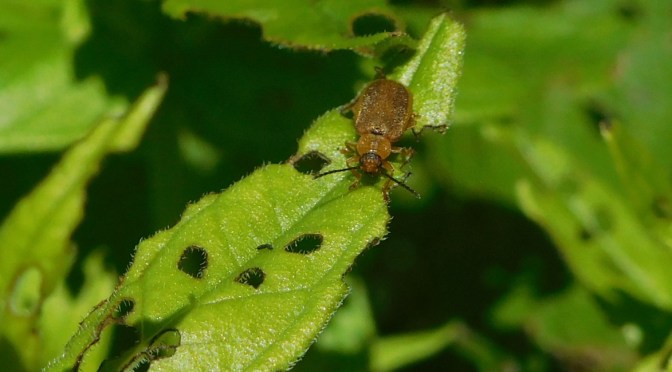
Galerucella beetles fed on these loosestrife leaves at Silver Lake State Park, photo by Amy McGinnis, State Parks
Several Galerucella beetles on a loosestrife plant at Silver Lake State Park, photo by Amy McGinnis, State Parks
The extent of purple loosestrife has declined dramatically in areas with this biocontrol. It is unlikely that the beetles will eliminate purple loosestrife populations entirely. The hope is that as more Galerucella beetles are released across the state, the invasive loosestrife will be diminished, making room once again for the native flora and fauna at these sites.
Galerucella calmariensis beetle on a purple loosestrife leaf at Silver Lake State Park, photo by Amy McGinnis, State Parks
Post by Amy McGinnis, State Parks
Featured image, Galerucella calmariensis beetle on a purple loosestrife, by Amy McGinnis, State Parks










 New York State Parks and Historic Sites Blog