In 2024, New York State Parks and Historic Sites will celebrate our Centennial, commemorating the 100th anniversary of the founding of our parks and sites system. While we have incredible public properties older than the 100-year-old system, the Centennial celebrates the vital legislation that allowed us to build and expand our network of parks and sites, forging the system we know and love today.
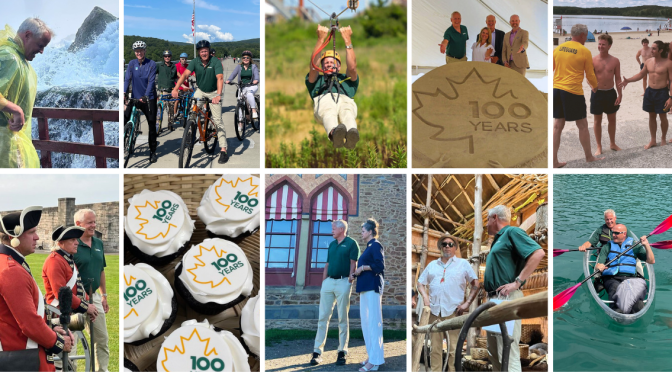
As OPRHP Commissioner, I am reminded every day of the immense pride and enjoyment New Yorkers take in our facilities. To prepare New York State residents and visitors from around the world for the exciting year ahead, I recently embarked on a two-day journey to showcase the breadth of our parks and sites system, highlighting various activities and partnerships that make our system so unique.
Poetry and literature have long been used to explore the natural world in ways that can circumvent the pitfalls of scientific and technological determinism. Similarly, in the history of architecture and landscape architecture, new modes of drawing and rendering can add contour and depth to insights from the environmental and biological sciences.
In Spring 2023, Jeanne Haffner, Special Assistant and Director/Chief Curator of the Jones Beach Energy & Nature Center and S.E. Eisterer, Assistant Professor for Architectural History and Theory at Princeton University, collaborated on a seminar for Masters and Ph.D. students called “Histories of Embodied Energy: From Turtles to the Grid.” The course followed the mission of the Jones Beach Energy & Nature Center, investigating “the relationships between human beings, energy systems, and environmental stewardship.” Students toured the Center and surrounding site, and then chose an artifact from Jones Beach to work with for the semester.
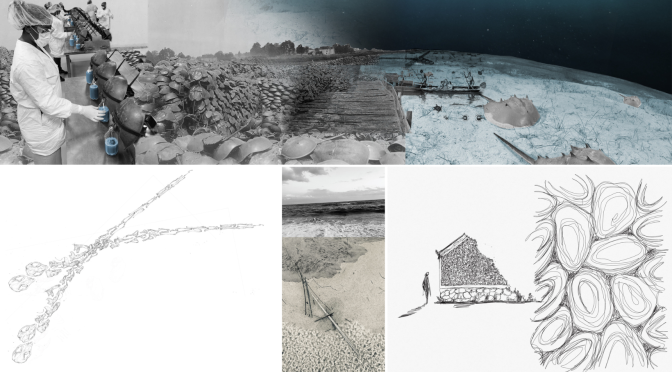
Having chosen an artifact, students wrote poems and created a drawing about it. But instead of producing abstract scientific diagrams or architectural renderings, they instead reflected upon alternative ways of representing the environment—ways that prioritize artistic, rather than strictly scientific, approaches. Maryam Popoola, for instance, sees an owl pellet not simply as an object for dissection but as a metaphor for the ever-changing nature of form. Valen Zhang’s poem and drawing considers oysters’ dynamic interactions with the ocean, beach, and built environment. For Marcos Garcia, beach grass on a sandy dune becomes a nexus between humans, lifestyles, and ecological impact. Masa Crilley depicts a horseshoe crab not in isolation, but in a long history that connects underwater worlds, Native American fishing practices, and industrialization.
This selection of poems and visuals reminds us of the continuing connection between art and environmental science, as well as the complex entanglements between environmental, social, and technical systems.
–Introduction written by Jeanne Haffner, Ph.D., Special Assistant and Director/Chief Curator, Jones Beach Energy & Nature Center (NYS Parks) and S.E. Eisterer, Assistant Professor of Architectural History and Theory, Princeton University
–Poems and visuals below created by Maryam Popoola, Valen Zhang, Marcos Garcia, and Masa Crilley
Jones Beach has always had a special relationship to energy. Located on Long Island’s South Shore just 20 miles from New York City, Jones Beach State Park is on a barrier island shaped over hundreds of thousands of years by the energy of advancing and receding glaciers, and later by the energy of the sun currents of ocean water and wind carrying sand along the coast.
Originally called Short Beach, this barrier island was inaccessible to the public. To create the state park almost a century ago, planners and engineers harnessed the energy of machines and human labor, moving sand and plants to expand the island, and building roads, amenities, and the Art Deco tower and buildings so recognizable today.
Today, energy is everywhere on Jones Beach. It’s in the dramatic dive of a predator like the Common Tern, and in the bright sun that drives photosynthesis of the Seaside Goldenrod, Beach Grass or Beach Pea. It’s in water that brings migratory species and the winds that distribute seeds and carry pollinators from plant to plant. But energy is also present in the engines of the cars that bring visitors to the Park, and in the historical construction of the parkways that they follow to get here.
In an era of climate change, and in the context of New York’s growing commitment to developing renewable energy systems, the Jones Beach Energy & Nature Center aims to help New Yorkers understand the fundamental ways human energy consumption and energy infrastructure continue to shape our natural environment.
To further this mission, the Center recently released Energy & Us, a 300-plus page curriculum for high school students that is available to view or download for teachers and school districts at no cost through jonesbeachenc.org/curriculum.
The goal of the program is to inspire young people to think critically about how energy shapes their landscapes and their lives, as well as their own roles in energy systems and ecosystems that surround them. With the beach itself as a classroom, Jones Beach State Park is the perfect place to learn about energy from sunlight, sand, wind, and water.
NATURAL ENERGY AT JONES BEACH
Let’s start by considering the very essence of Jones Beach – a simple grain of sand. A crystal structure composed of millions of molecules, typically of the compound silicate (SiO2), sand is held together with very strong bonds. By comparison, bonds in a drop of spray from the ocean are much weaker. Much less energy needs to be added to water than to sand to trigger what is known as phase shift: A puddle of water will quickly evaporate in the sun, while a similarly sized patch of sand won’t melt. Sand will melt with enough heat, as in done in glass-making, but does sand melt in nature?
Close-up images of grains of sand. (Photo credit – Wikipedia Commons)
Consider when lightning strikes a beach, it creates melted and recrystallized sand formations called fulgurites, also known as “fossil lightning.” Lightning possesses tremendous energy — the core of a lightning strike can reach 53,500 F — but only makes contact with a relatively small surface. The strike quickly heats the sand to a high enough temperature that its chemical bonds are broken. Fulgurite then forms as the energy transfers out of the melted sand into the surrounding ground and air, and the melted matter becomes solid again, forming this unusual form of fused sand.
Have you ever gone swimming in the late summer or early fall, and found the water to be warmer than the air? Solar energy that is absorbed over the course of the summer dissipates in the fall more easily from land and air than from water. This is because water is a relatively poor conductor; energy moves through it with difficulty, so water is slow to heat and slow to cool.
Air is a good insulator and a poor conductor, which is why fur and down help keep animals warm. It’s not the quantity of hairs or feathers that matters, but rather the layer of air trapped within that stops energy from being conducted out of the body into the surrounding air. Birds fluff up during the winter to trap more insulating air in their feathers.
A snowy owl sits among the sand dunes and beach grass at Jones Beach. (Photo credit – Sean Hanley and G. Anthony Svatek/Kulturfolger Productions)
When sunlight hits the beach, radiant energy transforms into the kinetic energy of excited electrons in the sand, which vibrate, producing what we experience as warmth. Maybe even too much warmth on a sunny day, as anyone who has walked barefoot knows! The excited electrons also release new photons, wave particles that carry energy away from the sand and produce what we perceive as glare.
A Monarch butterfly among the seaside Goldenrod in the maritime dunes at Jones Beach, harvesting the energy found in the flowers’ nectar. (Photo Credit – Julie Lundgren/NY Natural Heritage Program)
ENERGY DRIVES ECOSYSTEM CONDITIONS
At Jones Beach, dominant winds flow from the west and the north, pushing sand dunes gradually towards the sea. Meanwhile, ocean currents flow parallel to the mainland, pushing sand from east to west and moving the shoreline westward. A jetty constructed in the 1950s at the West End interrupts these currents, causing sand to accumulate on the eastern side while the western channel remains open.
Winter and storm-season waves typically contain more energy, pulling more sediment off the beach and into the water in a process called erosion. When large waves wash over dunes during high tides and storms — a phenomenon called “overtopping” — dunes can flatten and shift. In summer, ocean currents, waves, and winds typically bring sands back onto the beach and dunes in a everchanging cycle.
Jones Beach shoreline change map. (Photo credit – Ruth Nervig/JBENC)
Fresh sands are deposited by summer waves, wind and storms creating open habitat for piping plovers, terns and some rare plants like Seabeach Knotweed and Seabeach Amaranth. (Photo credit – Julie Lundgren/NYNatural Heritage Program)
Water and winds can also influence how species move through Jones Beach. Birds, winged insects, fish, phytoplankton, and various other organisms travel on currents in the air and water, and currents also distribute seeds, eggs, and nutrients that organisms need to survive. Local examples of this include plankton that float on ocean currents, providing food for larger marine animals; shorebirds that depend on the strong sea breeze; and grass seeds spread by water and wind. Although major storms can decimate local populations of some species, most of the plants and animals of this ecosystem are adapted to these natural processes.
Seabeach knotweed (Polygonum glaucum) is a plant that needs open and untrampled beach and dune areas. (Photo credit – Julie Lundgren/NY Natural Heritage Program)
In the aftermath of a hurricane at Jones Beach, the massive energy of the storm washed up this massive uprooted tree trunk. (Photo credit – Julie Lundgren/NY Natural Heritage Program)
ENERGY SHAPES PUBLIC INFRASTRUCTURE AND PRIVATE LIFE
When planner Robert Moses envisioned Jones Beach State Park in the 1920s, he recognized that the automobile would have an increasing role in daily American life.
The rise of cars was coupled with another innovation by automaker Henry Ford – the assembly line that allowed for costs to be reduced, creating a new class of workers with enough disposable income to purchase the goods they produced, and with more leisure time to allow travel.
Jones Beach State Park was one of the first and most prominent parks to connect this growing urban middle class to the environment.
Automobiles entering Jones Beach on its opening day on Aug. 24, 1929. (Photo credit – New York State Archives)
A map showing the Parks and Parkway envisioned by Robert Moses. (Photo Credit – Long Island State Parks Commission)
In 1924, as the new chairman of the State Parks Commission and President of the Long Island State Parks Commission, Moses began planning a system of “Parks and Parkways” to connect car-owning city residents to beaches and parklands across Long Island. Moses envisioned parkways as an extension of the parks themselves: green spaces that transported urban dwellers to a beautiful natural landscape.
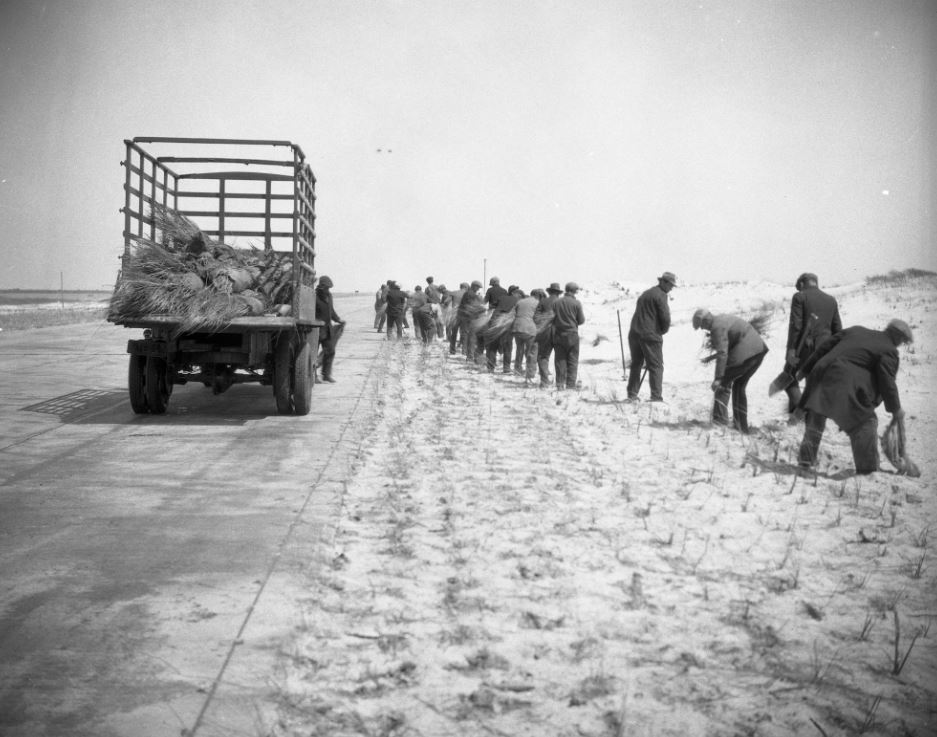
Jones Beach opened in 1929 as a triumph of 20th century engineering. Forty million cubic yards of sand were dredged from the bay to widen the beach and raise its elevation up to 12 feet. Workers hand-planted a million native Beach Grass plants to prevent the taller dunes from blowing away in the wind.
Workers planting Beach Grass during construction at Jones Beach State Park (Photo credit – NYS Parks)
Beach Grass (Ammophila breviligulata), native to Long Island, has long roots which help create and stabilize the maritime dunes at Jones Beach. (Photo credit – Julie Lundgren/NY Natural Heritage Program)
Moses’s plan for parks and roads across Long Island reflected a new approach to “nature,” one of landscapes constructed intentionally for public enjoyment. The parkways also helped spark a new era of Long Island suburbanization, which greatly increased consumption and the demand for energy.
Many different types of energy come together at the Jones Beach Energy & Nature Center. As climate change impacts the globe with rising seas and stronger storms, Jones Beach will model the positive possibilities for access and use of energy. Solar panels that power the Center represent New York’s commitment to expand renewable energy and reduce greenhouse gas emissions that are driving climate change. Resilient design modeled by the building itself will be key as New York’s communities adapt to rising sea levels and changing weather patterns.
There has never been a more important time for New Yorkers to understand the connections between energy, nature, and society. With the Energy & Us curriculum, young people throughout the state can begin to reconsider about how those forces shape their own lives, and how they can engage with them to transform the future.
Cover shot – Jones Beach Energy & Nature Center, Michael Moran/nArchitects
Post by Olivia Schwob, a writer, researcher, and editor interested in human geography, political economy, and public things. Olivia was Developer of the Energy & Us curriculum from 2020-2021, Curatorial Team Writer for the Jones Beach Energy & Nature Center from 2019 – 2020, and Managing Editor of Urban Omnibus, a publication of the Architectural League of New York, from 2016 – 2019. She lives in Brooklyn.
Early October is such a great time for families to get out and enjoy our parks: October skies are generally clear, colorful fall foliage enhances any scenic vista, and the cool fall days encourages all of us to explore the outdoors. State Parks has accessible trails (trails for people with diverse abilities) that all family members can enjoy autumn’s beauty. If you are looking for an accessible trail to explore this fall, check out one of these trails!
The path awaits you at Buffalo Harbor State Park
Areal view of Buffalo Harbor State Park accessible trail
The newest state park in Western New York (WNY) was created with a focus on providing access to the Buffalo waterfront and recreational opportunities for the whole community. In just four years, Buffalo Harbor State Park has become a popular destination with universally accessible shelters, docks, nautical-themed playground, and accessible van parking. The paved multi-use trail with shaded sitting areas and lighting, connects visitors with a beautiful view of Lake Erie and the path along the newly rehabilitated break wall provides one of the best views of the city. Buffalo Harbor is also a stop on the Shoreline Trail and the gateway to the Empire State Trail, the 750 mile trail that connects WNY to New York City along the Erie Canal.
You never know who you will meet along the trail. At Sackets Harbor Battlefield State Historic Site, visitors chat with a War of 1812 reenactor along the trail.
Sackets Harbor Battlefield History Trail tells the story of Sackets Harbor and the pivotal role it played during the War of 1812 through ten interpretive panels along the three-quarter mile loop trail. Additional panels highlight other historical aspects of the site including the 1860s Sackets Harbor Navy Yard and the importance of historic preservation. This accessible trail offers views of the 1860s Navy Yard structures, the 1913 War of 1812 Centennial 100-maple tree grove, the 1930s Civilian Conservation Corps decorative stonewall, abundant birdlife, and unsurpassed views of Black River Bay on the eastern end of Lake Ontario. The three-quarter mile trail was listed as a National Recreation Trail in 2015.
High atop Bear Mountain, along a 0.4-mile section of the Appalachian Trail (AT) is a popular trail enables everyone the opportunity to hike along the AT, that famous trail that runs from Georgia to Maine. From the trail, visitors can see the Hudson Valley and if it is clear, the Catskill Mountains.
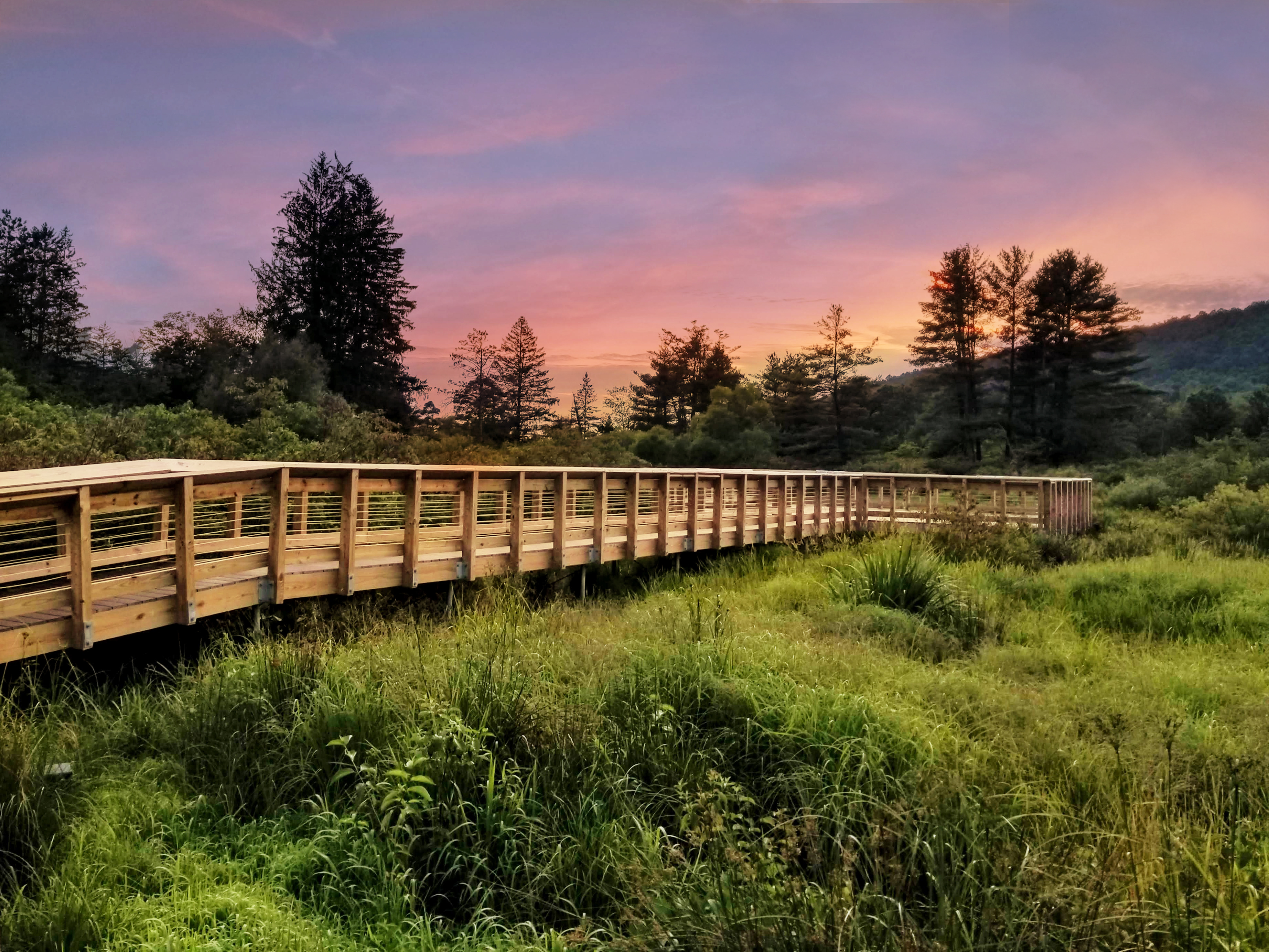
Allegany State Park Red House Wetland Interpretive Trail at sunset.
Allegany State Park’sRed House Wetland interpretive trail, constructed in the fall of 2016, brings visitors right into the heart of a diverse and constantly-changing scrub-shrub wetland located near Red House Lake. With the construction of America Disability Act -compliant boardwalks and crushed stone trails, this overlooked and all but impassable wetland habitat has become a popular destination accessible to all. A large observation deck, wildlife blind, and earthen viewing mound frame beautiful landscape views and offer an up-close look at the plants and animals inhabiting this essential ecosystem. Visitor experience is enhanced by a year-round schedule of educational programs and a collection of interpretive features that emphasize important aspects of wetland biodiversity, ecosystem benefits, stewardship values, and more. Everyone is welcome to visit Red House wetland and experience a landscape that can change practically overnight…you never know what you’ll see!
Miles of beaches to explore along the Jones Beach Bike Path.
????????????????????????????????????
If you are looking to explore the shore, then check out either the boardwalk and the bike path at Jones Beach State Park. An entry to the five-mile bike path is on the east side of the park’s East Bathhouse parking lot. The path travels along Zach Bay, where you can pause to watch the boats in the bay, look for migrating birds, and listen to chirping crickets. If you are looking for an ocean view, then head over to the Jones Beach Boardwalk, a two-mile boardwalk on the beach. There are two entrances to the boardwalk one in Field 1, the other in Field 6.
State Park offer safe and enjoyable places to explore and discover New York’s great outdoors throughout the year. venture out and experience the vast network of trails across the state in every season. Don’t miss out on one of the best times to visit. Enjoy State Parks trails this fall.
In 2012, one of the largest weather events in New York’s recorded history swept across the state’s southeastern border. Superstorm Sandy’s wrath bore down as counties upstate and on Long Island were still recovering from the devastating flood waters and wind damage brought by Hurricane Irene and Tropical Storm Lee in late summer 2011. Fourteen counties were declared federal disaster areas, thousands of lives were affected, countless miles of roads closed or washed out, and hundreds of thousands of homes damaged or destroyed by storm surge and catastrophic flooding. However, in typical New York style, once the storm subsided, people from across the state came together to begin the recovery effort.
Five years after the storms, the state is continuing to invest funds in order to ensure that New York is more resilient and better prepared to withstand future storm impacts. Although most of the attention has understandably focused on housing reconstruction and high-profile infrastructure proposals, there is a quieter, but no less critical story to be told, about our State Parks. Led by the tireless efforts of Governor Andrew Cuomo, state government has worked closely with local governments and community organizations to make the state park system more resilient than ever.
According to a recent report by the Governor’s Office of Storm Recovery (GOSR), the state has received over $4 billion in Community Development Block Grants for disaster recovery (CDBG-DR) from the United States Department of Housing and Urban Development (HUD). The CDBG-DR program was implemented by HUD in the 1970s to promote long-term recovery efforts in communities affected by disasters. Through this program, managed by GOSR, approximately $111 million of these funds have been invested toward resiliency improvements at four State Park facilities – Robert Moses, Jones Beach and Hempstead Lake State Parks on Long Island, and Roberto Clemente State Park in the Bronx.
One of the jewels of the state park system, Jones Beach State Park on Long Island’s south shore welcomes nearly six million visitors to swim, sunbathe, recreate and relax at its white sandy beaches every year. Less than 20 miles from New York City, the park is a vital public resource for the millions of residents and visitors in the community. During Sandy, the park suffered significant damage to its buildings and infrastructure. Thanks to $4 million in grant funding from GOSR, State Parks will be able to upgrade the park’s drainage infrastructure to slow down and filter stormwater runoff and help improve water quality at the popular Zach’s Bay swimming area. The project also includes funding to install flood resistant doors and windows on select buildings with critical infrastructure. Further, by incorporating native plantings and continuing to conserve the large natural areas in the park, the landscape can better buffer the impacts of storms on facilities in the park and around the bay.
Volunteers plant beach grass at Jones Beach State Park.
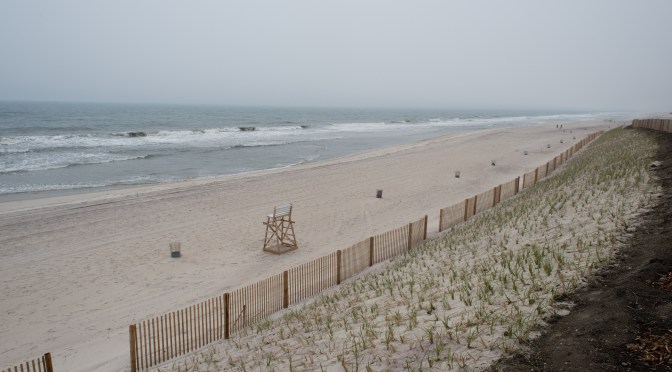
Robert Moses State Park, located on the western end of Fire Island, is best known for its five miles of public beaches which receive over four million visitors a year. The beaches and dunes on barrier islands, like those at Jones Beach or Robert Moses, serve as a crucial buffer between the open ocean and the coastal towns, helping to reduce the damaging effects that can occur during storm events. The natural habitats, animals, and plants of these places are adapted to the changing shoreline and the movement of sand, but roads and homes are not. During Sandy, Robert Moses State Park experienced severe erosion of its beaches from wind, waves, and heavy surf. Though nature would likely restore these beaches over time, there was high risk of damage to roads and buildings in the park. Grant funds through the CDBG-DR program helped stabilize these vulnerable areas of the park by nourishing those sections of beaches to return them to their pre-storm conditions. Additional CDBG-DR funding will also go toward replacing the park’s existing water treatment plant with a newer, more flood-resistant facility elevated above the current flood zone.
Improvements are also underway at Roberto Clemente State Park in the Bronx, which spans 25 acres along the Harlem River in the Morris Heights neighborhood. The park provides recreational facilities for underserved communities in the region in addition to serving as a coastal barrier for residents and local infrastructure, including the nearby River Park Towers residential complex and an adjacent Metro North station. During Sandy, floodwaters rose to more than three feet above the park’s 40-year-old bulkhead, damaging the park’s lower plaza and esplanade. CDBG-DR funds will be used to give this critical neighborhood gathering place a much-needed makeover. The outdated bulkhead will be replaced, and the esplanade will be rebuilt with modern infrastructure elements and green design (including landscaping with plants native to this area). These efforts will create a more stable, resilient shoreline and park facility.
Improvements to Hempstead Lake State Park, image courtesy of Stantec
Finally, plans are under development to invest $35 million in CDBG-DR funds at Hempstead Lake State Park on Long Island, as part of the larger $125 million Living with the Bay project. The Living with the Bay project aims to connect communities along Nassau County’s Mill River watershed and strategically install protective measures to help mitigate flooding, improve water quality, and enhance the overall ecology from Hempstead Lake State Park to the South Shore Estuary. As part of the overall project, major improvements will be made to the park, including rehabilitating a century-old dam and non-functional control systems, renovating multi-use trails, constructing fishing piers and boat launches, dredging park ponds (to increase water storage capacity during flood events), and constructing a “floatables catcher” to help capture trash that flows into the park during heavy rain events. A multi-purpose educational facility will also be constructed and will serve as a coordination center during emergencies.
Installing wetlands project
Constructing river rock dams to control water flow
Constructing a “floatables collectors’
Storms are a natural and often necessary part of maintaining our coastal ecosystems, but can be devastating to our homes, our communities, and businesses. Although New York has made tremendous progress recovering from the damages suffered during Superstorm Sandy, Hurricane Irene, and Tropical Storm Lee, there is still more work to be done. Governor Cuomo, recognizing the value of our parks to the state’s economy and to the health and well-being of its residents, has helped marshal the resources the agency needs for both immediate rebuilding and more strategic long-term recovery efforts. New York will continue to invest in its state parks to help us continue to become more resilient and able to meet the challenges yet to come.
Post by Ben Mattison, Excelsior Fellow, State Parks









 New York State Parks and Historic Sites Blog