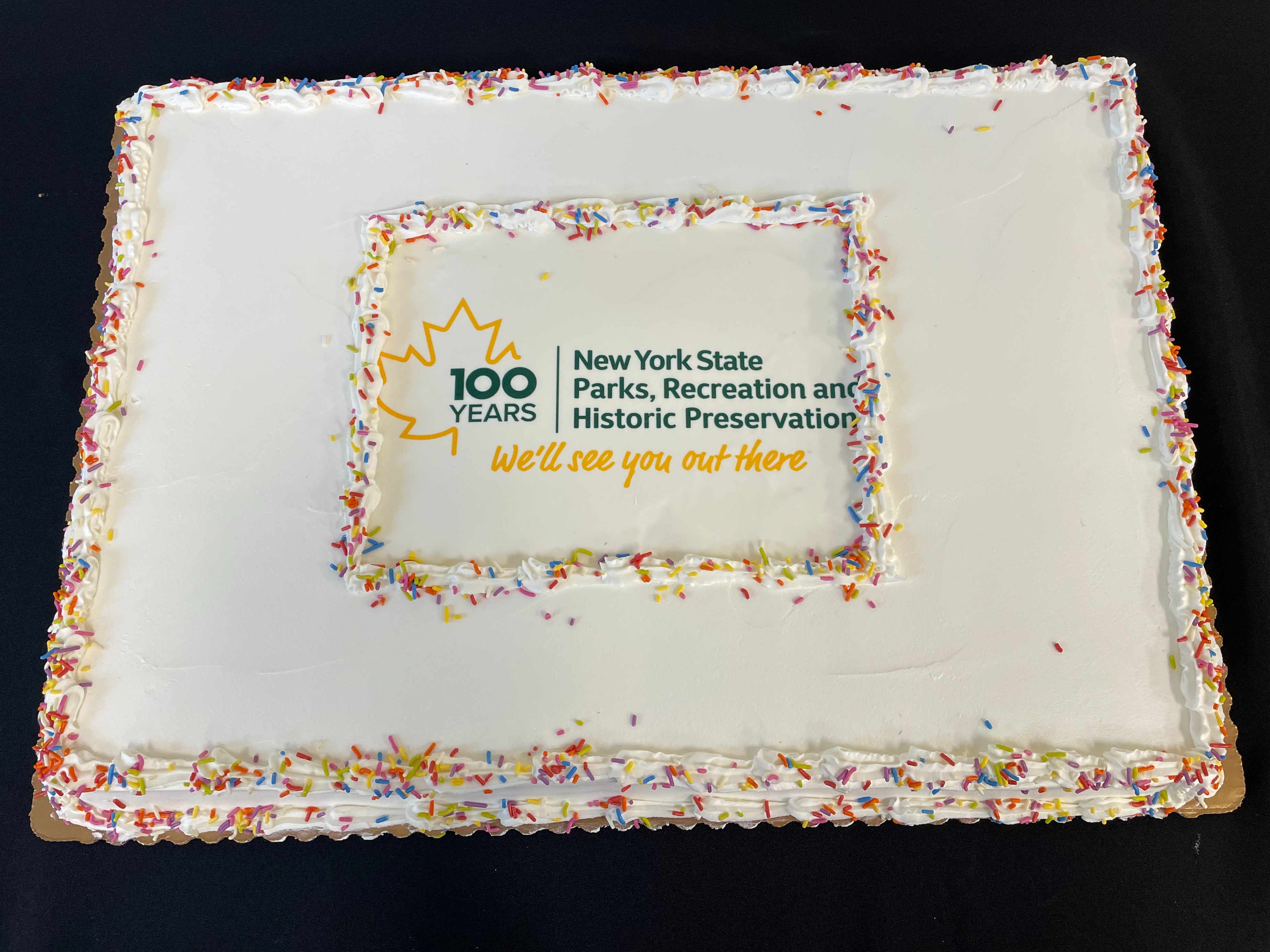
Happy birthday to us! The New York State parks and historic sites system is now 100 years old, and we celebrated our founding and lit up almost two dozen landmarks around the state in Parks green and Centennial gold to mark the day last week.
Although several of our parks and historic sites have existed for more than 100 years—Washington’s Headquarters State Historic Site and Niagara Falls State Park, for example—it was on April 18, 1924, that the State Council of Parks (SCOP) was formed, creating our modern parks system.
A Centennial birthday cake at the newly opened Robert H. Treman exhibit reception in Ithaca.
Established by Governor Alfred E. Smith and the New York State Legislature in 1924, SCOP and subsequent voter support for a $15 million Bond Act placed the future of many of New York’s public lands in our hands. Alongside great partners, staff at our agency have served as stewards since then, preserving New York’s most treasured lands and historically significant places. Today our system spans over 250 properties in every part of the state, improving the lives of millions of New Yorkers and connecting communities to the outdoors.
Missed our birthday? No problem. We created a video recap documenting the events of the day. You can find this video, along with other Centennial content, on our YouTube channel. Be sure to subscribe if you haven’t already, as we’ll be adding even more announcement videos into this digital goody bag as the year goes on!
Saratoga Spa State Park is remarkable not only for its heralded mineral springs, but also for its architecture and historic theater. Now known as the Spa Little Theater, the space was originally designed for the scientists who studied the surrounding mineral springs to share their findings.
In September, the Spa Little Theater and nearby buildings and grounds were once again a place of scientific knowledge sharing, hosting the 2023 New York State Invasive Species Expo that brought land managers, researchers, and the public together for an immersive three-day interactive learning experience and conference.
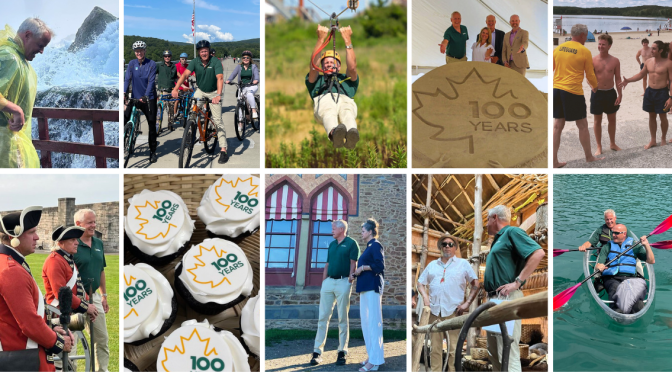
In 2024, New York State Parks and Historic Sites will celebrate our Centennial, commemorating the 100th anniversary of the founding of our parks and sites system. While we have incredible public properties older than the 100-year-old system, the Centennial celebrates the vital legislation that allowed us to build and expand our network of parks and sites, forging the system we know and love today.
As OPRHP Commissioner, I am reminded every day of the immense pride and enjoyment New Yorkers take in our facilities. To prepare New York State residents and visitors from around the world for the exciting year ahead, I recently embarked on a two-day journey to showcase the breadth of our parks and sites system, highlighting various activities and partnerships that make our system so unique.
When it comes to planning a vacation or getaway, New York State Parks has overnight options for all kinds of adventures – and budgets!
While some enjoy sleeping in tents away from it all in remote, natural settings under the stars, others crave a few more amenities. Whether you prefer booking rustic cabins and bringing your RV, staying in fully equipped cottages, or resting your head at a historic inn or resort with the comforts of home, State Parks has something for everyone.
Our Parks system includes 8,148 campsites, 967 cabins and cottages, 18 yurts, three inns, and – yes – a lighthouse. There are countless adventures for every type of stay. Get a map handy and explore highlights from some of our most interesting properties to inspire your next stay.
La Isla Bonita
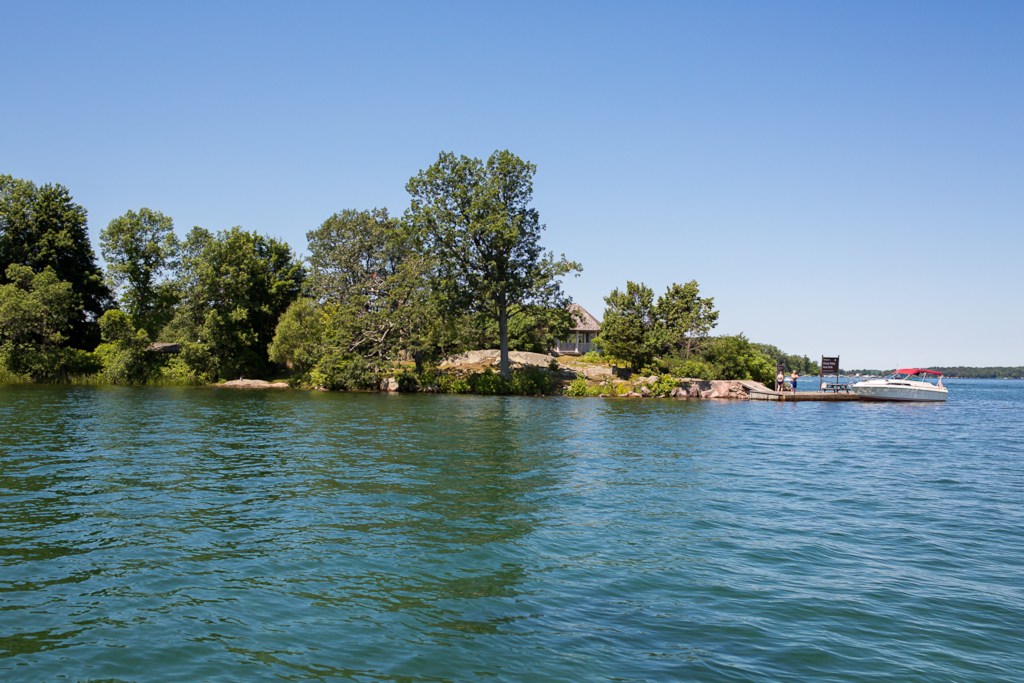
If you have a boat or have access to renting one, answer the siren song of the water and consider the benefits of staying on one of three island parks in the Thousand Islands that are only accessible by boat.
Why worry about clearing your campsite for the tent when you can enjoy a level platform? Platform camping provides a wooden deck floor for pitching your tent on a smoother and more even surface.
A camping deck inLake Taghkanic State Parkin Ancram.
The perfect place for a family reunion on the Great Lakes? Check. Lakefront luxe in the Finger Lakes for a bachelorette wine-tasting weekend? Check. Thousand Islands waterfront cabin for anglers telling fish tales about the day’s catch? Check. Memories to last a lifetime? Check, check, check.
Robert Wehle State Park’s cliffside compound, Thousand Islands region.
Robert Wehle State Park features a private setting that accommodates eight, and includes a compound with a main house, guest quarters, studio, and formal gardens set cliffside along the Lake Ontario shorefront.
A cabin porch at Betty and Wilbur Davis State Park in Schenevus near Cooperstown.
Fans of America’s pastime can stay at a cottage at Betty and Wilbur Davis State Park near Cooperstown and head to the National Baseball Hall of Fame, then go old school and listen to a game on the radio from the cottage’s front porch.
Spring has finally arrived, and with it comes the birth of this year’s first generation of Karner blue caterpillars. When these caterpillars hatch from the eggs that were laid by last year’s second generation of adults, they will eat only one thing, the leaves of the wild blue lupine plant. And you thought your kids were picky eaters!
Wild blue lupine is a perennial plant that prefers dry, sandy soils in open patches of land. It is typically found in pine barrens and oak savanna plant communities. These habitats require ecological disturbances, such as wildfires, to sustain the sunny, open areas that wild blue lupine needs to survive. Land development and the suppression of natural disturbances in these areas have led to degradation and loss of habitat, causing drastic declines in Karner blue butterfly populations. As a result of this, the Karner blue butterfly was declared endangered in New York in 1977 and federally endangered in 1992. The Karner blue butterfly’s range extends from Minnesota to New Hampshire, along the northern portion of the blue lupine’s range. In New York, populations are found from the Albany Pine Bush north to Glens Falls, with a segment of suitable habitat found in Saratoga Spa State Park.
Wild blue lupine. Photo by USFWS; Joel Trick.
There are two generations of Karner blue butterflies born each year, the first of which hatches in May from eggs that were laid the previous July. This timing coincides with the blooming of wild blue lupine flower stalks. The caterpillars spend about two to three weeks feeding on wild blue lupine leaves before they pupate. The adult Karner blue butterflies emerge at the end of May or beginning of June and typically live for about a week. During this time, the adult females lay their eggs on the underside of wild blue lupine leaves or stems. The eggs take around a week to hatch and the second generation of adults appear in mid-July to early August. This time the females lay their eggs on the ground close to the stem of a blue lupine plant to provide them with more protection as they overwinter.
Karner blue caterpillar (larva). Photo by Paul Labus, The Nature Conservancy, Indiana.
Adult Karner blue butterflies are relatively small, with an average wingspan of about one inch. You can tell the difference between males and females by looking at the coloration on the tops of their wings. Males’ wings are silvery blue to violet blue with a black margin and white fringed edges, while females’ wings are grayish brown towards the edges, turning into violet-blue in the centers of the wings. Both males and females are gray with black spots on their undersides and have a band of orange crescents along the edges of both wings. Females also have bands of orange crescents on the tops of their wings, while males do not.
Male Karner blue butterfly. Photo by Paul Labus, The Nature Conservancy, Indiana.
Female Karner blue butterfly. Photo by Paul Labus, The Nature Conservancy, Indiana.
Underside of the Karner blue butterfly. Photo by USFWS; Phil Delphey.
There are 18.5 acres of endangered Karner blue butterfly habitat in Saratoga Spa State Park. In recent years, restoration efforts have re-established approximately 5 of these acres as suitable Karner blue butterfly habitat. This was accomplished through the removal of small trees and shrubs that had taken over the habitat, as well as the scraping away of topsoil to remove invasive plant seeds and to expose the sandy soils that wild blue lupine needs to grow. Wild blue lupine and native nectar species were then planted in the exposed sandy soil. Saratoga Spa State Park staff monitors the Karner blue butterfly population and provide educational programs to the public about this endangered beauty.
In celebration of Earth Day, students from the Waldorf School contributed to the Karner blue butterfly habitat restoration effort by spreading the seed of the native blue lupine plant on 1.5 acres at Saratoga Spa State Park. Funding for this project was provided by Governor Cuomo’s NY Parks 2020 Initiative.
Waldorf School students spreading blue lupine seed. Photo by John Rozell, OPRHP.
Waldorf School students replenishing their seed supply. Photo by John Rozell, OPRHP.







 New York State Parks and Historic Sites Blog