Tag Archives: Thacher State Park

Best Loved Hikes in New York State Parks

When quizzed about some of their best loved hikes in State Parks, our staff had to choose from amongst the hundreds of miles of hiking trails along shorelines, through mountains and open fields, overlooking lakes, rivers and gorges, and meandering through old growth forests.

Here are some of their favorites. (Note: trail maps can be found at each park’s website)

Mike’s favorite: Mine Kill State Park, located in the scenic and historic Schoharie Valley, is about an hour southwest of Albany.  The park boasts almost 10 miles of trails, the most well-known being definitely the five-mile section of the Long Path.  The Long Path (LP) is a 358 mile-long hiking trail running from New York City to John Boyd Thacher State Park just south of Albany. This particular section of the LP was designated as a National Recreation Trail by the Department of the Interior (National Park Service) in 2014 due to its unique flora and fauna, diverse history and incredible scenery.  Along this stretch of trail, a hiker may wander past active bald eagle nests, the picturesque Mine Kill and Schoharie Creek, the historic Lansing Manor and its namesake, the 80-foot high Mine Kill Falls.
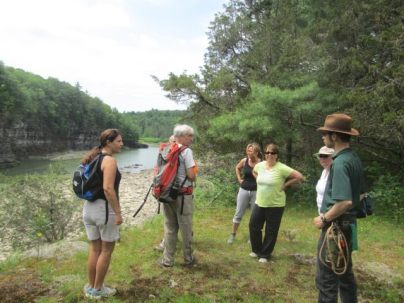
Mine Kill
Pausing along the Schoharie Creek at Mine Kill State Park, photo by State Parks

Nancy’s favorite: The Indian Ladder Trail (0.40 miles long) in Thacher State Park near Albany is like a hike through geological history. You get an up close look at the 1,200 foot high limestone escarpment as you climb metal staircases to start (and end) your hike along the bottom of the escarpment. Layers of limestone, sandstone, and shale, lifted and eroded by wind, water, and other elements, formed the escarpment over 100 million years ago. Prehistoric people used nearby areas as hunting camps, possibly as early as 6,000 B.C. Native Americans traversed the escarpment via footpaths and logs (acting as ladders) between the Mohawk/Hudson and Schoharie Valleys, hence the name ‘Indian Ladder’ Trail. Along the hike, you can see waterfalls (if it’s not too dry a season), marine fossils, small caves, and stand near the crowns of mature trees growing below the escarpment. Best of all are the views from the Indian Ladder Trail, and the Escarpment Trail above, of surrounding valleys, the urban landscape, and further in the distance, the Adirondack Mountains of New York and the Green Mountains of Vermont.

Thacher Indian Ladder Trail near Falls_0038
A mother and daughter travel through time along the Indian Ladder Trail at Thacher State Park, photo by State Parks

Nick’s favorite hikes at Minnewaska State Park Preserve in the Hudson Valley include the Lake Minnewaska Carriage Road, a two-mile gentle loop trail around the glacially formed Lake Minnewaska. It’s an historic carriage road left over from a Victorian Era mountain resort. This hike features many views of Lake Minnewaska, a peak at the Catskill Mountains from several spots, and views of the greater Hudson Valley. This hike is popular due to the lake (people love water!), the ease of access, and the rock perches and cliffs that overlook the lake and Hudson Valley.
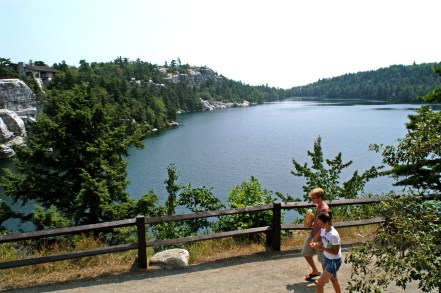
Minnewaska DSC_0101c
A couple on Red Carriageway around Lake Minnewaska, adjacent to the parking area in New York’s Minnewaska State Park Preserve, photo by State Parks

Nick’s other favorite hike is Gertrude’s Nose Trail, an approximately seven mile hike on a mixture of historic carriage roads and footpaths traversing some of the most rugged terrain in Minnewaska State Park Preserve. These footpaths are loaded with evidence (signs) of the last glacial event, featuring glacial polish, glacial erratics (large rocks deposited by glaciers), chatter marks (any of a series of grooves, pits, and scratches on the surface of a rock, usually made by the movement of a glacier(from Dictionary.com)), sharp cliffs and massive talus blocks (rock debris below a cliff face). This hike is very popular mainly because this cliff edge trail gives panoramic views of the Shawangunk Mountains along the way.

Gert's Nose
A foggy, fall day along the Gertrude’s Nose Footpath, photo by Duane Kolaya

Tom’s favorites: Green Lake and Round Lake Trails, located in Green Lakes State Park, are favorite hikes near Syracuse. They follow around the shores of these two glacial meromictic lakes. Meromictic lakes are lakes where there is no mixing of surface and bottom waters and they remain thermally (temperature) and chemically stratified (in layers) throughout the year. Other unique features of the lakes include their brilliant blue green appearance and the presence of “thrombolitic microbiolite marl reefs.” This basically means that a living organism is creating a rock out of material in the water. More specifically a cyanobacteria or algae is taking calcium compounds that entered the lake with groundwater seeping through the surrounding limestone bedrock and making it into a solid as part of cellular respiration. The United States Department of Interior designated Round Lake as a National Natural Landmark in 1975.

Green and Round Lake Trails are generally flat, 8-10 feet wide, and easy hiking trails. The full loop, including both trails, is approximately three miles long with benches located periodically for resting and enjoying the scenery. A swimming beach, playground and boat rentals are located at the north end of Green Lake. These trails are part of a 17-mile trail system in the park that also takes you through or to old growth forest, wetlands, grassland bird habitat, cliff edge overlooks, camping areas, a golf course, and connects to the 36-mile Old Erie Canal State Historic Park.
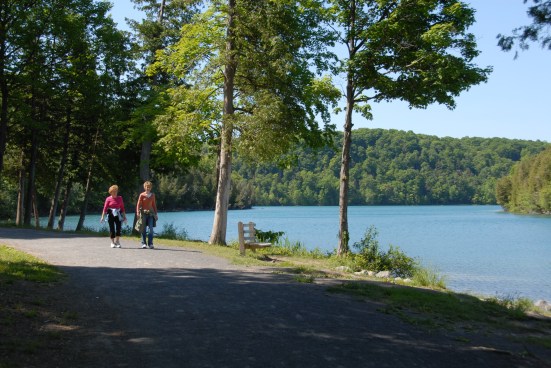
Green Lakes 5-2008 (63)
Strolling on the Green Lake Trail at Green Lakes State Park, photo by State Parks

Nicole’s favorite: As the largest State Park in the Long Island region, hiking at Connetquot River State Park Preserve can feel secluded even in the middle of densely populated Long Island. The beautiful scenery and diversity of life within the park make it her favorite hiking spot. Starting from the parking lot, the Greenbelt Trail (indicated by the white and yellow blazes) takes you directly to the fish hatchery, where you can get up close and personal with trout being raised. From there, the Red Trail can take you back along the Connetquot River to Main Pond. The Red Trail merges with the Blue Trail at the pond and the hike ends at the historic Grist Mill and Main House. Then it’s a short distance down the road back to the parking lot. This loop is a little over two miles but flat and even throughout, making it perfect for all age groups. Don’t forget to check in with the Nature Center at the Main House on the way out to find out about all of the amazing programs they have there.

first day hikes 007
Traveling along the Greenbelt Trail at Connetquot State Park Preserve, photo by State Parks

Molly recommends hiking at Wellesley Island State Park in the Thousand Islands Region. A favorite is to start at the Minna Anthony Common Nature Center and hike along the Eel Bay Trail (1.1 miles) to the Narrows Trail (0.45 miles). From there you can head back the same way or follow along another trail to loop back to the Nature Center. Sitting on the exposed granite outcroppings and watching the St. Lawrence River Eel Bay and passing glacial potholes are highlights of this hike. The Narrows is a narrow water passageway located between Wellesley Island and Murray Isle connecting South and Eel Bays. Along the Narrows Trail you can watch boats pass through the channel and see a variety of birds while picnicking on an open rock area. These trails are generally easy hiking but have some steeper rock climbing areas. Don’t forget to check out the Nature Center!

OLYMPUS DIGITAL CAMERA
Checking out the trail map at Wellesley Island State Park, photo by State Parks

FORCES stewards Nick and Adriana recommend two hikes in the Finger Lakes Region.

Buttermilk Falls State Park is a located in the heart of the Finger Lakes to the south of Cayuga Lake and has much to offer avid hikers, families, and visitors to the area. Hike the Rim and Gorge Trails together for a 1.5-mile loop, or hike each separately. Starting either trail from the lower parking lot will require a strenuous uphill walk (Rim Trail) or climbing of a long staircase (Gorge Trail). The Gorge Trail has much to offer and you will encounter many waterfalls, and beautiful rock formations along the 0.65 mile trek up the gorge.  Mosses, liverworts, and ferns coat entirety of the gorge, providing a vivid green walk that is topped by a hemlock hardwood forest along the ridge. As you come out of the gorge, you will cross a bridge to take the 0.82-mile Rim Trail back to the parking area. This walk takes you through a beautiful hemlock hardwood forest filled with eastern hemlock, chestnut oak, and witch hazel, along with many other species. This loop can be done in about an hour, but more time may be needed for taking in all the sights along the way. Hiking these two trails as a loop is a relatively easy hike after you complete the initial stairs, or uphill climb.
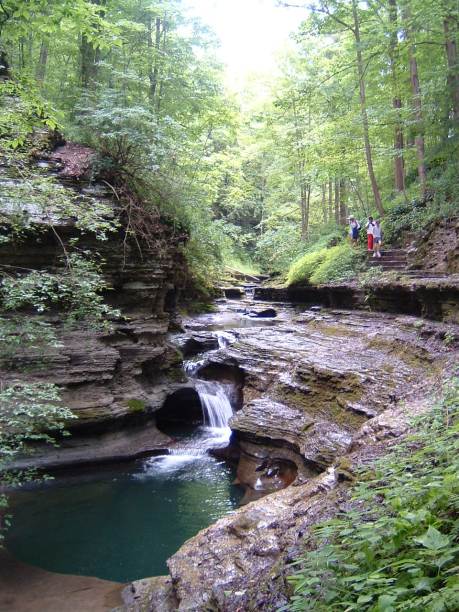
Buttermilk trail web
Along the trail at Buttermilk Falls State Park, photo by State Parks

The Upper Loop in Robert H. Treman State Park is a one mile round trip on sections of the Gorge and Rim Trails. The trail is situated above Treman Gorge and offers spectacular views of the many waterfalls including the 115-foot Lucifer Falls. The trail begins at the upper section of the park (the Old Mill Parking area) at the entrance to the Gorge Trail and takes visitors through the upper gorge. The trail highlights the scenic beauty of the gorge, amazing rock formations, stone bridges, and the many water features along Enfield Creek through the ravine. The trail takes you to the top of Lucifer Falls and then down the side. At the bottom is a wooden bridge over the stream that will take you to the Rim Trail and the second portion of the hike. This begins with a climb up the “Cliff Staircase” – it is the most difficult section of the loop but it also offers some of the best views in the park. At the top is an overlook of Lucifer Falls and then a moderate downhill slope back to the upper parking lot. Multiple overlooks from high vantage points make the trail perfect for photo ops and for viewing the gorge below. Although the hike is short, some visitors may find to be strenuous due to the elevation change and the many staircases.

out of state visitors to RHT
Visitors pause at Robert H. Treman, photo by State Parks

This weekend, try one of these hikes or find your own ‘best-loved hike’ in a park near you.


— Post compiled by Nancy Stoner, State Parks

Amphibians on the Move!

As temperatures rise, spring rains roll in, and the ground thaws, the amphibians of New York are preparing themselves for a great migration. On the 10th of March, a group of about 30 volunteers congregated near Hop Field at Thacher State Park armed with flashlights and buckets. With great excitement they looked along the road edges for salamanders and frogs, hoping to help them cross the road as the amphibians migrated to woodland pools. Throughout most of the year, mole salamanders and woodland frogs spend their time burrowed under rocks and leaves on the forest floor, but each spring salamanders and frogs can migrate up to a quarter mile to woodland pools to breed. The mass migrations to the vernal pools occur during spring rainstorms with temperatures above 40 degrees.

The rain was intermittent that night, and although spring peepers and leopard frogs were escorted across the road, no salamanders were found. The migrations typically happen in late March and early April, so there is still hope! On nights when the conditions are right, many nature enthusiasts can be seen on roadways close to wetlands helping the amphibians safely cross the road. If you are interested in getting involved in preventing vehicle related deaths during these mass migrations, contact your local State Park or local DEC office. These organizations sometimes coordinate volunteers to come together on rainy nights to help salamanders cross busy roads. The more volunteers there are to help, the more amphibians will successfully breed! Before you help the amphibians, be sure to brush up on your identification! Here is a sampling of the native amphibians that you could see in New York.

Mole Salamanders:

Blue Spotted
Blue spotted Salamander, By Greg Schechter [CC BY 2.0 (http://creativecommons.org/licenses/by/2.0)%5D, via Wikimedia Commons
The blue spotted salamander is black with pale blue flecks all over its body. It can grow from 3.5 to 5.5 inches long. They are frequently seen in woodlands.

The spotted salamander is black and has yellow spots. It can grow up to 8 inches long. It is one of the most common salamanders in the area, and if you go out on a migration night there is a good chance that you will see it!

Jefferson salamander
Jefferson Salamander, By Unspecified (Vermont Biology Technical Note 1) [Public domain], via Wikimedia Commons
The Jefferson salamander is dark brown and has pale blue spots on its limbs and lower sides. The blue speckling is best seen on younger salamanders. It can crossbreed with the blue spotted salamander and usually grows to 4.5 to 7 inches long.

Red eft
Red Eft, By Jason Quinn (Own work) [CC BY-SA 3.0 (http://creativecommons.org/licenses/by-sa/3.0)%5D, via Wikimedia Commons
This red eft/ red spotted newt can secrete poisonous toxins. When it is on land in its juvenile stage, it is orange. However, in its aquatic adult stage it is an olive brown color and has a wide paddle like tail.

Frogs:

Wood Frog
Wood Frog, By USFWS Mountain-Prairie (Wood Frog) [CC BY 2.0 (http://creativecommons.org/licenses/by/2.0)%5D, via Wikimedia Commons
The wood frog has an extremely high freeze tolerance and can live in a variety of habitats including forests, tundra, and bogs. It has the nickname “Lone Ranger” because the coloration on its face resembles a mask. Last year a bill was proposed by a class of 3rd graders to declare the wood frog the State Amphibian of New York. To see the bill’s progress check out this website.

Peeper
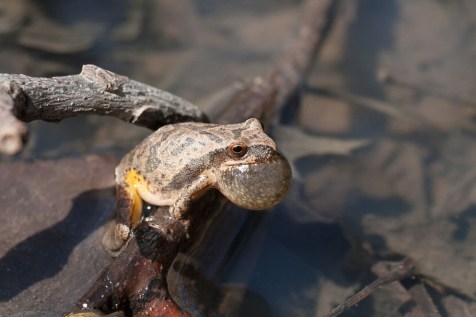
Spring Peeper, By Justin Meissen [CC BY-SA 2.0 (http://creativecommons.org/licenses/by-sa/2.0)%5D, via Wikimedia Commons
The spring peeper has large vocal sacs that it uses to create high pitched tones during the spring mating season. It typically grows to about one inch long and has a dark X marking on its back. Listen to the call of a male spring peeper.

Leopard frog
Leopard Frog, By Douglas Wilhelm Harder (Own work) [CC BY-SA 3.0 (http://creativecommons.org/licenses/by-sa/3.0)%5D, via Wikimedia Commons
The leopard frog gets its name from the irregularly shaped dark patches on its legs and back and can grow to be 3 to 5 inches long. They were once the most abundant frog species in North America, but they suffered large population declines in the 1970s.

Recommended Links:

Salamander Migration Extraordinaire” Check out this naturalist’s blog post  that has videos of spotted salamanders and Jefferson salamanders migrating to a vernal pool. There is amazing underwater footage of the salamanders at the breeding site!

Check out this video of Ranger Eric Powers from Your Connection to Nature to learn more information about vernal ponds and the animals that rely on them!

Post written by: Emily Crampe, SCA Member, Thacher State Park

Sources for text:

http://www.vernalpool.org/inf_mol.htm

http://www.dec.ny.gov/lands/82722.html

http://animals.nationalgeographic.com/animals/amphibians/northern-leopard-frog/

https://www.michigan.gov/dnr/0,4570,7-153-10370_12145_12201-32988–,00.html


Nature in Autumn: What to Look out for in the Ecological World

The days start getting shorter, the nights are cooler, and the leaves start to turn vibrant colors. Fall is a time of change and when plants and animals start to prepare for the long winter months ahead. It is a great time to get outdoors and observe nature’s seasonal changes.

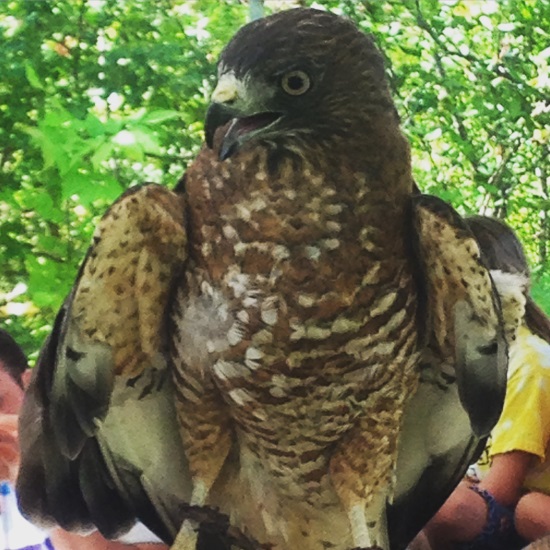
Broad Winged Hawk. Photo by April Thibaudeau, Thacher Park.

One of the Northeast’s finest wildlife spectacles happens in fall, the autumn migration of hawks. Beginning in early September until the end of November, broad-winged hawks, falcons, eagles, kestrels, harriers, and more travel from their northern breeding grounds south due to scarcity of food during the winter. The birds soar on thermal updrafts, minimizing energy expenditure. A group of birds in a thermal is termed a “kettle” and may resemble a spiral of ascending birds. The migrators utilize these updrafts to glide over ridges and down the coast to regions as far as Central and South America where food is plentiful. Thacher Park hosts an annual Hawk Migration Watch at the escarpment overlook where visitors can help count passing birds and learn more about the species they see.

Burr Oak nut showing the cupule of the acorn, which protects the fruit while it grows and matures. Photo by Ben VanderWeide, Oakland

Plants start dispersing their seeds in the fall by way of wind, water, animals, and even explosion or ballistic seed dispersal. It all starts at the end of August when blackberries, mulberries, and other fleshy fruits start to ripen and fall to the ground. These fruits contain small hard seeds and are dispersed after passing through the digestive system of animals, but make a yummy treat for us!  Acorns are theseeds of oak trees and sprout rapidly after falling to the ground. Squirrels can be seen scurrying around this time of year, storing nuts to eat later in the winter. Luckily for trees, squirrels only find about 30% of the nuts they hide – allowing more seedlings to sprout in the spring.

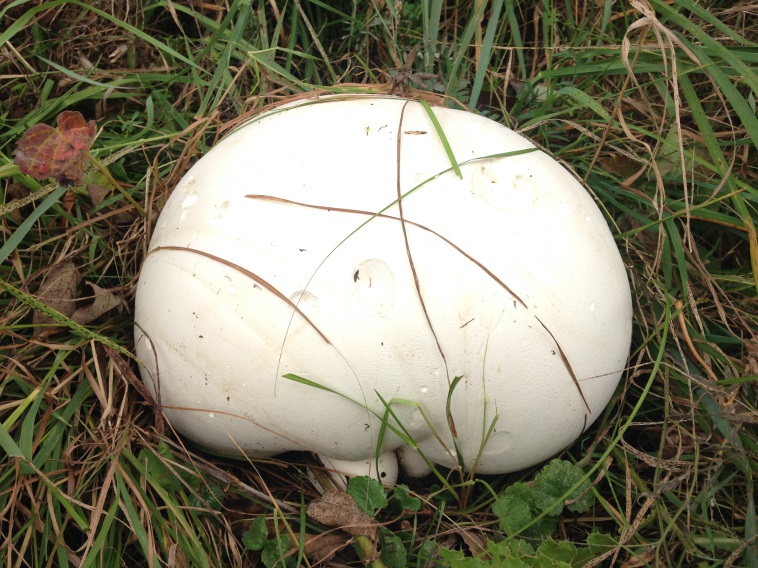
Puff ball mushroom. Photo by April Thibaudeau, Thacher Park.

A warm summer leading to damp September days is the perfect combination for mushrooms to sprout throughout the forest floor.  Fungi are made up of a vast underground network called mycelia, which helps decompose leaf litter, dead animals, and rotting wood. The mushrooms we see above- ground are the fruiting bodies of the mycelium and are composed of spores that disperse in the fall to continue the growth of their kingdom. Puff balls, hen of the woods, oyster mushrooms, and fly agaric are just a few of the mushrooms to look for on a forest hike. It is important to have a great deal of knowledge on mushrooms before picking any to eat, as some can be fatally poisonous.

For fall hikes happening at Thacher State Park check out our Program Calendar.

 Post by April Thibaudeau, Student Conservation Association Intern, Thacher State Park

For further information about these topics please consult:

Hawk Migration

http://www.hawkmountain.org/raptorpedia/migration-path/page.aspx?id=352

Seeds and Nuts

http://bioimages.vanderbilt.edu/pages/fruit-seed-dispersal.htm

Fungi

http://www.countrysideinfo.co.uk/fungi/struct.htm

http://www.fs.fed.us/nrs/pubs/gtr/gtr_nrs79.pdf

The Mysteries of Fall Foliage Revealed

Have you ever wondered what makes the leaves change color in the fall? Or why some years are more vibrant than others? It is quite a fascinating phenomenon, and it all starts with the seasonal temperature and day light hour change. In the fall, the days become shorter and the evenings become cooler. This is what triggers deciduous trees (trees that lose their leaves in the winter) to begin their process of preparation for the winter months to come. This is also why the foliage changes color around the same time every year.

abcission layer
Photo of abscission layer and leaf detachment. Photo by Lilly Schelling.

It starts with the expansion of the abscission layer between the stem and leaf, which slowly blocks the movement of water and sugar back and forth between the leaf and stem. This causes the leaf to lose the ability or resources to replenish chlorophyll, which gives leaves their green coloration. The chlorophyll rapidly breaks down and we are left with xanthophylls and carotenoids, which are responsible for the yellow and orange pigments you see on trees like aspen and birch. These pigments are usually present in the leaf throughout the growing season but are masked by the green pigment of the chlorophyll.  Anthocyanins are responsible for red and purple coloration and are created by the buildup of sugars trapped in the leaf. As fall progresses into winter all of the other pigments break down, as the chlorophyll did, and the only pigment that remains are the tannins, which are responsible for the brown color of the fallen leaves – though some trees retain their brown leaves throughout the winter, such as oak and beech.

Factors that affect the color and duration of fall foliage are temperature, sunlight and moisture. Ideal conditions for colorful fall foliage are a good growing season followed by dry, warm, sunny days and cool nights. If there was stress in the growing season, such as a drought or flood, the abscission layer may form early and the leaves will fall off before changing color. Additionally, too low of temperatures (freezing) in the beginning of fall will rapidly break down the products responsible for bright colors and the only pigment left will be brown. Other factors that can affect colorful fall foliage are heavy rain and windy storms, as these conditions will cause the leaves to fall.

When you are out admiring the fall colors this year, try to identify which pigment products are responsible for the colors you are seeing on the trees. A great way to view the fall foliage is from a canoe or kayak, but remember to wear your personal floatation device as the water will be chilly! The New York Fall Foliage Report is a great tool for tracking the color changes across the state: http://www.iloveny.com/seasons/fall/foliage-report/#.VgQGwstVhBd.

References:

The United States National Arboretum

Post by Lilly Schelling, OPRHP.


Lace up those boots for National Trails Day!

In August 2011, Hurricane Irene and Tropical Storm Lee devastated the Catskill Mountains and Schoharie Valley with a torrent of wind and rain.  Several bridges were washed out, including the historic Blenheim Covered Bridge located just north of Mine Kill State Park.  A culvert over a tributary of the Mine Kill on the Long Path was subsequently destroyed.  On June 6th, the Student Conservation Association (SCA), Long Path North Hiking Club and New York State Parks will join together to construct a new bridge spanning 40 feet over the drainage to once again allow safe passage over this creek for hikers.

Every year, on the first Saturday in June all across the country, people celebrate National Trails Day by getting out and going hiking, biking, geocaching and more.  National Trails Day is not only about getting out and recreating, but is a great day to give back and volunteer on projects helping to build and maintain trails that we all love and enjoy.  This year, three Trails Day projects will be organized and led by SCA AmeriCorps members at Mine Kill State Park in North Blenheim, John Boyd Thacher State Park in Voorheesville, and Hudson River Park in Manhattan.  These projects not only accomplish vital work on trails in the region, but also provide SCA members with valuable experience in project management and peer leadership.

For many years, the SCA Hudson Valley AmeriCorps program has been partnering with New York State Parks, Recreation and Historic Preservation as well as New York State Department of Environmental Conservation and several non-profit organizations providing internships across the Hudson Valley region.  Currently, 46 SCA members serve for up to ten months at sites from Saratoga Springs to New York City.  To learn more about the SCA and Trails Day projects you could get involved in, visit www.thesca.org/events.

Post by Nick Marcet, Student Conservation Association (SCA). Photos by SCA.